
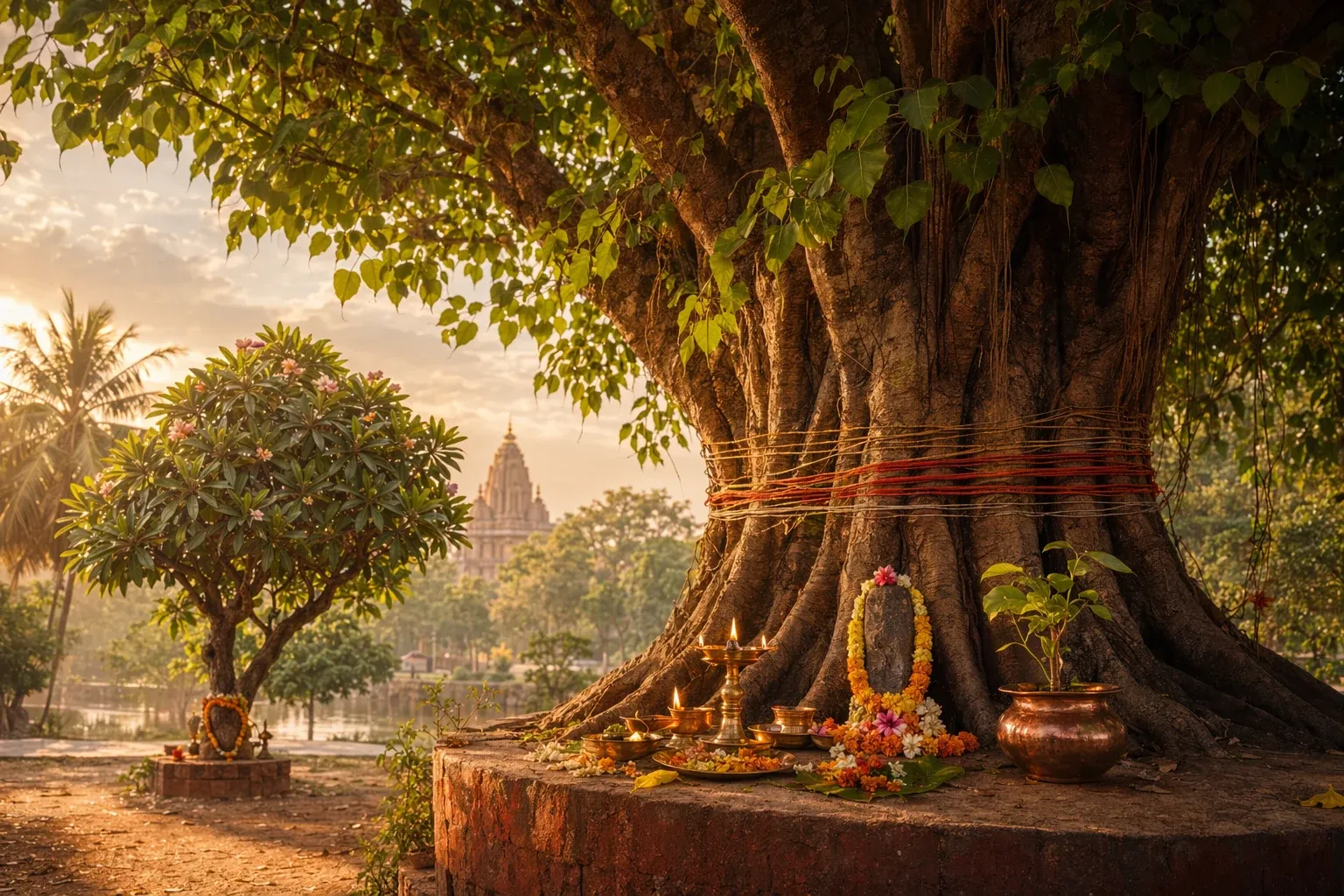
Across India, a sacred tree is not only a plant with a religious label. It is often a living meeting point: a village resting place, a temple marker, a memory of a story, a seasonal offering, a shade-giving elder, and sometimes a small conservation rule that people keep because the tree is loved. That is why the answer to “what trees are considered sacred?” has to be careful. There is no single official all-India list that covers every region and every community. India’s sacred-tree traditions change from Tamil Nadu to Rajasthan, from Odisha to Assam, from household courtyards to large temple groves.
Still, some names appear again and again. Peepal, banyan, neem, tulsi, bael, ashoka, kadamba, banana, coconut, mango and khejri are among the most familiar examples. Some are linked with Hindu worship, some with Buddhist and Jain memory, some with village-deity traditions, and some with everyday ideas of health, fertility, hospitality and protection. A good way to understand them is not to ask, “Which tree is the winner?” but “What relationship does this tree create between people, place and devotion?”
Sacred trees are local, not one universal checklist
In many Indian homes, the most sacred plant may be tulsi in the courtyard. In a Shiva temple, bael leaves may feel central. In a Vaishnava setting, tulsi has a special devotional place. Near a Buddhist pilgrimage story, the peepal becomes unforgettable because the Bodhi Tree belongs to the same species, Ficus religiosa. In parts of Rajasthan, khejri is deeply respected because it can survive harsh dry conditions and support village life. In Kerala, Karnataka, Maharashtra, Meghalaya and other regions, sacred groves protect not just one tree but a whole patch of land connected with a deity, ancestor, serpent shrine or village guardian.
This variety matters. When someone says “the most sacred trees,” they may be speaking from a family custom, a temple custom, a textbook list, a festival memory or a regional tradition. Bhaktilipi’s safer answer is: many trees are considered sacred in India, but the exact list depends on region, sampradaya, local ecology and community practice.
Peepal: the tree of awakening and continuity
Peepal, also called pipal, ashvattha or sacred fig, is one of the best-known sacred trees of South Asia. Botanically it is Ficus religiosa, a fig species native to the Indian subcontinent and nearby regions. Its heart-shaped leaves with long tapering tips are easy to recognise, especially when they tremble in a light breeze. The tree is important in Hindu, Buddhist, Jain and Sikh cultural memory, though the meanings are not identical in every tradition.
In Buddhist tradition, the Bodhi Tree at Bodh Gaya is remembered as the tree under which Gautama Buddha attained enlightenment. In Hindu settings, the ashvattha is associated with sacred presence, worship, vows and philosophical symbolism. In Jain memory too, sacred trees can be connected with tirthankara narratives and places of meditation. Historically, we should separate these layers: the botanical tree is one thing, the Bodh Gaya lineage and pilgrimage tradition is another, and the wider Hindu symbolic life of ashvattha is another. Together they explain why the peepal is so widely respected.
Banyan: shelter, village life and long time
The banyan, Ficus benghalensis, is another powerful sacred tree in India. Its aerial roots grow downwards, take support in the soil and can become trunk-like pillars. A mature banyan can feel less like a single tree and more like a green mandapa, a natural hall of shade. This physical form helps explain its cultural role. It becomes a place to sit, settle disputes, tell stories, meet travellers and hold small rituals.
In Hindu symbolism, banyan is often connected with long life, continuity and protection. The Vat Savitri or Vat Purnima observance in parts of India brings the banyan into household and marital devotion, though practices differ by region. The national tree of India is also the banyan, which shows how its cultural meaning extends beyond one temple story. Its sacredness is not only mythic; it is also practical. A large banyan can hold a community together under its shade.
Tulsi, neem and bael in everyday devotion
Tulsi is technically a sacred plant rather than a tree, but Indian readers usually include it when discussing sacred plants. Ocimum tenuiflorum, holy basil, is widely cultivated in homes and is especially important in Vaishnava worship. Many families keep a tulsi plant in a raised courtyard structure, offer water, light a lamp nearby, and treat it as a sign of auspicious domestic life. This is a living example of sacred ecology inside the home, not only inside a forest or temple.
Neem, Azadirachta indica, carries another kind of reverence. It is known across India for shade, leaves, twigs, oil and traditional household uses. In many places it is linked with protective and purifying ideas, and with goddess traditions. We should avoid turning this into medical overclaiming. The safer point is cultural: neem’s usefulness, bitterness, resilience and association with protection made it easy for communities to treat it with respect.
Bael, Aegle marmelos, has a very clear devotional association with Shiva worship. Its trifoliate leaves are offered in many Shiva temples and home pujas. The three leaflets invite many interpretations: some see them as linked with Shiva’s three eyes, some with the three gunas, and some simply follow inherited practice without giving a single explanation. Here again, tradition and interpretation should be kept apart. The offering is widespread; the meanings may vary.
Ashoka, kadamba, banana, coconut and mango
Ashoka, Saraca asoca, is loved for its flowers and its poetic-cultural presence. Its name is often understood as “without sorrow,” and it appears in classical imagination, temple surroundings and festival decoration. It is also a species with conservation concern in some accounts, which reminds us that sacred respect should not stop at symbolism. If a tree is culturally precious, protecting real living specimens matters.
Kadamba is strongly associated in devotional art and poetry with Krishna, especially in Vrindavan imagination, monsoon moods and playful pastoral scenes. Mango leaves are used in toranas and kalash decoration in many Hindu ceremonies, where they signal freshness and auspicious welcome. Banana plants are placed near entrances or ritual spaces in several regions because they suggest fertility, abundance and hospitality. Coconut, especially in coastal and temple cultures, becomes a symbol of offering, self-surrender and completeness, even though it is more often handled as a fruit offering than discussed as a “tree” in the same way as peepal or banyan.
Khejri and sacred groves: ecology as devotion
Khejri, Prosopis cineraria, is a powerful example from arid and semi-arid India, especially Rajasthan. It survives drought, gives fodder and shade, and supports rural life in difficult landscapes. The memory of the Bishnoi community’s sacrifice at Khejarli in 1730, when people resisted the cutting of khejri trees, is often remembered as a landmark of ecological devotion. Here sacredness is not decoration. It becomes an ethic: do not destroy what protects life.
Sacred groves take this idea further. In many regions, a grove is protected because it belongs to a deity, serpent spirit, ancestor or village guardian. Rules may restrict cutting, hunting or careless entry. Modern conservation language calls these places biodiversity refuges, but the older protection often came through faith, taboo and community memory. Some groves are famous, like Mawphlang in Meghalaya, while many are small and local. They show that sacred trees in India are also about sacred places.
A simple way to remember the main examples
If you want a beginner-friendly list, start with this: peepal for awakening and sacred presence; banyan for shelter and long life; tulsi for household devotion; bael for Shiva worship; neem for protection and everyday usefulness; ashoka for beauty and poetic memory; kadamba for Krishna devotion; mango, banana and coconut for auspicious rituals; and khejri for desert ecology and sacrifice. This is not a final census. It is a doorway.
The deeper lesson is that sacred trees are respected because they connect many kinds of value at once. They carry stories, provide shade, feed birds, mark temples, hold village meetings, protect soil and water, and teach restraint. For a modern reader, that may be the most useful meaning. A tree becomes sacred when a community learns to see life around it as worthy of care.
What trees are considered sacred?
In India, commonly sacred trees include peepal, banyan, neem, bael, ashoka, kadamba, mango, banana, coconut and khejri. Tulsi is also central as a sacred household plant. The list changes by region and tradition, so it is better to speak of important examples rather than one fixed national list.
What are the most sacred trees?
Peepal and banyan are among the most widely recognised sacred trees because they appear across several Indian religious and cultural settings. Bael is especially important in Shiva worship, tulsi in Vaishnava devotion, and khejri in parts of western India. “Most sacred” depends on the community asking the question.