
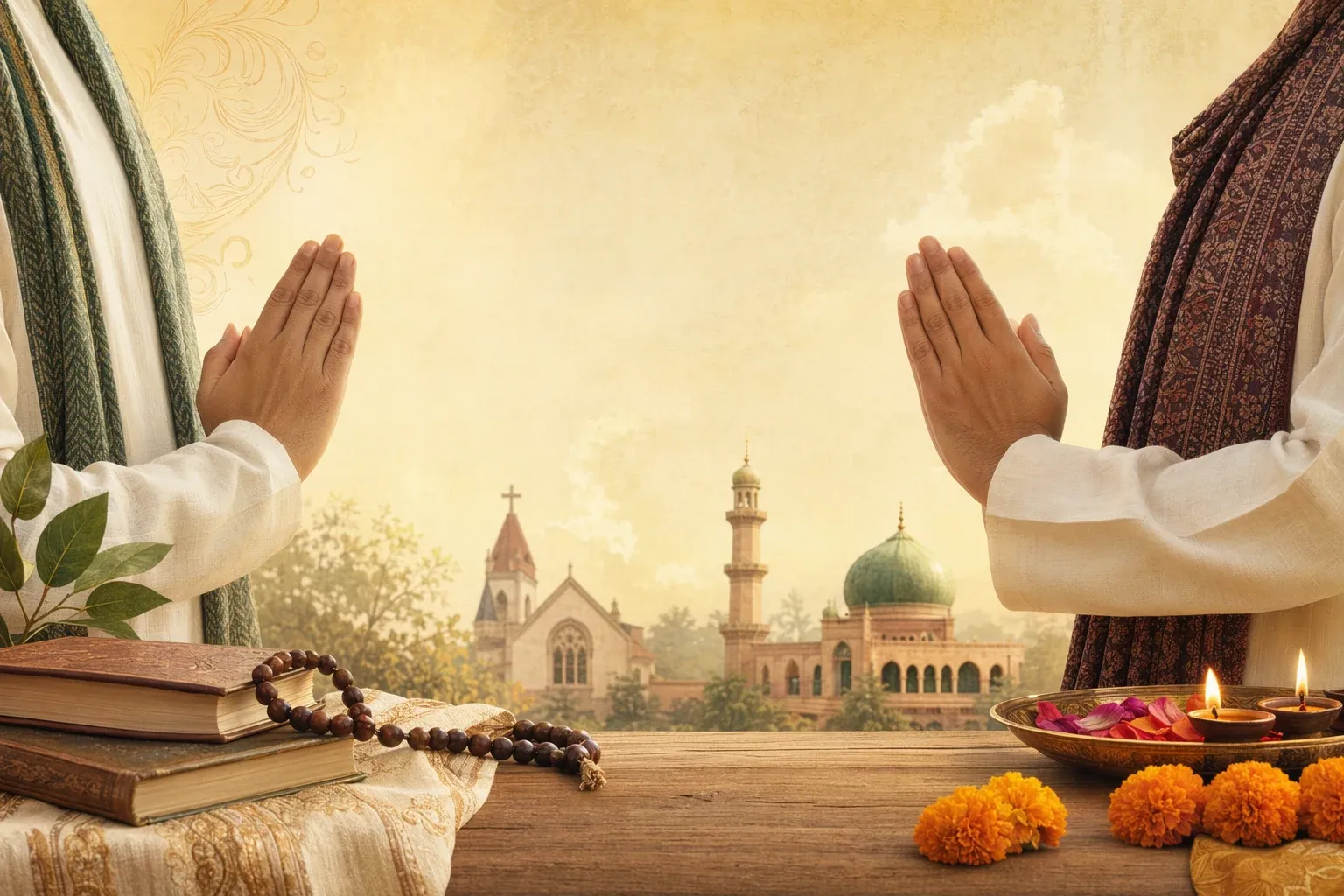
Christians, Muslims, Catholics, and people of other faiths can often say Namaste as a respectful cultural greeting, especially in Indian social contexts. Personal comfort, family tradition, and religious guidance still matter.
The respectful short answer
For many people, Namaste works like a polite greeting: I respectfully greet you. For some, the word or gesture may feel religious or spiritually loaded. A kind answer leaves room for conscience instead of turning it into an argument.
Cultural greeting or religious statement?
Namaste can be cultural, social, devotional, spiritual, or formal depending on the person and setting. That is why one flat answer does not fit everyone. A Hindu devotee in a temple, a yoga student, a tourist, and an Indian Christian greeting neighbours may all understand the word differently.
If someone uses Namaste as a simple greeting, replying politely does not automatically mean accepting every spiritual interpretation attached to it online.
For Christians and Catholics
Many Christians and Catholics in India understand Namaste as a respectful social greeting. Others may prefer Hello, Peace be with you, Praise the Lord, or a local-language greeting depending on church culture and personal conviction.
If your conscience is uneasy, you can still be respectful without using the word. A smile, nod, handshake where appropriate, or another greeting can keep the interaction warm.
For Muslims
Many Muslims in India and beyond interact with Namaste as a cultural greeting, especially when speaking with Hindu neighbours, colleagues, teachers, or hosts. Others may prefer Salaam, Assalamu alaikum, Hello, or another greeting.
Respect goes both ways. A Muslim who says Salaam should not be mocked, and a Hindu who says Namaste should not be mocked. Good etiquette allows people to greet each other sincerely.
A respect-first rule
A respectful Namaste is usually simple: bring the palms together if it feels natural, bow the head slightly, keep the tone calm, and avoid turning the gesture into a joke or performance.
If you are unsure, follow the host, the local community, and your own conscience. For wider ethical context, read Dharma. For the word’s language background, see Sanskrit for Beginners.
Questions people ask
Does Namaste always have a spiritual meaning?
No. Some people use it spiritually, some use it culturally, and many use it as a polite greeting. Context decides the weight of the word.
Is it okay if I use another greeting instead?
Yes. Respect is more important than forcing one word. Hello, Namaskar, Pranam, Salaam, Vanakkam, Sat Sri Akal, or another local greeting may fit better in different settings.
Why this small greeting still matters
Namaste matters because it reminds us that ordinary manners can carry memory, culture, and humility. A greeting is small, but repeated every day it shapes how people meet each other. When used with sincerity, Namaste keeps respect at the centre of the conversation.
How to handle personal conscience kindly
If your religious conscience says not to use Namaste, you can still respond with kindness. Say Hello, Salaam, Peace, good morning, or another greeting with warmth. Most reasonable people will understand when the tone is respectful.
If you are comfortable using Namaste culturally, you can still avoid making claims that do not fit your belief. You do not have to accept every spiritual interpretation to greet a neighbour politely. Interfaith respect works best when people are honest and gentle at the same time.
Everyday examples that make the meaning clearer
Imagine entering a home where an elder opens the door and greets you with folded hands. A simple Namaste in return is not a performance; it is a small sign that you recognize the warmth of the welcome. In a classroom, it can show respect to a teacher without becoming overly formal. In a cultural event, it can help visitors participate politely without pretending to know everything.
The same word can also close a meeting gently. A host may say Namaste while seeing guests off, a yoga teacher may say it after practice, or a speaker may use it at the end of a talk. The meaning remains connected to respect, but the emotional colour changes with the moment: welcome, thanks, farewell, or reverence.
Common misunderstandings
One misunderstanding is that Namaste has only one fixed English translation. It is better to think of it as a respectful salutation, with meaning shaped by context. Another misunderstanding is that every Indian person uses it constantly. India is too diverse for that. Different regions, religions, languages, families, and generations use different greetings.
A third misunderstanding is that using Namaste automatically makes a person spiritual or culturally sensitive. The word alone does not do that. Respect comes from tone, listening, and behaviour. Saying Namaste while mocking the culture behind it is not respectful. Saying Hello with genuine warmth may be more respectful than saying Namaste carelessly.
A practical etiquette checklist
- Use a calm voice and natural expression.
- Keep folded hands simple; do not turn the gesture into theatre.
- Follow the local greeting if someone uses another word first.
- Do not use Namaste to stereotype all Indian people or all yoga spaces.
- When in doubt, pair the word with humility rather than drama.
A final beginner reminder
The main lesson of Can Christians or Muslims Say Namaste? A Respectful Explanation is not to memorize a perfect script. It is to understand the feeling behind the greeting: respect, awareness, and context. If those three are present, the word becomes easier to use well.
Beginners should also remember that Indian culture is not one flat thing. A greeting may feel devotional in one home, formal in another, ordinary in a school, and symbolic in a yoga class. Paying attention to the people in front of you is therefore better than relying only on a textbook definition.
Use Namaste with sincerity when it fits, use another greeting when that is more natural, and avoid turning a living cultural expression into decoration. That simple balance keeps the word friendly, respectful, and useful.