
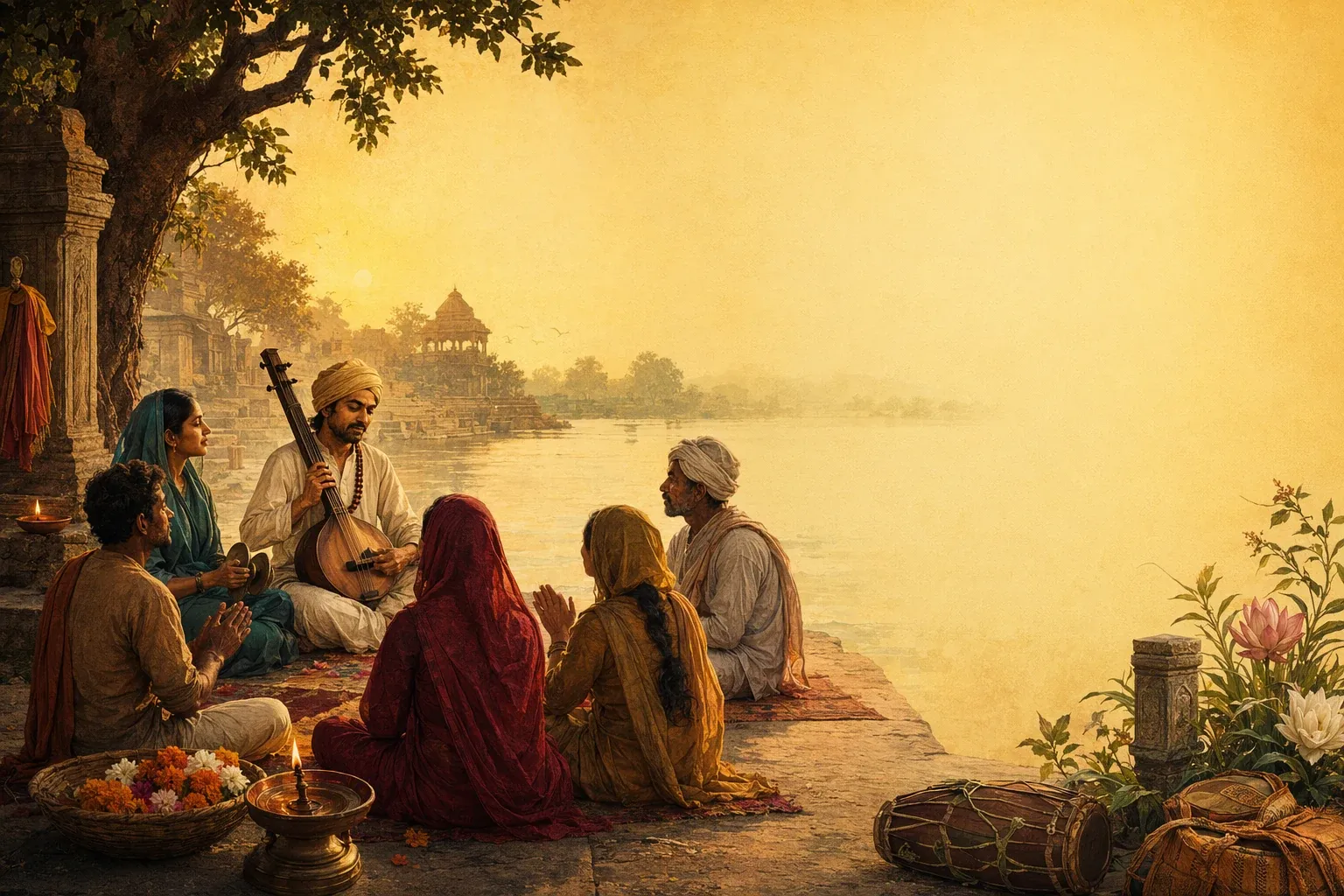
The Bhakti Movement often challenged social arrogance by teaching that sincere devotion matters more than caste pride, wealth, gender, learning, or public status. Many saints spoke in the language of spiritual equality: the Divine is not impressed by ego, and a humble devotee can be spiritually greater than a powerful person. At the same time, we should be honest. Bhakti did not magically make society equal everywhere. Its impact varied by region, community, period, and saint tradition.
Simple answer
Yes, many bhakti voices challenged social inequality, especially the pride that ranked people by birth, status, ritual power, or gender. Saints such as Kabir, Ravidas, Tukaram, Janabai, Mirabai, Andal, Akka Mahadevi, Lal Ded, and others are often remembered because their songs and lives gave dignity to devotion outside narrow social approval.
But the careful answer is not “bhakti ended caste” or “bhakti made women fully free.” History is more complex. Bhakti created powerful religious language against arrogance and exclusion, but social structures did not disappear overnight. Some communities became more open; some inequalities continued; some saint messages were later interpreted in safer or more institutional ways.
Spiritual equality in bhakti thought
Many bhakti voices taught that the Divine responds to love, not ego. A poor devotee could be spiritually rich. A person without social status could possess deep wisdom. A scholar could still be spiritually empty if knowledge produced pride instead of humility.
This idea was powerful because it gave dignity to people often ignored by elite structures. Songs, poems, and local-language teachings allowed deep spiritual expression beyond formal power. A weaver, leatherworker, farmer, woman saint, wandering singer, or household devotee could become a voice of devotion remembered for generations.
Caste and community questions
Some saint-poets criticized caste pride and empty ritualism sharply. Kabir questioned religious arrogance across boundaries. Ravidas is remembered for devotion joined with dignity. Tukaram’s abhangas speak with emotional force about humility and love for Vithoba. Many Varkari memories honour devotion that gathers people in pilgrimage and song.
Still, a careful article should avoid saying every bhakti community abolished caste in practice. Bhakti opened spiritual space where social status could be questioned, but local realities differed. Some devotional communities challenged hierarchy strongly. Others preserved older social habits while still singing about equality before God. This tension is part of the real history.
Women in bhakti
Women’s voices are essential in bhakti memory. Mirabai’s Krishna devotion is remembered for longing, courage, and refusal to let social pressure define her relationship with the Divine. Andal’s Tamil Vishnu devotion is central to Sri Vaishnava devotional culture. Akka Mahadevi’s Kannada vachanas speak with radical intensity. Lal Ded’s mystical poetry has deep importance in Kashmir. Janabai’s songs bring devotion into the world of household labour and everyday life.
These women were not simply “examples” added to a male story. They shaped bhakti’s emotional and spiritual vocabulary. Their lives also remind us that devotion could challenge expectations placed on women. But each figure belongs to a particular region, language, tradition, and memory. Respectful learning means avoiding one-size-fits-all slogans.
Language as a social opening
One reason bhakti mattered socially was language. Many saints used Tamil, Marathi, Hindi, Braj, Awadhi, Kannada, Bengali, Assamese, Punjabi, Kashmiri, and other living languages. This made devotional teaching easier to hear, sing, remember, and share. Spiritual expression did not remain only in formal scholastic spaces.
Local-language devotion helped people carry teaching into homes, fields, workshops, pilgrimage routes, and community gatherings. For young readers, this is a useful lesson: culture changes not only through big declarations, but also through songs people repeat, stories people love, and words that make dignity feel real.
Limits and complexity
The Bhakti Movement was spiritually bold, but social reality was complex. Some saint traditions challenged caste pride. Some devotional spaces allowed wider participation. Some women saints spoke with extraordinary confidence. Yet society did not become fully equal simply because devotional poetry existed.
This complexity does not make bhakti weak. It makes history real. A movement can inspire change even when society changes slowly. In fact, one reason bhakti remains powerful is that its best voices keep questioning arrogance wherever it appears: in caste pride, gender control, wealth, scholarship, ritual status, or even religious ego.
Why this matters today
For modern readers, the lesson is not to use bhakti as a simple political label. The deeper lesson is humility. Do not measure a person’s devotion by birth, money, gender, accent, clothing, followers, or public image. The tradition repeatedly reminds us that inner sincerity matters.
If devotion makes us kinder, less arrogant, more truthful, and more willing to see dignity in others, then bhakti’s social teaching is still alive. If devotion becomes another way to show superiority, then it has missed its own heart.
For a wider yoga context, see our guide to types of yoga including bhakti and karma.
For the ethical idea of right conduct, read our beginner guide to dharma.
Common misunderstandings
The first misunderstanding is that bhakti was only about private emotion. It was also about community, language, memory, song, and dignity. The second is that every bhakti saint had the same social message. They did not. The third is that bhakti instantly solved caste and gender inequality. It did not. The fourth is that social complexity cancels the movement’s importance. It does not.
A balanced view can say both things together: bhakti gave India some of its strongest devotional language for equality and humility, and the actual social results were uneven across time and place.