
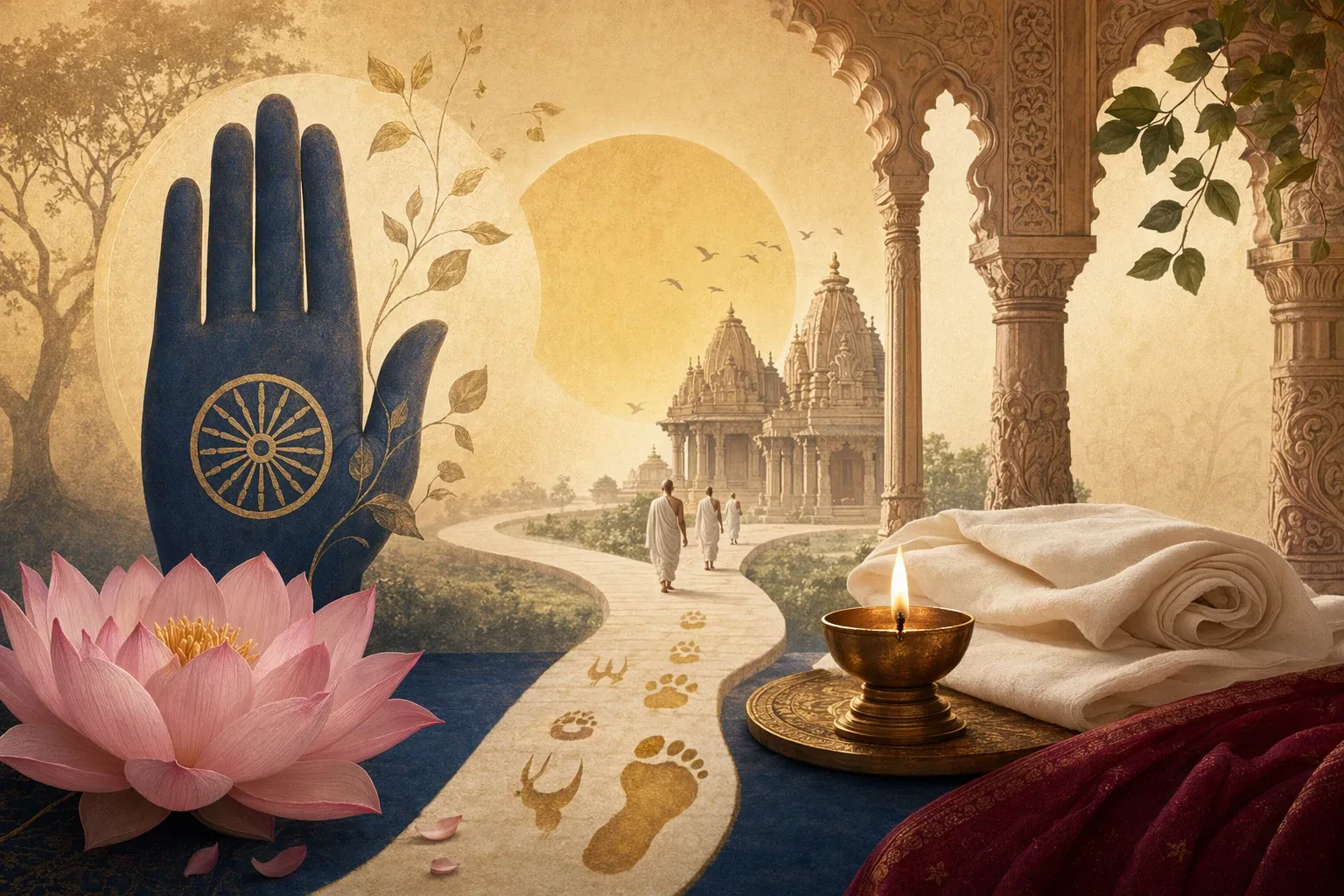
The beginner-friendly answer is: Mahavira is central to Jainism, but Jain tradition does not treat him as the one person who invented Jainism from nothing. He is remembered as the 24th Tirthankara of the present time cycle, a great teacher who renewed and clarified an older path.
This distinction matters because many school-style questions ask “Who founded Jainism?” and expect the name Mahavira. That answer is useful for exams, but it is incomplete. A respectful explanation should also mention the Tirthankara lineage and the Jain belief that the path has been taught again and again by enlightened teachers.
Why Mahavira is often named
Mahavira lived in ancient north India around the same broad period as the Buddha. He renounced worldly life, practised intense discipline, attained kevala jnana, and taught a path of ahimsa, self-control, non-attachment, and liberation. Because his teachings shaped the Jain community known to history, many textbooks name him as the founder or major reformer of Jainism.
For beginners, it is fair to say: Mahavira is the most historically visible teacher of Jainism and the 24th Tirthankara, but Jain tradition remembers a much longer sacred lineage before him.
What a Tirthankara means
A Tirthankara is not a creator God. The word suggests a “ford-maker”, one who shows a crossing place over the river of samsara. In Jainism, Tirthankaras are perfected teachers who discover and teach the path to liberation. They do not create the universe, control people’s fate, or grant liberation by personal favour. They show the way through their example and teaching.
This is why Jain devotion has a distinctive mood. When Jains bow before a Tirthankara image, they are honouring perfected qualities: purity, knowledge, non-attachment, compassion, and victory over inner passions.
Rishabhanatha and the older lineage
Jain tradition names Rishabhanatha, also called Adinatha, as the first Tirthankara of the present time cycle. Between Rishabhanatha and Mahavira, the tradition remembers other Tirthankaras, including Parshvanatha, who is especially important and historically significant in discussions of pre-Mahavira Jain tradition.
This long lineage prevents us from reducing Jainism to a single starting date. It also shows why Jain identity is not only about one biography. It is about a recurring path of liberation taught by those who have conquered attachment and karma.
Was Mahavira the god of Jainism?
No. Mahavira is not understood as a creator God. He is revered as a Tirthankara, a liberated teacher and model of the path. Jains honour him deeply, especially during Mahavir Jayanti and in temple worship, but the reverence is not the same as belief in a supreme creator who makes and manages the world.
For a wider explanation of worship and God in Jain thought, this article connects naturally with our later guide on Jain worship; for now, the key point is that Jain devotion honours perfected beings as ideals, not controllers of destiny.
How to answer in school or conversation
If someone asks quickly, you can say: “Mahavira is often called the founder of Jainism in textbooks, but Jain tradition sees him as the 24th Tirthankara, part of a long lineage of teachers.” That answer is both simple and respectful.
If the person wants more nuance, explain that Jainism has ancient roots, that Parshvanatha and Rishabhanatha matter in tradition, and that “founder” is a modern shortcut rather than the full Jain view.
Mahavira’s teaching in everyday language
Mahavira’s message can be understood through a few strong themes: do not harm, do not cling, do not lie, do not steal, and do not let desire rule the mind. For monks and nuns these vows are extremely strict. For householders, they are adapted into smaller vows that can be practised while living family and social life.
This is why Mahavira remains important beyond dates and biographies. His life represents the possibility that a human being can discipline the senses, overcome inner enemies, and show others a path of freedom. The focus is not celebrity, miracle, or conquest of land, but conquest of the self.
Why the founder question needs nuance
Modern readers often want one name, one date, and one place. Ancient traditions rarely fit so neatly. Jainism includes remembered cosmic time cycles, Tirthankara lineages, historical communities, oral teaching, scripture, and living practice. Mahavira’s role is central, but the Jain view is wider than a modern founder label.
Using nuance does not make the answer weak. It makes it more accurate: Mahavira is the central historical teacher of the present Jain community and the 24th Tirthankara, while Jain tradition honours a much older path.
Parshvanatha and continuity before Mahavira
Parshvanatha, the 23rd Tirthankara, is especially important when discussing Jainism before Mahavira. Jain tradition remembers him as a major teacher whose path was later completed and clarified through Mahavira’s teaching. This is one reason scholars and devotees both avoid treating Jainism as if it suddenly appeared in one lifetime.
For readers, the takeaway is simple: Mahavira is central, but not isolated. He stands in a remembered line of teachers, practices, vows, and communities. That continuity gives Jainism historical depth and sacred meaning at the same time.
What beginners should remember
Mahavira did not “create” Jainism in the way a company founder creates a new brand. He renewed, taught, and embodied a path that Jain tradition understands as ancient. Remember him as the 24th Tirthankara, a central teacher of ahimsa, self-discipline, and liberation, while also respecting the larger Tirthankara lineage.
For readers who want the broader ethical background, Jain teachings on action connect naturally with India’s larger conversation about karma and disciplined conduct.
This nuance makes the tradition more interesting, not more confusing. It helps us see Jainism as a deep Indian path with history, memory, devotion, and philosophy woven together.