
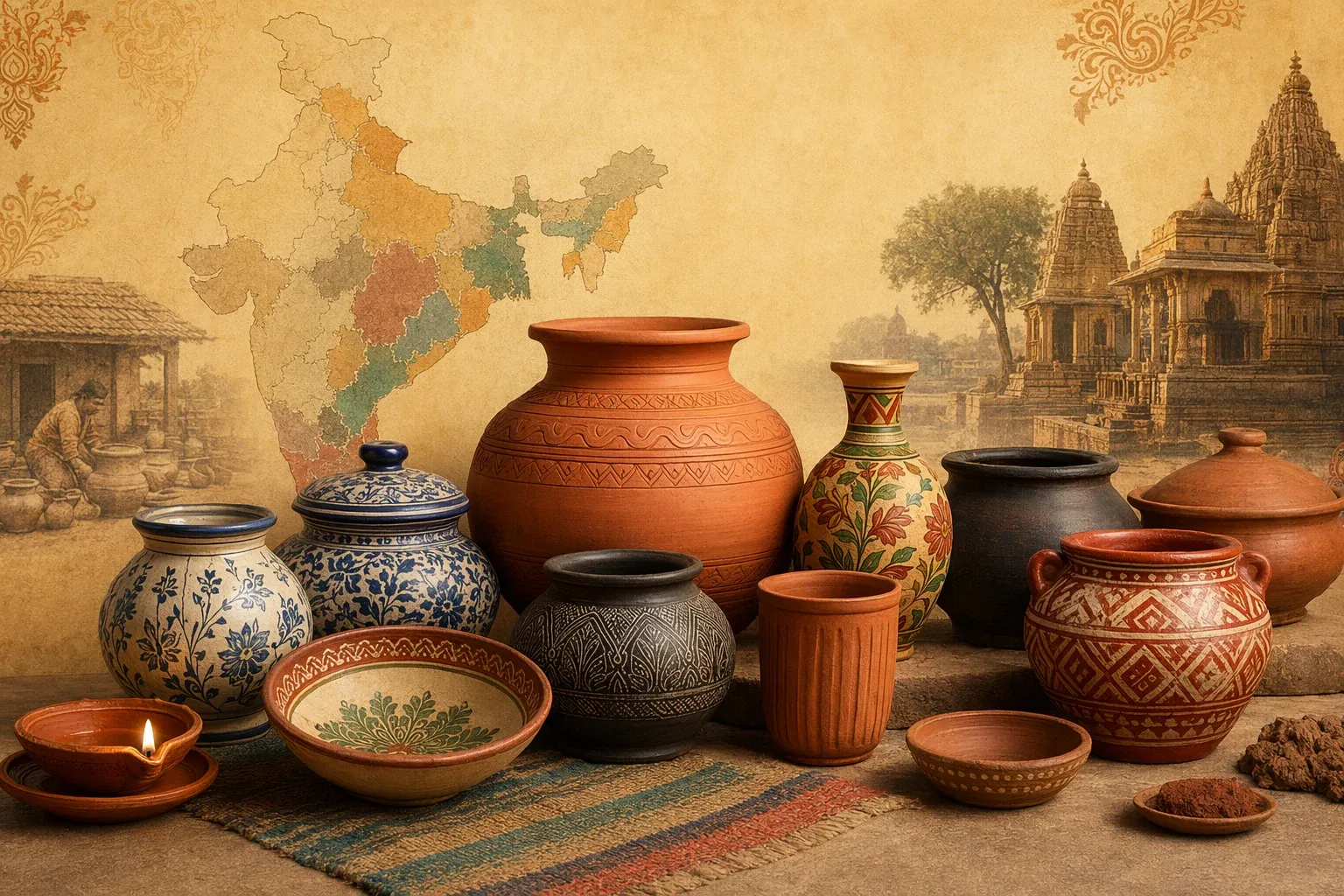
Traditional Indian pottery is not one craft with one look. It is a family of clay traditions shaped by region, soil, water, firing, community memory, market demand, ritual use, and everyday need. A pot from Kutch, a terracotta horse from Bankura, a glazed bowl from Khurja, and a black vessel from Nizamabad all belong to the wider world of Indian pottery, but each speaks a different local language.
That variety is the most important thing for beginners to understand. If we say “Indian pottery” as if it were one design style, we miss the real beauty. India’s pottery traditions are plural. They belong to villages and towns, to homes and shrines, to craft clusters and museum galleries, to both humble utility and serious artistic imagination.
For one famous terracotta craft example, read Bankura Horses: Heritage, Significance in Indian Culture. For another regional folk-art tradition that shows how place shapes style, see Warli Art from Maharashtra: Meaning, Style, and Beginner Context.
Region gives pottery its character
Pottery begins with local earth, so geography matters. Clay from one place may be more sandy, fine, iron-rich, sticky, or suited to a particular firing method. Water, fuel, weather, and local tools also shape the craft. A coastal or desert region may develop different needs from a riverine village. A community making water pots will think differently from one making ritual plaques or glazed tableware.
This is why regional names are useful. They remind us that pottery is not only an object but also a place-based knowledge system. A craft cluster carries habits of preparation, shaping, drying, firing, decoration, selling, and teaching. Many skills are learned by watching elders, correcting mistakes, and repeating work until the hand understands what the eye cannot fully explain.
Terracotta, glazed ware, black pottery, and red clay
Terracotta means fired earth. In India, it appears as lamps, figurines, plaques, horses, tiles, temple panels, planters, toys, and vessels. Its warm reddish or brown colour often comes from iron-rich clay and firing. Terracotta can be simple and functional, but it can also be highly expressive, as seen in Bengal’s horses, Rajasthan’s deity plaques, and many village ritual objects.
Glazed pottery uses a glassy surface layer that can make vessels colourful, smooth, and less porous. Khurja in Uttar Pradesh is widely known for glazed ceramics with bright hand-painted surfaces. Black pottery, especially associated in popular craft writing with Nizamabad in Uttar Pradesh, uses controlled firing and smoke effects to create a dark body, often decorated with incised designs filled in a lighter tone. Plain red earthenware remains equally important because many everyday vessels were never meant to be showpieces.
Bankura, Molela, Khurja, Khavda, and Nizamabad
Some examples make the map easier. Bankura and Panchmura in West Bengal are strongly associated with terracotta horses and related craft forms. These horses are not just decorative shapes; they grew in a cultural world of folk practice, ritual offering, and rural craft identity. West Bengal craft source checks describe Panchmura as a terracotta hub, and the Bankura horse has become one of the most recognisable images of Indian rural handicraft.
Molela in Rajasthan is known for terracotta plaques, often connected with local deities, folk heroes, and community worship. Incredible India source checks describe Molela clay work as a distinctive Rajasthani craft. Khurja is known for glazed pottery and ceramic ware. Khavda in Kutch is often discussed for painted clay traditions shaped by local material and desert-region craft memory. Nizamabad black pottery stands out for its dark finish and carved decoration. These examples are not a complete list; they are starting points for seeing India’s regional range.
The making process in living craft families
A traditional potter’s work usually moves through several stages: collecting or buying clay, cleaning it, kneading it, shaping it by hand, wheel, or mould, drying it slowly, adding surface details, firing it, and finishing or painting it. Each stage can go wrong. Clay can split while drying. A wall can collapse. A pot can dry unevenly. Fire can overcook, undercook, blacken, or break the piece.
This labour is why handmade pottery deserves respect. A buyer may see only the final diya or vase, but the artisan sees timing, moisture, temperature, proportion, and risk. In many places, the whole family may be part of the work: preparing clay, painting, polishing, carrying, selling, and teaching children. Modern support schemes and craft exhibitions can help, but they cannot replace fair payment and serious appreciation from buyers.
Sacred, useful, decorative: not one box
Traditional Indian pottery often refuses our neat categories. A diya is useful because it holds oil and flame, but it is also sacred in ritual and beautiful in its simplicity. A terracotta horse may be a craft product, a folk symbol, a ritual offering, and a decor object depending on context. A matka is a water vessel, but it also carries memories of summer, courtyard life, and the taste of cool earthen water.
This is why cultural writing should avoid treating craft as only “aesthetic”. Pottery sits inside life. It touches food, water, worship, childhood, markets, climate, caste and community histories, labour, migration, and modern design taste. A respectful article should not romanticise poverty or freeze artisans in the past. Living craft changes because artisans also need income, safety, education, and dignity.
Buying and learning with respect
If you want to buy traditional pottery, ask where it comes from, whether it is decorative or food-safe, and how to care for it. Unglazed clay can absorb water and smell. Some decorative pieces should not be used for cooking or serving food. Glazed items should be trusted for food only when the seller clearly states they are food-safe. For old-looking objects, avoid illegal antiques and anything taken from archaeological sites.
If you want to learn, begin with museums, craft fairs, artisan pages, government craft documentation, and field visits where allowed. Notice names of places, not just styles. Pay attention to the person behind the product. Traditional Indian pottery is not a single trend; it is a living conversation between clay, community, use, devotion, and design.
People also ask
What are traditional Indian pottery types?
Common broad types include terracotta, everyday earthenware, glazed pottery, black pottery, painted regional pottery, ritual plaques, clay lamps, toys, figurines, water pots, and decorative vessels.
Which places are famous for pottery in India?
Well-known examples include Khurja in Uttar Pradesh, Bankura and Panchmura in West Bengal, Molela in Rajasthan, Khavda in Kutch, and Nizamabad in Uttar Pradesh, among many others.
Is traditional pottery only for decoration?
No. Some pottery is decorative, but much of it is useful, ritual, educational, seasonal, or community-based. A clay lamp, water pot, cooking vessel, toy, or offering can carry both function and meaning.
Related reading
For broader context on Bhaktilipi, continue with Udaipur's Living Heritage: Ancient Crafts and Traditions Thrive and Living Traditions: Dashakarma and Rituals Across India's Sacred Landscapes - A 2025 Journey.