
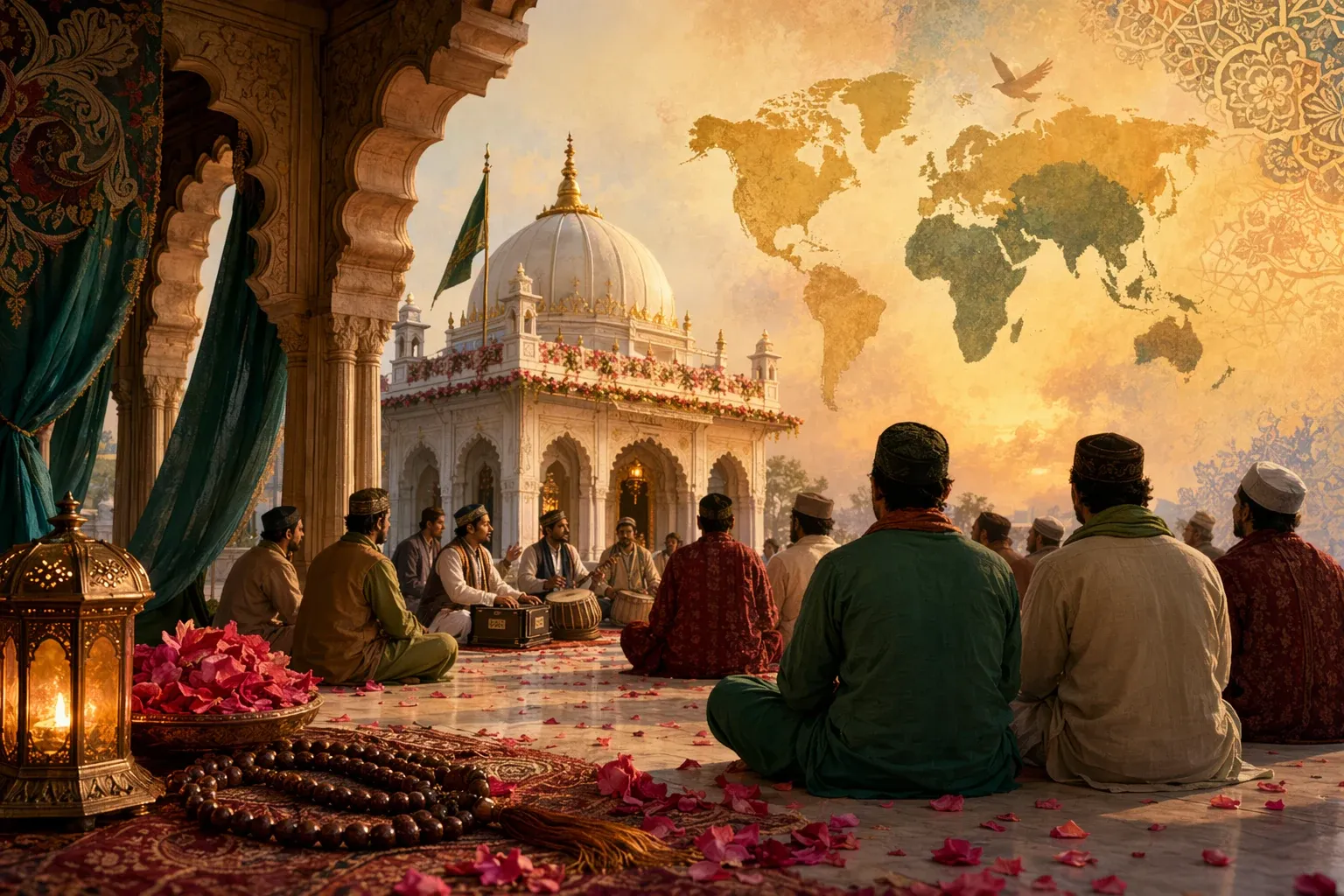
When people ask “where is Sufism the strongest?”, they are usually looking for a clear country name: India, Turkey, Pakistan, Iran, Morocco or somewhere else. The more honest answer is careful rather than competitive. Sufism has never belonged to only one country, and there is no reliable global scoreboard for “most Sufi”. What we can do is look at regions where Sufi orders, shrines, poetry, music and devotional memory have been especially visible.
Sufism is a mystical and devotional current within Islam, linked with remembrance of God, discipline under a teacher, service, love, humility and the polishing of the heart. In some regions it appears through famous dargahs and qawwali. In others, through whirling ceremonies, poetry, silent remembrance, saintly lineages, pilgrimage or local festivals. For a simple India-first foundation, start with Bhaktilipi’s beginner guide to Sufism in India.
Why no country can be ranked neatly
The first problem is measurement. Many Muslims may respect Sufi saints, visit shrines, sing devotional poetry or belong to families connected with a Sufi order, but not describe themselves with a single public label. Others may practise within an order very seriously, while remaining almost invisible in surveys. Some communities honour saints culturally even when they do not belong to a formal Sufi lineage. A simple percentage can miss all of this.
The second problem is diversity inside Islam. Pew Research Center’s global work on Muslim communities shows a broad shared core of belief, but also major differences in local practice, religious authority and acceptable customs. That matters because Sufism is not a separate world outside Islam. It has lived inside Muslim societies, sometimes respected, sometimes debated, sometimes reformed and sometimes criticised. A country can have strong Sufi memory and strong non-Sufi or anti-shrine movements at the same time.
The third problem is history. Sufi orders travelled through trade routes, scholars, poets, migrants, armies, courts and ordinary seekers. A place may be famous today because one shrine is world-known, while another place may have deeper everyday teaching networks that outsiders rarely see. So instead of asking for the one “most Sufi” country, it is wiser to ask which regions shaped Sufi culture in powerful ways.
South Asia: dargahs, qawwali and public memory
South Asia is one of the most visible Sufi zones in the world. India, Pakistan and Bangladesh all carry strong Sufi memories through shrines, poetry, music and saintly lineages. In India, the Chishti order is especially well known because of figures such as Khwaja Mu‘in al-Din Chishti of Ajmer and Nizamuddin Auliya of Delhi. Their dargahs are not only historical sites; they are living places of prayer, music, charity, grief, gratitude and hope. Bhaktilipi’s guide to Sufi saints and dargahs in India gives more context for that shrine world.
Indian Sufism also became culturally powerful because it met many languages and communities. Persian, Arabic, Hindavi, Punjabi, Urdu, Sindhi, Bengali and regional speech-worlds all shaped devotional expression. Qawwali, especially associated with South Asian Sufi settings, gave many people an emotional doorway into poetry about longing for God, love for the Prophet and reverence for saints. This is why even people who know little theology may recognise the atmosphere of a dargah courtyard or a qawwali night.
But India should not be described as “the Sufi country” in a simplistic way. Indian Muslims are diverse by region, school, language, caste background, family tradition and reform movement. Many Hindus, Sikhs and others have also visited dargahs as shared cultural spaces, but that does not make everyone “Sufi”. India is better understood as a major centre of Sufi cultural influence, especially through Chishti memory, dargah life, poetry and music.
Turkey, Iran and Central Asia
Turkey is famous globally because of the Mevlevi order linked with Jalal al-Din Rumi and the Sema ceremony. UNESCO notes that the Mevleviye developed from Konya and spread through the Ottoman world, with Konya and Istanbul remaining especially famous centres. The whirling ceremony has become a global symbol of Sufism, though UNESCO also warns that modern performances can lose spiritual context when reduced for tourism. That caution is useful: visibility is not the same as depth.
Iran and Persianate culture shaped Sufi imagination through poetry, philosophy and devotional language. Names such as Rumi, Hafez, Sa‘di, Attar and Jami travelled far beyond present-day Iran. Their poems influenced readers in Central Asia, Anatolia, South Asia and the wider world. Central Asia also has deep Sufi history, including important links with the Naqshbandi tradition, Bukhara, Samarkand and wider networks of scholarship and remembrance.
Here again, no single label is enough. Turkey’s public Sufi image is different from Iran’s literary heritage or Central Asia’s order-based histories. Each has a strong claim, depending on whether you care about poetry, ritual, orders, public ceremonies or historical influence.
North Africa, West Africa and the wider Muslim world
Sufism has also been very influential across North Africa and West Africa. Morocco, Algeria, Senegal, Mali, Sudan and other regions have long histories of Sufi brotherhoods, saint veneration, devotional gatherings and Islamic scholarship. Orders such as Qadiriyya, Tijaniyya and Muridiyya became part of social life, education, trade networks and community identity. In Senegal, for example, Sufi brotherhoods have played a major public role in religious and social organisation.
Beyond these regions, Sufi traditions have appeared in the Balkans, the Caucasus, Southeast Asia, East Africa, China and Europe. Some are linked to old orders; others grew through migration, teaching circles or modern seekers. This wider map helps us avoid a narrow India-versus-world view. Indian Sufism is not an isolated branch. It is part of a huge family tree, with roots and branches crossing languages and empires.
What makes Indian Sufism distinctive
India’s distinctiveness lies in its public devotional culture. Dargahs such as Ajmer Sharif and Nizamuddin are woven into city life, pilgrimage routes, family vows, music, local legends and shared memory. The Chishti emphasis on generosity, hospitality and distance from excessive worldly power became especially important in popular imagination. Whether every story told at a shrine can be verified historically is a separate question; the lived memory itself is culturally real.
Indian Sufism also developed beside Bhakti, temple traditions, court culture, vernacular poetry and everyday plural contact. That does not mean all traditions became the same. It means people often met through songs, festivals, markets, languages and sacred spaces. For a careful comparison of devotional overlap and difference, read Bhaktilipi’s guide to Bhakti Movement and Sufism.
Which country is most famous for Sufi culture?
If the question means global public image, Turkey is often famous because of Rumi and the Mevlevi whirling ceremony. If it means shrine culture and qawwali, India and Pakistan are extremely visible. If it means Persian Sufi poetry, Iran and the wider Persianate world are central. If it means powerful brotherhoods in public life, parts of North and West Africa are essential. So the honest answer is a map, not a trophy.
Where should beginners start?
Start with India if you want to understand dargahs, Chishti saints, qawwali and shared devotional spaces. Add Turkey for Mevlevi culture and Rumi’s afterlife. Add Iran and Central Asia for Persian poetry and major lineages. Add Morocco, Senegal and Sudan for African Sufi brotherhoods and living community life. Together, they show why Sufism is not strongest in only one place. It is strong wherever disciplined remembrance, love, service and spiritual teaching have taken root in people’s lives. For the musical side of India’s Sufi public culture, Bhaktilipi’s Sufi music and qawwali explainer is a natural next read.