
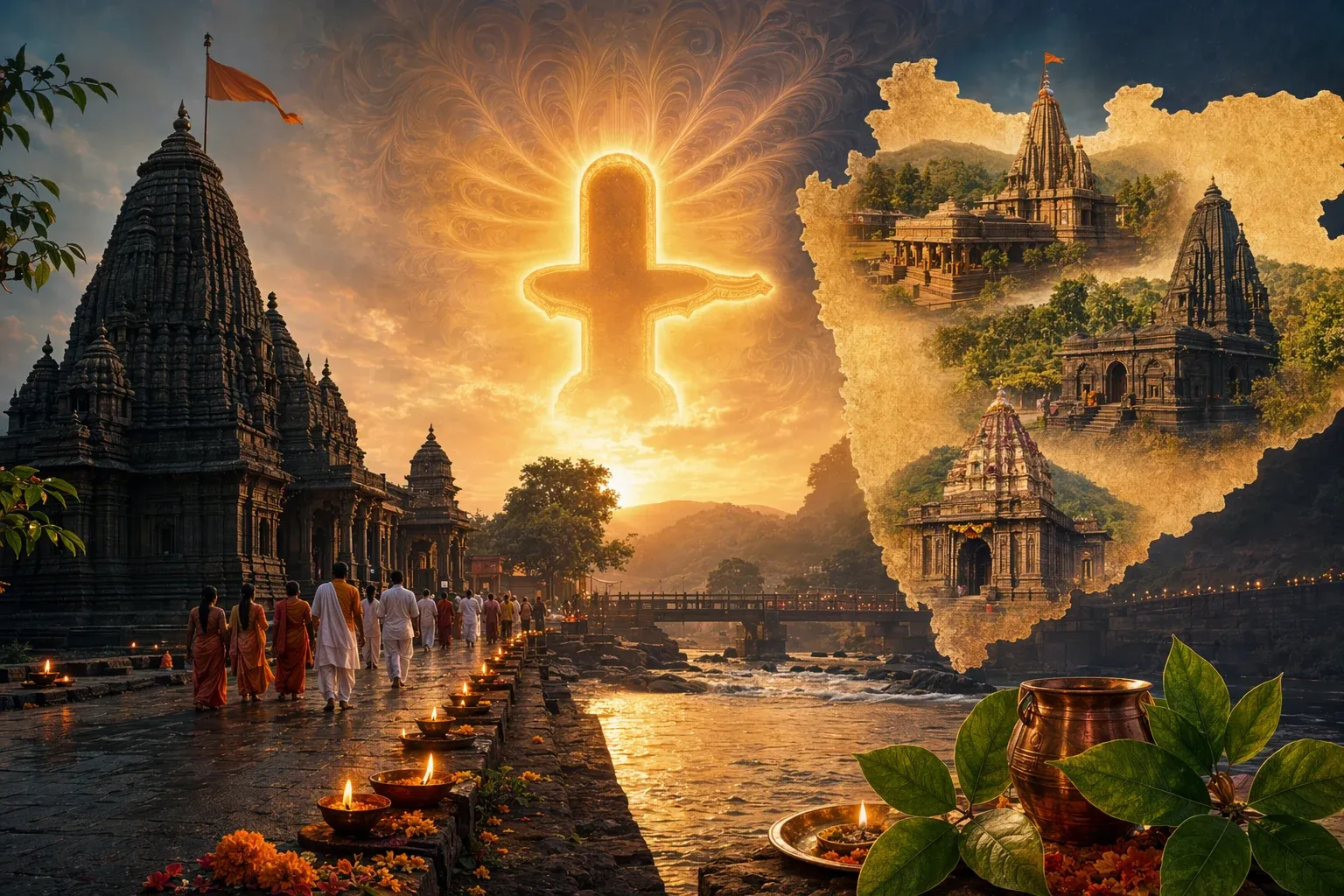
Maharashtra has a deep connection with Jyotirlinga pilgrimage, especially through Trimbakeshwar, Bhimashankar, and Grishneshwar. Many families also hear different counts or local claims, which can make the topic confusing.
This guide gives a calm beginner-friendly map: which shrines are commonly linked with Maharashtra, where they are, and why each one matters in Shiva devotion.
Simple answer
Maharashtra is strongly linked with Jyotirlinga pilgrimage through Trimbakeshwar, Bhimashankar, Grishneshwar, and local traditions.
How many Jyotirlingas are in Maharashtra?
In the commonly used 12 Jyotirlinga list, Maharashtra is strongly associated with Trimbakeshwar, Bhimashankar, and Grishneshwar. Many devotees also encounter local traditions around Aundha Nagnath and Parli Vaijnath, especially when discussing Nageshwar/Nagnath and Vaidyanath identifications.
So the safest beginner answer is: at least three widely accepted Jyotirlingas are in Maharashtra, and some additional local claims are part of living regional devotion. Avoid mocking the difference; simply explain it carefully.
Trimbakeshwar near Nashik
Trimbakeshwar is near Nashik and is deeply connected in popular memory with the Godavari region. The name “Triambaka” links to Shiva as the three-eyed one. Many families know it through rituals, pilgrimage, and the wider sacred geography of Nashik.
Bhimashankar in the Sahyadri region
Bhimashankar is associated with the Sahyadri/Western Ghats landscape. For beginners, its importance is not only the temple name but also the feeling of a forested, hilly pilgrimage. Weather, road access, and physical comfort matter when planning a visit.
Grishneshwar near Ellora
Grishneshwar, also written Ghrishneshwar or Ghushmeshwar in some contexts, is near Ellora/Verul in Maharashtra. It is often remembered as one of the 12 and is important for people exploring the Aurangabad/Chhatrapati Sambhajinagar region’s heritage landscape.
Why confusion happens
Confusion happens because sacred lists travel through texts, local recitation, family tradition, temple boards, and regional pride. The respectful approach is to name the commonly accepted list and then mention alternate local traditions without turning devotion into a fight.
How to use this guide in real life
If you are planning a visit, use this article as a cultural starting point, not as the final authority for timings, bookings, special pujas, or crowd rules. Temple procedures can change because of festivals, weather, local administration, security, renovation work, or special occasions. Always check current official notices or a trusted local source before travelling.
If you are learning from home, keep a small map of India nearby and mark the shrine or region being discussed. Jyotirlinga learning becomes easier when you connect the name with a place, a story, and one key idea. That way the topic stops feeling like a random memorisation list and starts becoming a living cultural map.
Mini FAQ for beginners
Is every local version exactly the same? No. Sacred stories often have regional retellings. Learn the common version first, then respect local variations instead of treating them as mistakes.
Do I need to visit all 12 Jyotirlingas to be a real devotee? No. Many devotees never visit all 12. Sincere prayer, ethical living, learning, and respect matter too. Pilgrimage is meaningful, but bhakti should not become a pressure contest.
Can children and teenagers learn these topics without heavy Sanskrit? Yes. Start with simple words: Shiva, light, darshan, pilgrimage, story, place, and meaning. Deeper Sanskrit and scripture references can come gradually.
Beginner outline recap
This draft was shaped around these step outline points: Why Maharashtra is strongly associated with Jyotirlinga pilgrimage; Trimbakeshwar: Nashik and Godavari connection; Bhimashankar: Sahyadri/Shiva tradition; Grishneshwar: near Ellora/Aurangabad area; Common confusion around count and local traditions.
Common mistakes to avoid
Do not turn Jyotirlinga learning into a race, a ranking list, or a fear-based checklist. Devotion becomes healthier when it includes humility, patience, cleanliness, and respect for local rules.
Also avoid pretending that every detail is the same in every region. Hindu traditions often preserve many local memories. A mature learner can respect difference without confusion or mockery.
Bhaktilipi takeaway
For beginners, the best way to understand Jyotirlingas is to see three layers together: sacred story, living devotion, and historical geography. The story gives meaning, the devotion gives feeling, and the geography shows how culture travels across India.
A beginner-friendly way to read this
This guide is mainly about Jyotirlingas in Maharashtra: Names, Locations, and Why They Are Important. The useful way to read it is not as a final verdict, but as a beginner-friendly map: learn the key idea, notice the context, and then connect it with the wider Indian cultural world. Important terms in this article include Jyotirlingas, Maharashtra, Names, Locations, They. The central angle is: High-volume regional cluster. Explain Trimbakeshwar, Bhimashankar, Grishneshwar, and commonly associated Maharashtra traditions carefully, noting accepted lists/disputed Vaijnath/Nagnath traditions where needed.
Jyotirlinga articles sit at the meeting point of story, devotion, temple geography, and living pilgrimage. A beginner should understand that devotees do not revere these shrines only as tourist locations. The stories, names, regional memories, and repeated journeys make them part of a sacred map of Shiva bhakti across India.
What to remember
At the same time, temple details can vary. Lists, local legends, darshan rules, timings, crowd systems, and travel conditions may change by shrine and season. A responsible guide explains the cultural meaning while encouraging readers to check official temple notices before planning a visit or assuming a universal rule.
For modern readers, the safest approach is to keep curiosity and humility together. A tradition can be meaningful without being reduced to a slogan, and a complex topic can be made simple without pretending that every region, family, school, or teacher follows the exact same wording.
The simplest takeaway is that a Jyotirlinga guide should create respect before itinerary. Learn the name, location, story, and devotional significance first; travel planning becomes clearer when the cultural context is already understood.
Where to go next
For a wider base before going deeper, read our Jyotirlinga meaning guide. It gives the surrounding context so this article feels less isolated.
Common misunderstandings to avoid
A common mistake is to treat Jyotirlingas in Maharashtra: Names, Locations, and Why They Are Important as only one sentence or one social-media definition. In reality, Jyotirlinga tradition topics usually carry many layers: language, practice, regional memory, family tradition, teacher explanation, and modern interpretation. A beginner guide should simplify the entry point, but it should not erase that depth.
Another mistake is to assume that one version explains every community. Indian traditions often travel through many regions and languages, so examples may differ. That does not make the topic confused; it means the tradition is alive and has been remembered in more than one way.
The safest reading habit is to keep the main idea clear and hold details gently. Start with what the word means, then notice where it appears, who practices or discusses it, and what value it is trying to teach. This makes Jyotirlingas in Maharashtra: Names, Locations, and Why They Are Important easier to remember without forcing a narrow answer.
Why this matters today
This topic still matters because young readers are meeting Indian culture through school, family stories, social media, travel, music, health conversations, and festival posts. Without context, the same idea can look either too mysterious or too casual. A clear explanation helps readers respect the subject without feeling lost.
For Bhaktilipi readers, the practical value is not just information. The goal is better cultural literacy: knowing enough to ask good questions, avoid lazy stereotypes, and recognise why earlier generations preserved these ideas through stories, songs, rituals, debates, art, and daily habits.
Good learning also means knowing the limits of a short article. This guide gives a reliable starting point, but deeper study can come from teachers, trusted books, temple or community elders, museums, performances, and careful reading of primary traditions where possible.
Simple takeaway
If you remember only one thing, remember this: Jyotirlingas in Maharashtra: Names, Locations, and Why They Are Important becomes meaningful when the definition, the cultural setting, and the human purpose are read together. That balanced view protects the topic from both blind rejection and blind romanticisation.
Use this article as a first map. Revisit the key words, compare them with real examples, and keep learning patiently. Dharma-oriented learning is not about collecting facts quickly; it is about understanding what those facts ask us to value and practice.
Related Bhaktilipi guides
For the larger foundation behind this topic, read our Jyotirlinga beginner guide.