
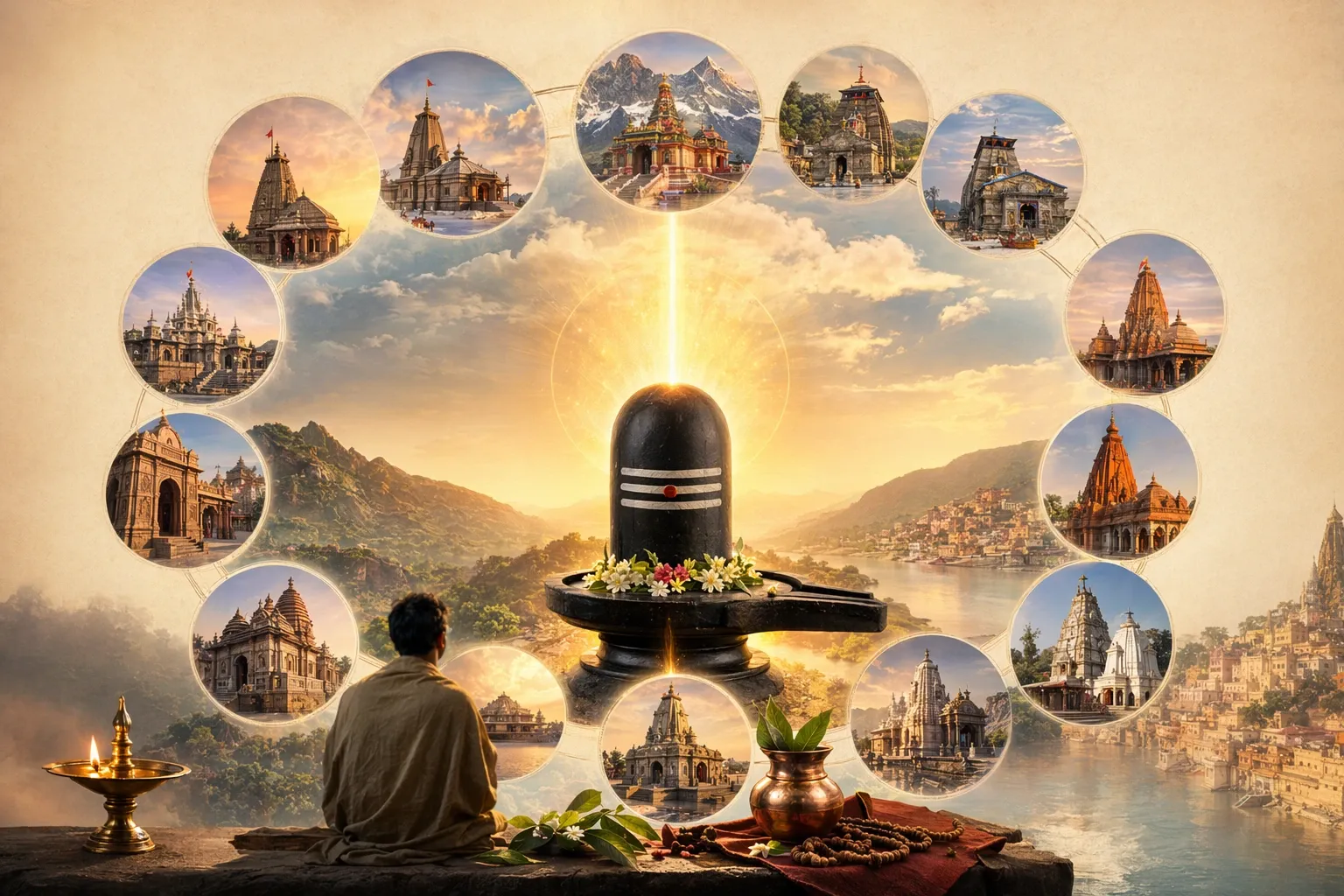
Jyotirlingas are among the most loved sacred sites in the Shiva tradition. Many people know the phrase “12 Jyotirlingas” from family conversations, pilgrimage plans, calendars, songs, and temple lists. But beginners often ask a simple question: what exactly is a Jyotirlinga, and why are these shrines so important?
A Jyotirlinga is traditionally understood as a radiant form of Shiva, where the divine is worshipped as a linga of light. The word combines jyoti, meaning light or radiance, and linga, a sacred symbol of Shiva. The idea is not merely a stone object. It points to Shiva as presence, formlessness, energy, and grace made accessible for worship.
The story behind Jyotirlinga
A well-known tradition tells of Brahma and Vishnu trying to find the beginning and end of an endless pillar of light. The pillar was Shiva, beyond measurement. This story teaches that the divine cannot be fully captured by ego, argument, or ordinary pride. The Jyotirlinga becomes a symbol of that infinite light.
For nearby context, read our Shiva linga meaning guide and the Shiva Purana beginner guide before planning shrine visits or deeper study.
Different Puranic and regional traditions tell stories connected with specific shrines. These stories are not only travel details. They teach devotion, humility, protection, repentance, courage, and the presence of Shiva in sacred geography.
The twelve famous Jyotirlingas
The widely known list of twelve includes Somnath in Gujarat, Mallikarjuna in Andhra Pradesh, Mahakaleshwar in Madhya Pradesh, Omkareshwar in Madhya Pradesh, Kedarnath in Uttarakhand, Bhimashankar in Maharashtra, Kashi Vishwanath in Uttar Pradesh, Trimbakeshwar in Maharashtra, Vaidyanath or Baidyanath with location traditions that vary, Nageshwar with varying identifications, Rameshwaram in Tamil Nadu, and Grishneshwar in Maharashtra.
Beginners should know that some location identifications have regional debates. This is common in living traditions. A respectful article should not treat every variation as a fight. Instead, it should explain that communities preserve sacred memory in different ways.
Tradition, interpretation, and historical context
In tradition, visiting a Jyotirlinga is an act of devotion to Shiva. Pilgrims may travel long distances, offer prayers, perform abhishek where allowed, chant mantras, and seek blessings for strength, peace, and spiritual growth.
In interpretation, the light symbolism is powerful. Shiva as jyoti suggests that the divine is not limited by form, yet can be approached through form. The linga becomes a focus for meditation, humility, and surrender.
Historically, Jyotirlinga shrines developed as major pilgrimage centres with layers of temple building, local patronage, regional politics, reconstruction, oral traditions, and devotional practice. Their importance is not only architectural; it is emotional and civilisational.
Jyotirlinga and pilgrimage
Many families dream of visiting all twelve Jyotirlingas. Some people follow specific routes, while others visit according to time, health, money, and opportunity. There is no need to turn devotion into a competitive checklist. A single sincere darshan can be meaningful.
Practical respect matters. Check temple rules before visiting. Dress modestly, follow queue systems, avoid pushing, do not photograph where it is prohibited, and listen to local instructions. Sacred places are not content studios; they are living spaces of worship.
Common beginner questions
Is every Shiva temple a Jyotirlinga? No. Every Shiva temple can be sacred to devotees, but Jyotirlinga refers to a specific revered group of shrines. Are Jyotirlingas natural or made? Traditions vary, and many are understood as self-manifest or ancient forms, while temple structures around them have changed over time.
Can anyone visit? In general, devotees and respectful visitors can visit, but each temple may have its own rules. Some rituals may be restricted by timing, crowd, local custom, or priestly guidance.
Why Jyotirlingas still matter
The Jyotirlingas remind us that sacred geography is not just about maps. It is about memory, longing, movement, and faith. People travel across mountains, coasts, cities, forests, and rivers because they believe Shiva’s light can be met there. Whether you visit one shrine or only learn about them from home, the deeper lesson is humility before the infinite.
Common beginner mistakes
One mistake is treating the twelve shrines like a tourist scoreboard. Pilgrimage is not only about covering locations. It is about preparing the mind, travelling with humility, respecting local customs, and returning with some change in conduct. A rushed selfie trip may miss the point.
Another mistake is arguing aggressively over every variation in lists and locations. Sacred geography often carries multiple memories. Instead of turning devotion into online fighting, learn the main tradition, note the regional view, and speak respectfully.
A gentle way to remember the twelve
Beginners can remember the Jyotirlingas region by region: western shrines like Somnath and Nageshwar, central shrines like Mahakaleshwar and Omkareshwar, Himalayan Kedarnath, Maharashtra-linked shrines such as Bhimashankar, Trimbakeshwar, and Grishneshwar, northern Kashi Vishwanath, southern Rameshwaram, and the debated Vaidyanath tradition.
The exact memorisation can come later. First remember the meaning: Shiva as light beyond ego, present in places where generations have prayed. That understanding makes the list warmer and less mechanical.
Learning without losing respect
When reading about Jyotirlingas, use careful sources and avoid sensational claims. Some online content turns sacred places into miracle factories or ranking lists. A better way is to learn the story, geography, temple tradition, and living practices while accepting that faith cannot be reduced to trivia.
If you visit, let the journey affect your behaviour after returning. Speak more gently, serve better, reduce ego, and remember Shiva not only at the shrine but also in daily conduct.
That daily remembrance is what makes pilgrimage complete. The road to a shrine may end at the temple door, but the inner journey continues in how we treat people, work, nature, and our own mind.