
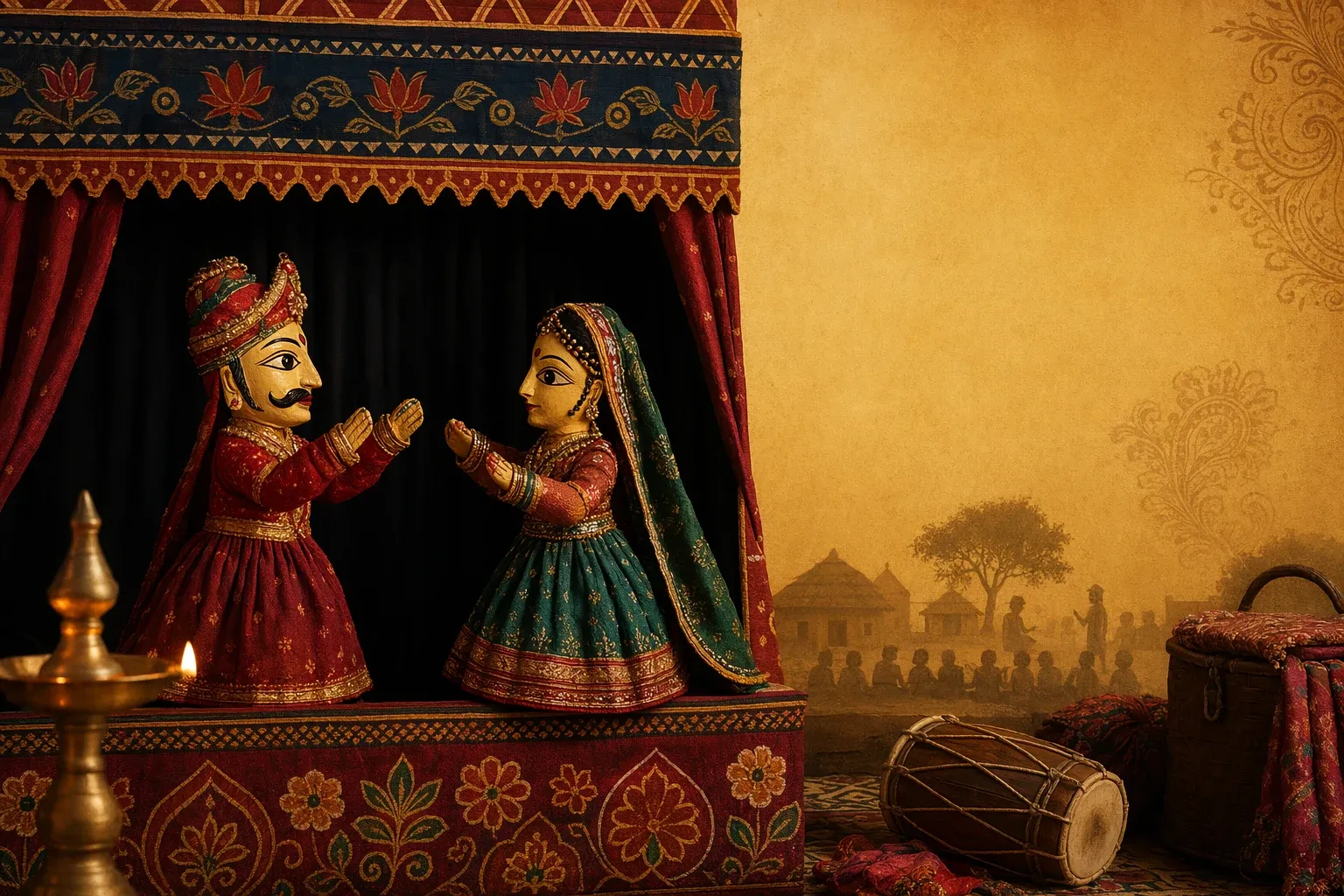
Indian glove puppetry is one of the most direct forms of puppet theatre because the performer’s hand enters the puppet and becomes its body. The index finger usually supports the head, while the thumb and middle finger control the two arms. With only three fingers, a skilled puppeteer can make a small figure bow, clap, fight, dance, complain, bless, flirt, or tease the audience. The technique looks simple from outside, but it requires strong hands, clear rhythm, expressive voice, and a sharp sense of timing.
Glove puppets are found in several parts of India, including Kerala, Odisha, West Bengal, and Uttar Pradesh, with different local names and performance styles. Some traditions are devotional and linked to epic or puranic stories. Some are comic, satirical, or educational. Some use a small booth or curtain; others are performed in a more open setting. What unites them is the closeness between hand and figure. Unlike string puppets, glove puppets do not hang from above. Unlike shadow puppets, they are not viewed as silhouettes. They are small actors worn on the hand, and their energy comes from the immediacy of touch.
How a glove puppet is built
A typical Indian glove puppet has a carved or modelled head, two arms, and a cloth body that fits over the puppeteer’s hand like a loose sleeve. The head may be made of wood, papier-mache, clay-based material, or other lightweight substances depending on region and maker. The face is painted with bold features so it remains readable from a distance: large eyes, arched brows, moustache, red lips, or a strong nose. The arms may be stuffed cloth or small carved pieces attached to the costume. The lower body is often suggested through fabric rather than fully formed legs.
The costume is not just decoration. It hides the performer’s hand, shapes the puppet’s body, and helps identify the character. A king may wear a crown and rich cloth. A demon may have a fierce face and dark colours. A clown may have exaggerated features. A female character may wear a sari-like drape, ornaments, and a painted hairline. Because the puppet is small, every detail has to be clear. Too much fine decoration may disappear during performance; strong colour and silhouette work better.
The hand position determines the puppet’s range. The index finger lifts and turns the head. The thumb and middle finger create arm gestures. The wrist moves the whole body. A quick wrist flick can show surprise. A gentle tilt can show sadness. Two raised arms can signal anger, dancing, or appeal depending on the voice and rhythm. The same physical movement can mean different things when paired with different dialogue.
Regional names and traditions
Kerala’s glove-puppet tradition is commonly known as Pavakathakali. The name points to its relationship with Kathakali, the classical dance-drama of Kerala. Pavakathakali puppets often represent Kathakali characters in miniature, with elaborate headgear, painted faces, and costumes inspired by the live theatre form. Stories may come from the Ramayana, Mahabharata, and Krishna legends. The puppets are smaller than human dancers, but they carry the visual memory of Kathakali through colour, costume, and dramatic expression.
Odisha has glove puppets often called Sakhi Kandhei or related local names, depending on area and usage. These may be connected with devotional and folk storytelling, including Krishna-related themes. Odisha’s wider puppet culture also includes string puppets and the famous shadow form Ravana Chhaya, so glove puppetry is one part of a broader performance environment. The puppets may be small and lyrical, with music and narration guiding the action.
West Bengal has a glove-puppet tradition known as Bener Putul or Bene Putul in some references. Performances have included folk tales, social themes, and comic exchanges. The puppets are hand-operated, often colourful, and suited to lively speech. In north India, including parts of Uttar Pradesh, glove puppets have also been used for folk entertainment and educational messages. Regional names and exact practices vary, but the essential technique remains the same: the hand brings the figure to life from inside.
The performance space
A glove-puppet stage can be modest. Many performances use a small booth, curtain, or raised screen that hides the puppeteer’s body while allowing the puppet to appear above the edge. The stage may be made from cloth and bamboo, wood, or a temporary frame. Because the puppets are small, the audience usually needs to sit fairly close. This creates an intimate atmosphere. The puppeteer can respond to children laughing, adults commenting, or a crowd gathering in a village square.
In some settings, one performer may manage a short scene alone, switching puppets and voices quickly. In others, a small team handles music, narration, and multiple characters. The puppets may enter from the sides, pop up from below, bow to the audience, or strike each other in comic rhythm. Since the performer’s hands are occupied, the staging must be planned carefully. Puppets need to be arranged within reach. Entrances and exits must happen smoothly. If a character’s crown catches on the curtain, the illusion can break, so practical design matters.
Voice, music, and rhythm
Glove puppetry depends heavily on voice. The puppeteer may speak in different tones for a king, queen, child, demon, priest, clown, or animal. A high voice can make a character seem mischievous. A deep voice can make a demon or elder sound imposing. A nasal tone may create comic effect. Some performers use songs to introduce characters or mark emotional moments. Drums, cymbals, harmonium, or local instruments may accompany the action, though the exact ensemble varies widely.
Rhythm is especially important because the puppet has limited body parts. A hand puppet cannot show every subtle movement of a human actor, so timing makes the gesture meaningful. A pause before a head turn can signal suspicion. Three quick arm beats can signal anger. A slow bow can signal devotion or respect. When the rhythm, voice, and movement align, the puppet feels alive even though its face does not change.
Stories and characters
Indian glove puppetry can present mythological stories, folk tales, moral episodes, comic sketches, and public messages. In Kerala’s Pavakathakali, the link with Kathakali makes epic characters especially important: Krishna, Arjuna, Bhima, Draupadi, Ravana, Hanuman, and other figures can appear in miniature. The performance may condense a well-known episode into a shorter sequence suitable for a small stage. Instead of presenting a full night of live dance-drama, the puppets capture key confrontations, emotions, and recognisable costumes.
Folk and comic glove puppetry may use everyday characters: a quarrelling couple, a clever servant, a boastful official, a teacher, a doctor, a village elder, a thief, or a trickster. These characters allow the puppeteer to speak directly to audience concerns. Traditional puppeteers have long used humour to talk about social behaviour. Modern groups may use glove puppets for health awareness, environmental education, literacy, road safety, or classroom learning because the form is portable and immediately engaging.
Why glove puppets feel so lively
The liveliness of glove puppetry comes from direct contact. The performer does not pull strings from a distance; the hand is inside the figure. Every pulse of the wrist travels into the puppet. This produces quick reactions and strong comic timing. A puppet can duck instantly, slap another puppet, turn to the audience, or collapse in mock despair. The movement can be smaller than a string puppet’s dance but more immediate.
This closeness also means the performer must control energy carefully. Too much movement becomes shaking. Too little movement feels flat. The best glove puppeteers use clean gestures. They hold the puppet still when it is listening, turn the head when it is thinking, and use the arms only when the character needs emphasis. Beginners often wave the arms constantly; experienced performers know that stillness can be powerful.
Pavakathakali as a special example
Pavakathakali is especially useful for understanding how Indian puppet forms borrow from neighbouring arts. Kathakali is known for elaborate makeup, codified gestures, heavy costumes, and dramatic stories. Pavakathakali cannot reproduce every detail of a trained dancer’s body, but it translates the visual identity into puppet scale. The headgear, face colours, and costume shapes tell the audience what kind of character is present: noble, heroic, demonic, feminine, or comic.
The puppeteer’s challenge is to suggest Kathakali-like drama through hand movement. A raised arm, a side turn, a proud posture, or a sudden confrontation can evoke the larger theatre. Music and narration support the scene. For viewers who know Kathakali, the puppet version feels like a miniature echo. For beginners, it is an accessible way to see how Indian performance traditions speak to each other.
How to watch as a beginner
When watching Indian glove puppetry, sit where you can see the puppet’s head and hands clearly. Notice how the performer uses the edge of the booth or curtain. The puppet may lean over it like a balcony, disappear below it, or use it as a boundary for chase scenes. Watch the arms: because they are controlled by fingers, they reveal the performer’s skill. A clean clap, a pointed accusation, a folded greeting, or a mock fight can be very difficult to time well.
Listen closely to voice changes. In a small troupe, the same performer may speak several roles. The shift in pitch, speed, and accent helps the audience follow the story. Also notice how the puppet “looks” at other characters. Since its eyes are painted and fixed, looking is created by turning the whole head or body. A tiny head turn at the right moment can be funnier than a long speech.
Indian glove puppetry today
Like many traditional performing arts, glove puppetry has changed with modern entertainment habits. Long itinerant circuits have declined in many places, and hereditary performers may not always find enough income through shows alone. At the same time, glove puppets remain useful because they are portable, affordable compared with large productions, and effective for education. Schools, museums, theatre groups, and cultural organisations use glove puppets to introduce stories, languages, and social themes.
The future of the form depends on supporting both craft and performance. A puppet head in a display case shows carving and costume, but the tradition lives when the figure speaks, moves, jokes, and meets an audience. Workshops can teach children to make simple hand puppets, but deeper training is needed to preserve regional styles such as Pavakathakali. Documentation, fair payment for artists, local-language performances, and regular stages all matter.
Direct FAQs
What is a glove puppet?
A glove puppet is a puppet worn over the hand. The performer’s fingers control the head and arms from inside the puppet, making it move directly without strings.
Which Indian regions have glove puppetry?
Important references include Pavakathakali in Kerala, glove-puppet traditions in Odisha, Bener Putul or Bene Putul in West Bengal, and folk glove-puppet practices in parts of north India such as Uttar Pradesh. Names and styles vary by region.
How is glove puppetry different from string puppetry?
String puppets hang from threads and are controlled from above. Glove puppets are controlled from inside by the performer’s hand. This makes glove puppets quick, intimate, and responsive, while string puppets often allow suspended dance and larger spatial movement.
What stories do Indian glove puppets tell?
They may tell epic and devotional stories from the Ramayana, Mahabharata, and Krishna traditions, as well as folk tales, comic sketches, moral stories, and modern educational themes.
Can one person perform a glove-puppet show?
Yes, short scenes can be performed by one person using different voices and quick puppet changes. Larger performances may include musicians, singers, narrators, and assistants.