
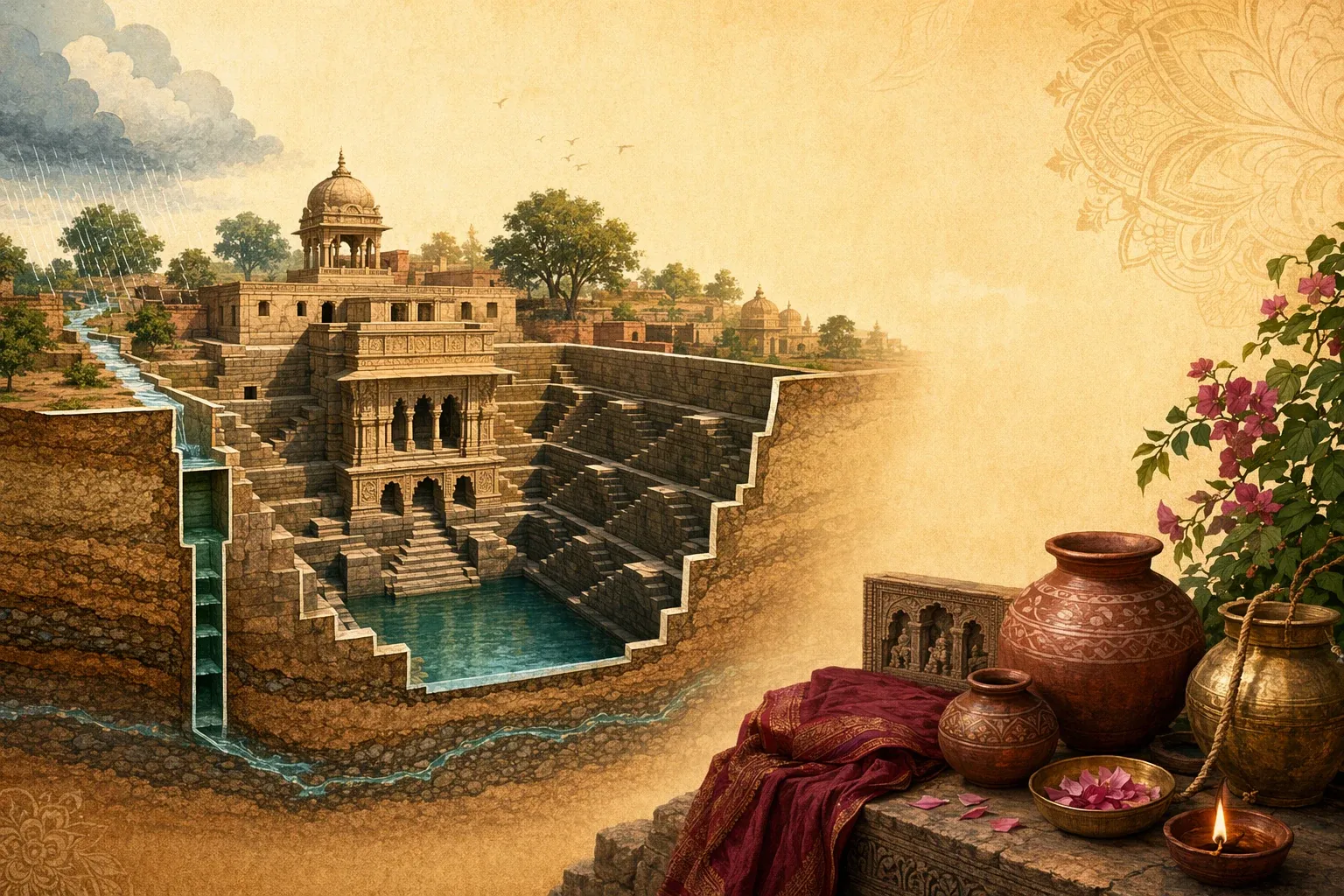
Stepwells worked by making water reachable as its level changed. That is the core engineering idea. A normal well gives access from the top. A stepwell creates a built path downward, so people can walk closer to the water during dry months. The stairs, walls, landings, shafts, and chambers are not only beautiful features. They are part of a water system designed for seasonal India.
To understand a stepwell, think of three connected tasks. First, the structure must reach water or hold water. Second, it must stay stable inside the earth. Third, people must be able to use and maintain it safely. Different regions solved these tasks in different styles, which is why a Gujarati vav, a Rajasthani baori, and a Delhi baoli may not look identical.
The descending staircase solved a changing water problem
Water level is not fixed. After rains, a well may hold more water. In summer, the level may fall. A stepwell responds to this by adding many steps. When the water is higher, people do not need to go far. When it drops, they descend deeper. This is the simplest reason the stepped form matters.
The stairs also make access shared and visible. People can carry pots, pause on landings, and move in groups. In some stepwells, symmetrical flights create dramatic geometry, but the practical idea remains clear: the path follows the water down.
The shaft, tank, and underground passages
Many stepwells include a vertical shaft or well portion where water collects, and a stepped corridor or series of levels that lead toward it. Some have broader tanks or pond-like spaces. Others are more like long sunken passages ending in a well. The exact plan depends on the local water table, soil, stone, settlement need, and patron’s resources.
Side chambers and galleries could support movement, resting, and structural stability. Pillars and beams helped carry loads. Retaining walls held back earth. The deeper the structure, the more important careful masonry became. This is one reason famous stepwells impress architects: they are not only carved surfaces, but underground structures resisting pressure, water, and time.
Rain, groundwater, and seasonal recharge
Stepwells were part of a wider water-conservation world. Some accessed groundwater. Some received rainwater or runoff through surrounding systems. Some worked with nearby tanks, drainage patterns, or settlement layouts. The purpose was to keep water available beyond the immediate rainy season.
This does not mean every stepwell functioned perfectly forever. Silting, neglect, pollution, falling groundwater, urban change, or damaged catchments could weaken the system. Rani ki Vav, for example, was buried under silt for a long period before restoration. That history reminds us that water structures need maintenance, not only admiration.
Stone, depth, and temperature
Stepwells also worked as cool spaces because of their depth and material. Stone absorbs and releases heat differently from open ground, and deeper shaded levels receive less direct sunlight. As a person goes down, the surrounding walls reduce exposure to hot wind and harsh sun. This made the stepwell more comfortable for users in hot climates.
The cooling effect was not a luxury. It supported daily use. People drawing water, travellers resting, or residents gathering could spend time in a shaded space. In this sense, the structure conserved not only water but also human energy.
Water conservation through access and discipline
Conservation is not only about storing water. It is also about how people use water. A stepwell makes water visible. When people see the level falling, scarcity becomes real. When silt gathers, the need for cleaning becomes visible. A hidden pipe can make water feel endless, but a stepwell shows the community that water has limits.
This visibility can encourage discipline. Communities had to keep the structure clean, protect the catchment, repair damaged sections, and follow habits around use. A stepwell without community care becomes unsafe. A maintained stepwell becomes a lesson in shared responsibility.
Examples that show the working idea
Chand Baori at Abhaneri is often described through its striking repeated steps and great depth. Whether a visitor first notices geometry or scale, the design shows the logic of descent: many paths toward the lower tank. Its famous visual pattern is beautiful because it is also functional.
Rani ki Vav at Patan shows another direction. Here the stepwell becomes highly sculptural and symbolic, often described as an inverted temple. Its multiple levels, pillars, and panels remind us that water engineering in India could be joined with sacred art and royal memory. The function was water access; the experience became cultural heritage.
Ordinary wells, tanks, and stepwells
A stepwell is not the same as every traditional water structure. An ordinary well is usually a vertical shaft. A tank or pond stores water in a more open basin. A johad, common in parts of Rajasthan, is an earthen rainwater-harvesting structure that helps recharge groundwater and support local use. A stepwell combines the idea of a well or reservoir with built steps for access.
These systems often belonged to the same water-thinking culture. The best question is not which one is superior in all situations. The better question is: what did the landscape need? In one place, a tank made sense. In another, a stepwell. In another, a johad or ordinary well.
Questions people ask
How did stepwells work?
Stepwells worked by providing steps down to water, so people could reach it as the water level rose or fell. They used masonry, shafts, corridors, and sometimes tanks or chambers.
How do stepwells help in conserving water?
They help by storing or accessing water across seasons, supporting groundwater use, reducing dependence on temporary surface water, and making water levels visible to the community.
How are stepwells useful?
They are useful for water access, shade, rest, community gathering, local identity, and heritage learning. Historically, they could support villages, towns, routes, and travellers.
What are stepwells for?
Stepwells are for reaching and managing water, especially in places with dry months or changing water levels. Some also became sacred, artistic, or social spaces.
A practical lesson for today
Modern India cannot simply copy every old stepwell and solve all water problems. Cities, population, pollution, groundwater stress, and climate pressures are different now. But stepwells still teach a useful principle: water systems should be designed with local climate and community behaviour in mind.
The ancient stepwell worked because it joined environment, engineering, and social responsibility. It accepted that water changes with season. It gave people access without pretending that water is infinite. It made public welfare visible in stone. That is why studying stepwells is not only heritage appreciation. It is also a reminder to think carefully, humbly, and collectively about water.