Why Buddha images use mudras
Buddha images are not random portraits. Every detail can carry meaning: posture, eyes, robe, seat, expression, and hands. Mudras help tell the viewer what quality or moment is being shown. A Buddha with hands in the lap may suggest meditation. A Buddha touching the earth points to a famous moment of awakening. A raised palm may offer reassurance.
For beginners, learning Buddha mudras is like learning to read visual poetry. The hands do not shout. They quietly guide your attention toward wisdom, compassion, teaching, courage, or stillness.
Dhyana Mudra: meditation and inner steadiness
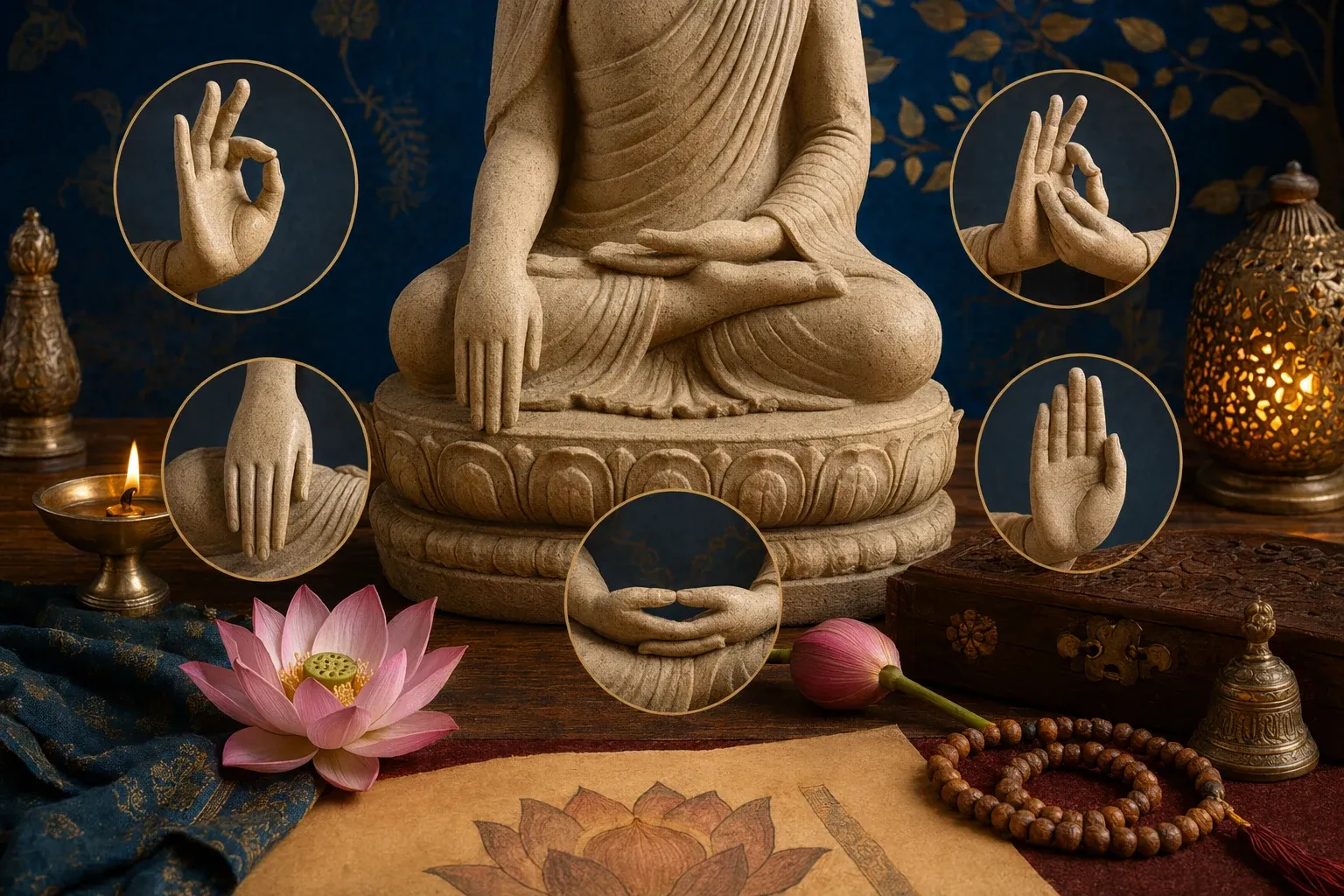
Dhyana Mudra is one of the most recognisable Buddha hand gestures. The hands rest in the lap, often with palms upward and one hand placed over the other. The thumbs may touch gently. This mudra is linked with meditation and collected awareness.
When you see Dhyana Mudra, notice the whole image. The body is usually seated, the face calm, the eyes lowered or softly focused. The hands support the mood of deep stillness. This is why Dhyana Mudra is also useful for modern meditation practice, though its sacred art meaning should be respected.
Bhumisparsha Mudra: touching the earth
Bhumisparsha Mudra means “earth-touching” gesture. In many images, the Buddha sits in meditation while one hand reaches down to touch the earth. This refers to the moment when the earth is called as witness to the Buddha’s awakening.
This mudra is powerful because it is both humble and strong. The hand does not point upward in display. It reaches down, connecting awakening with the earth itself. For viewers, it can suggest grounded truth, resolve, and the witness of reality.
Abhaya Mudra: reassurance and fearlessness
Abhaya Mudra is usually shown with one hand raised and palm facing outward. It is commonly understood as a gesture of reassurance, fearlessness, and protection. In Buddhist art, it can feel like a calm message: do not be afraid.
The mood is gentle, not aggressive. The palm is open. The face is peaceful. The image offers steadiness rather than drama. This is a good example of why a mudra must be read with expression and posture.
Dharmachakra Mudra: teaching the turning of the wheel
Dharmachakra Mudra is often linked with teaching, especially the “turning of the wheel of Dharma.” The hands are held near the chest with fingers arranged in a symbolic form. It may appear more complex than beginner mudras, but its broad meaning is easier to remember: the Buddha is teaching the path.
When you see this mudra, think of communication, wisdom shared, and a teaching set in motion. It is not just a decorative hand shape; it points to the living transmission of insight.
Varada Mudra: giving and compassion
Varada Mudra often shows the hand lowered with palm open, suggesting giving, generosity, compassion, or blessing. In some images it appears together with Abhaya Mudra: one hand reassures, the other gives. The combination creates a balanced message of safety and kindness.
Reading Buddha mudras respectfully
If you visit a Buddhist site, monastery, museum, or temple, take time before clicking photos. Notice the silence of the image. Read any local signs. Follow rules about footwear, photography, and behaviour. Sacred art is not just content; for many people it is part of devotion.
Online, avoid using Buddha mudras as random aesthetic symbols. A respectful caption, correct name, and honest curiosity are better than shallow decoration.
Example: identifying a Buddha statue
Suppose you see a seated Buddha with one hand resting in the lap and the other touching the ground. You might identify Bhumisparsha Mudra and connect it with awakening. If both hands rest in the lap, Dhyana Mudra may be present. If one palm is raised outward, Abhaya Mudra may be shown. Each clue helps you read the image more carefully.
A note for museum visits
If you see a Buddha image in a museum, read the label but also observe silently for a moment. The label may give date and region; the mudra gives emotional direction. Together they help you understand the object as sacred art, not only old stone or metal.
Do all Buddhist traditions show the same mudras?
Not exactly. Buddhist art across India, Sri Lanka, Tibet, Nepal, Southeast Asia, East Asia, and beyond has many styles. Names and interpretations may vary. The same broad mudra can appear with regional details. Beginners should learn common meanings while staying open to local tradition.
Slow looking builds respect
Instead of trying to identify every mudra quickly, spend time with one image. Notice what your eyes return to: the hand, the face, the seat, or the surrounding figures. Art teaches through patient attention.
FAQ
Is every Buddha hand gesture a mudra?
Most meaningful hand gestures in Buddha images are called mudras, but details depend on tradition, period, and artistic style.
Which Buddha mudra is best known?
Dhyana Mudra and Bhumisparsha Mudra are very widely recognised. Abhaya Mudra is also common and easy to identify.
Can I practise Buddha mudras at home?
You can use simple meditation gestures respectfully. If a mudra belongs to a specific Buddhist practice, learn it from a reliable teacher or tradition.
Where to go next
For Anjali, Dhyana, and Abhaya in wider Indian art, read `anjali-dhyana-abhaya-mudra-meanings`. For basic hand signs, read `mudra-hands-hand-signs-types-explained`. For meditation practice, read `mudra-yoga-meditation-best-for-beginners`.