
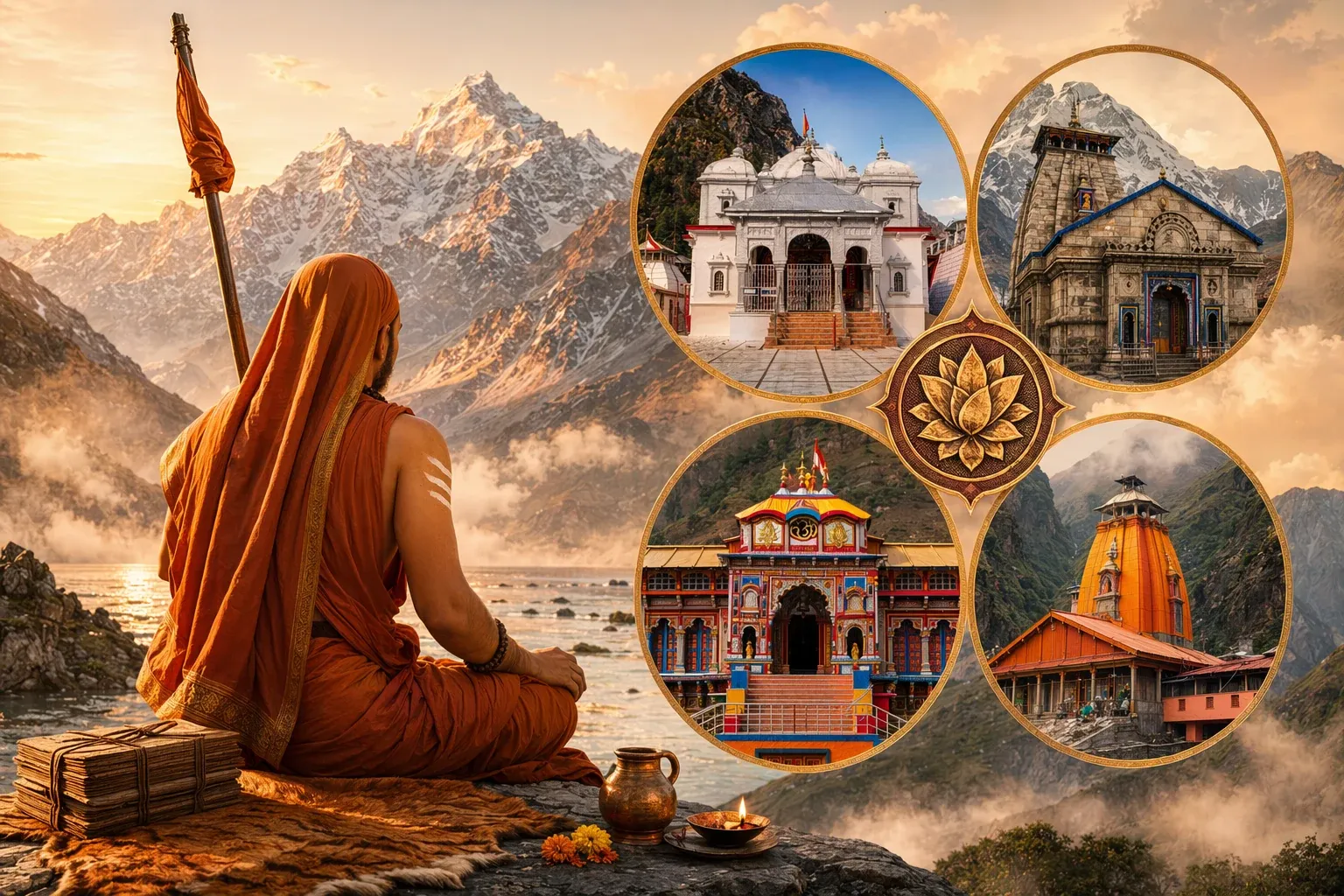
Many popular explanations say that Adi Shankaracharya established or organized the Char Dham tradition. This is an important traditional association, but beginners should understand it carefully rather than reducing the whole history to one simple sentence.
Char Dham is best seen as a sacred-geography tradition shaped by temples, pilgrimage routes, devotional memory, teachers, communities, and time. Adi Shankaracharya’s name is strongly linked with the idea in popular Hindu memory.
The simple answer
Tradition commonly associates the organization or revival of Char Dham with Adi Shankaracharya, the great philosopher and teacher of Advaita Vedanta. Historically, it is safer to say the Char Dham tradition developed through many layers, with Shankaracharya remembered as a major organizing figure.
The basic Char Dham context
The word “Char” means four, and “Dham” means a sacred abode or holy destination. In everyday Hindu usage, Char Dham usually refers to the four major pilgrimage centres spread across India: Badrinath in the north, Dwarka in the west, Jagannath Puri in the east, and Rameswaram in the south. Many people also use “Chota Char Dham” for the four Himalayan shrines of Uttarakhand: Yamunotri, Gangotri, Kedarnath, and Badrinath.
Why beginners often get confused
A good beginner approach is to separate devotion, geography, history, and travel planning. Devotion explains why pilgrims feel drawn to these places. Geography shows how the four Dhams connect different corners of India. History explains how traditions grow through temples, teachers, routes, and community memory. Travel planning is a practical matter of season, health, transport, registration, weather, and local rules.
This balance matters because online answers often mix everything together. A shrine can be spiritually important without every travel detail being fixed forever. A route can be popular without being the only valid way to learn about the tradition. A local temple can be meaningful without being one of the classical four Dhams.
Why Adi Shankaracharya is linked with Char Dham
Adi Shankaracharya is remembered for travelling across India, debating, teaching, writing, and strengthening spiritual institutions. Because Char Dham also spans India’s directions, his name naturally became connected with the idea of unifying sacred geography.
Many Hindus therefore speak of him as the one who established or systematized the Char Dham. This traditional memory matters, even when historians discuss details with more caution.
What history can and cannot prove simply
The exact formation of pilgrimage traditions is rarely as simple as one date and one founder. Temples existed in living regions, local worship developed across time, routes changed, and later communities preserved memories in different ways.
A responsible beginner answer should not dismiss tradition, but it should also avoid fake certainty. It is better to say: Char Dham is traditionally associated with Adi Shankaracharya, while its lived history includes many temples, teachers, pilgrims, and regional communities.
Why this history matters today
The history question is not only academic. It helps us see Char Dham as a civilizational network rather than a random list. North, west, east, and south become connected through devotion, learning, travel, and sacred memory.
That wider view also protects the tradition from being reduced to a travel product. The four Dhams are part of a long conversation about Dharma, pilgrimage, temple culture, and the unity of diversity in Indian sacred life.
How to read Char Dham information responsibly
Char Dham is a living religious tradition, so language should be respectful. It is better to say “many devotees believe,” “tradition remembers,” or “popularly associated” when the matter is faith or inherited memory. Avoid turning pilgrimage into a guaranteed result, a competition, or a tourist checklist.
If you plan to travel, use updated official sources for registration, road status, temple opening dates, medical advisories, and weather. A cultural explainer can help you understand meaning, but it cannot replace current local instructions, health advice, or safety planning.
A simple beginner checklist
Remember the two main sets clearly: the pan-India Char Dham is Badrinath, Dwarka, Puri, and Rameswaram; the Chota Char Dham is Yamunotri, Gangotri, Kedarnath, and Badrinath in Uttarakhand. Notice that Badrinath appears in both lists, which is one reason beginners get confused.
When reading any guide, ask four questions: which set is being discussed, which deity or tradition is connected with the shrine, what is the location, and whether the advice is cultural background or current travel information.
Common beginner questions
Did Adi Shankaracharya establish Char Dham?
Many traditions popularly associate Char Dham with Adi Shankaracharya, especially as an organizing or reviving figure. Exact historical details are more nuanced.
Was Char Dham created in one year?
No reliable beginner answer should claim a single simple year. Pilgrimage traditions develop across time through temples, teachers, routes, and communities.
Why is Shankaracharya important here?
He is remembered as a major teacher who travelled across India and helped shape Hindu intellectual and spiritual institutions.
Related reading on Bhaktilipi
For nearby background, read Hindu Philosophy and the Temple System and What Is Dharma? on Bhaktilipi.
A calm takeaway
The calm way to understand Char Dham is to see it as sacred geography first and travel logistics second. The four Dhams are not only dots on a map; they represent memory, devotion, regional diversity, temple culture, and the idea that spiritual life can be encountered across the whole land.
For beginners, clarity is itself a form of respect. Learn the names properly, do not mix the two Char Dham sets, avoid miracle-style claims, and approach pilgrimage with humility, safety, and care for the places and people who keep these traditions alive.