
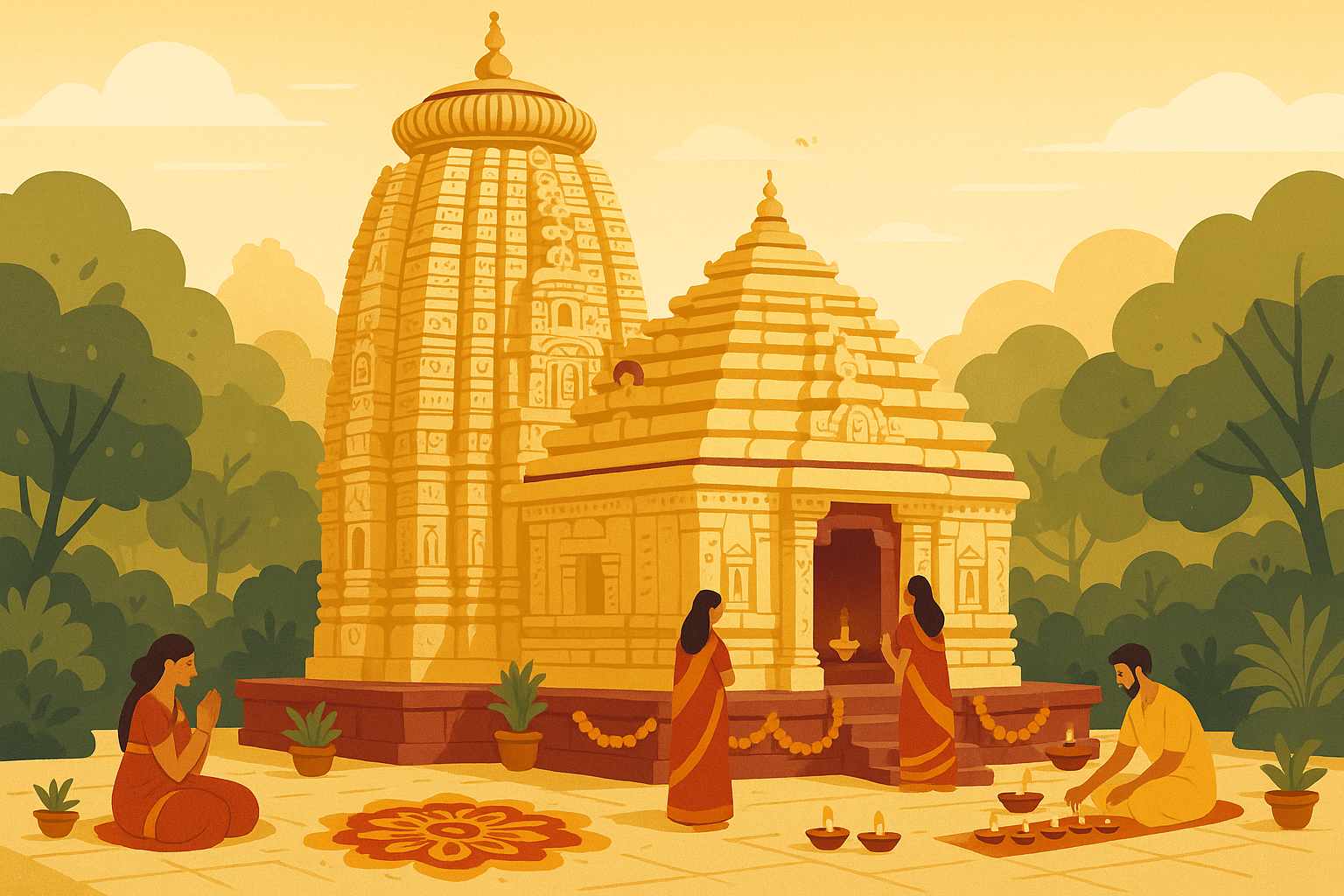
Tirthesvara Siva Temple is a small, west-facing living Shiva temple in Talabazar, Old Town Bhubaneswar, Odisha. It stands on the left side of the road leading from Bindusagar to Lingaraj Temple. IGNCA's archaeological-site documentation dates it on architectural grounds to the fourteenth century, in the latter part of Ganga rule.
The temple is important not because it hides a sensational “mystery,” but because it joins living worship with a compact example of Kalinga architecture. Its documented condition also shows the pressures faced by lesser-known heritage within a dense modern city.
Identity and location
The official site record identifies the monument as Tirthesvara Siva Temple, Talabazar, Old Town, Bhubaneswar, Khurda district. It gives coordinates near 20°14′36″N, 85°50′10″E and describes the approach from Bindusagar toward Lingaraj Temple.
That location is useful because Bhubaneswar contains many Shiva temples with similar names. A visitor should confirm the Talabazar site rather than assuming every “Tirtheswar” map pin, shrine or search result refers to this monument.
Do not confuse Tirthesvara with Kotitirthesvara
IGNCA's Khurda inventory lists Tirthesvara Siva Temple and Kotitirthesvara Siva Temple as separate sites. Their similar names and Old Town setting make online conflation easy.
Tirthesvara is the Talabazar temple on the Bindusagar–Lingaraj route discussed here. Any claim about a tank, street, festival, architecture or deity should be checked against the correct site record before being copied.
What the official documentation establishes
- Period: fourteenth century CE, latter part of Ganga rule, based on architectural features.
- Use: a living temple with a Shiva linga set within a circular yonipitha.
- Orientation: west-facing.
- Main parts: a square vimana and rectangular jagamohana.
- Architectural order: a rekha vimana and pidha jagamohana in the Kalinga tradition.
- Material: sandstone structure with laterite used for the foundation.
- Construction: ashlar dry masonry.
- Later history: subsequently renovated; the exact construction date and architect are not recorded in the inventory.
- Custodianship at documentation: Talabazar Temple Committee.
This evidence does not support confident claims that the temple was built in the eighth, ninth, tenth or eleventh century. Several earlier Bhaktilipi pages gave mutually incompatible dates; the fourteenth-century architectural assessment is the defensible baseline.
Architecture: vimana and jagamohana
Rekha vimana
The vimana is the sanctuary structure housing the presiding linga. The record describes it as square in plan, pancharatha in its vertical projections and panchangabada in elevation. Its curving rekha superstructure belongs to the established vocabulary of Odisha temple architecture.
These technical terms describe form; they do not by themselves identify a precise king, architect or ritual history. Dating comes from comparative architectural study and must remain open to stronger inscriptional or archaeological evidence.
Pidha jagamohana
The jagamohana, or assembly hall, is rectangular and follows the tiered pidha form. IGNCA records a simpler triangabada articulation for this part. Together the two blocks measure roughly 8.06 metres long by 4.30 metres wide, with the recorded height around 7.21 metres.
The compact scale matters. Tirthesvara should not be described as a vast palace-like complex or compared by size with Lingaraj. Its value lies in its form, setting, continuity and place within Old Town's temple landscape.
Material, surface and later change
Sandstone is the principal recorded building material, while laterite forms the foundation. The heritage survey notes cement plaster and an ochre-red wash on the exterior, and states that the temple was renovated later.
Those changes complicate visual reading. A painted or plastered surface may conceal older masonry, and a feature visible today may result from repair. Visitors should not scrape paint, touch carvings, apply substances or remove fragments in an attempt to reveal an “original” layer.
The presiding deity and living worship
The sanctum contains a Shiva linga within a circular yonipitha. The record classifies the temple as in use and notes observances including Chaturdashi, Dahana Chori and Shivaratri.
Living use means the site is not merely an archaeological exhibit. Worshippers, priests and local custodians have priorities that may differ from sightseeing. Photography, entry, footwear, offerings and festival access should follow current local instructions.
Name and meaning
Tirtha can refer to a sacred crossing, pilgrimage place or sacred water context, while ishvara means lord. “Tirthesvara” can therefore be translated approximately as “Lord of the tirtha.” But an etymology is not proof of a particular lost tank, miracle or pan-Indian pilgrimage rank.
The official inventory does not record a foundation legend or a named historical event for the temple. Claims about secret tunnels, miraculous water, an unknown royal patron or uninterrupted rituals for a precisely stated number of centuries should be attributed and verified rather than added as fact.
Historical setting: Ganga-period Bhubaneswar
By the fourteenth century, Bhubaneswar already had a long and varied temple-building history. Tirthesvara belongs to a later phase of that landscape under Ganga rule, not to the earliest surviving temples of the city.
The label “Kalinga architecture” covers development across centuries. Tirthesvara's rekha-and-pidha combination connects it to a regional architectural language, but each temple differs in scale, ornament, patronage, condition and later alteration.
Condition and conservation concerns
The IGNCA survey assessed the temple's condition as fair and recorded signs of deterioration. It reported that the structure was buried up to part of the wall zone and that rainwater entered during the monsoon. Natural factors and urban pressure were identified as threats.
This is a more meaningful heritage story than vague claims about “time revealing secrets.” Drainage, ground level, water penetration, cement repair, traffic and dense construction can affect a small living monument. Conservation must coordinate technical expertise with the temple committee and worship community.
How to visit respectfully
- Confirm the Talabazar location and do not confuse it with Kotitirthesvara.
- Ask locally about current opening, puja and photography rules; no reliable permanent public timetable is established here.
- Remove footwear where directed and dress appropriately for active worship.
- Do not photograph worshippers or rituals without explicit consent.
- Do not touch, lean on, climb or apply oil, vermilion, water or paint to historic fabric unless a designated ritual area and custodian explicitly permit it.
- During rain, expect wet stone, drainage problems and slippery lanes.
- Keep the narrow approach clear and avoid blocking residents or processions.
- Do not fly a drone or use commercial lighting without the required permissions.
- Carry waste away and do not leave plastic offerings.
A careful Old Town route
Tirthesvara can be understood as part of the Bindusagar–Lingaraj sacred landscape. Walk only where access is public and current local rules allow. Lingaraj Temple has its own entry restrictions; a route passing nearby does not guarantee entry to every visitor.
Nearby temples should not be treated as interchangeable examples. Read site-specific records for orientation, period and deity. A slow route through two or three sites is more respectful and educational than rushing through a checklist.
Frequently asked questions
Where is Tirthesvara Siva Temple?
It is in Talabazar, Old Town Bhubaneswar, on the left side of the road from Bindusagar toward Lingaraj Temple.
How old is the temple?
The IGNCA archaeological-site record dates it through architectural features to the fourteenth century, in the latter part of Ganga rule. It does not give an exact construction year.
Is it a Somavamshi temple?
The official documentation used here assigns it to the Ganga period. Earlier or Somavamshi dating should not be stated without stronger site-specific evidence.
What style is the temple?
It has a rekha vimana and pidha jagamohana of the Kalinga architectural order.
Is the temple still active?
Yes. The survey records it as a living temple with a Shiva linga and ongoing observances.
Is Tirthesvara the same as Kotitirthesvara?
No. IGNCA lists them separately. Confirm the site name and location before using information or directions.
Are official opening hours available?
No stable official timetable was found in the consulted heritage record. Ask the local temple committee and respect worship schedules.