
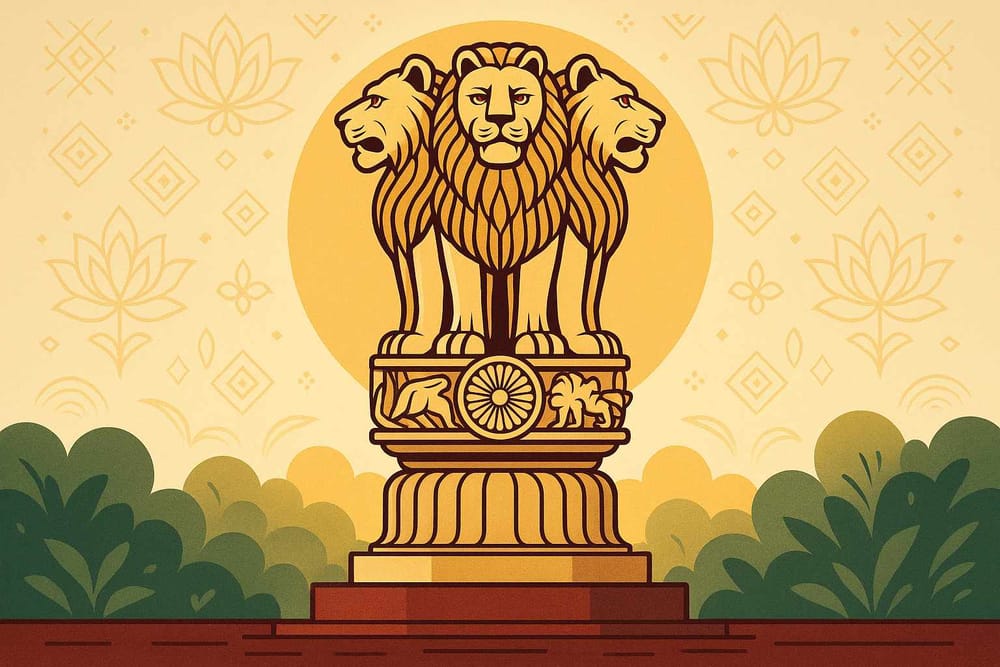
The Significance of the Lion Capital of Ashoka: Explores Indian History
Have you ever paused for a moment, holding a currency note or looking at your passport, and truly looked at the four lions standing so majestically? That symbol, the Lion Capital of Ashoka, is something we see almost every day. But how often do we think about its story? It’s not just a design; it’s a powerful whisper from our past, a reminder of our nation’s soul, carrying tales of a great emperor, a profound spiritual awakening, and the very ideals that form the bedrock of India.
This isn't just a historical artifact; it's a piece of our collective identity. Let's journey back in time together and uncover the profound meaning behind this timeless symbol.
A King's Change of Heart: The Birth of a Legacy
The story of the Lion Capital begins with one of ancient India’s most formidable rulers, Emperor Ashoka of the Mauryan Empire. His reign wasn't always about peace. After the brutal Kalinga War, the sight of immense suffering transformed him completely. Ashoka put down his sword and embraced Buddhism, dedicating his life to 'Dhamma'—the path of righteousness, compassion, and non-violence.
To spread this message far and wide, he commissioned the creation of magnificent pillars across his vast empire. These weren't just pillars of stone; they were pillars of principle. Crafted from highly polished sandstone by the masterful artisans of his time, they stood as beacons of his new vision. The most iconic of these was crowned with the Lion Capital at Sarnath, the very place where Lord Buddha gave his first sermon after attaining enlightenment. It was a message in stone, a declaration of peace over war, and of moral duty over conquest. For a deeper dive into its origins, you can explore the complete history and significance of the Lion Capital of Ashoka.
Decoding the Symbolism: Every Carving Tells a Story
The Lion Capital is a masterclass in symbolism, where every element has a deep, spiritual meaning. It’s a visual representation of universal law and moral order.
- The Four Majestic Lions: Standing back-to-back and facing the four cardinal directions, the lions are the most striking feature. They aren't just symbols of power and courage; they represent the Buddha's teachings (the "lion's roar") spreading in every direction, fearlessly and universally. They embody the sovereignty of Dharma over the entire earth.
- The Circular Abacus: Below the lions rests a circular base, or abacus, which is just as significant. It features four animals carved in exquisite detail: a galloping horse, a majestic bull, a powerful lion, and a serene elephant. These animals are often interpreted as guardians of the four directions or as symbols representing different phases of Lord Buddha's life.
- The Dharma Chakra (The Wheel of Law): The very centre of our national flag, the Dharma Chakra, is a prominent feature on the abacus. This wheel represents the eternal cycle of 'Dharma'—moral law and righteousness. It signifies constant movement and progress, reminding us that truth and justice must always prevail. The profound meaning behind these elements is a study in itself, and you can learn more about the symbolism of the Lion Capital of Ashoka explained on our platform.
From Ancient Art to Modern Identity: A Timeless Emblem
The Lion Capital is a stunning example of Mauryan artistry, showcasing a level of skill that continues to mesmerize historians and artists. The lustrous polish on the sandstone, a technique that has baffled experts for centuries, speaks volumes about the advanced craftsmanship of ancient India.
But its importance goes far beyond art. On 26th January 1950, when India became a republic, this powerful symbol was officially adopted as our National Emblem. It was chosen because it perfectly encapsulates the values of a newly independent nation: strength, justice, courage, and truth. The motto inscribed below it, "Satyameva Jayate" (Truth Alone Triumphs), further anchors it to our core civilizational values.
Every time we see it on government buildings, official documents, or our currency, we are reminded of our rich heritage and the moral principles that should guide us. It connects every Indian, from a small village to a bustling city, to a shared history and a collective dream of a just and compassionate society.
Exploring symbols like the Lion Capital helps us connect with our roots. At Bhaktilipi, we are dedicated to this very mission. We strive to preserve and share timeless devotional literature and stories that form our cultural fabric. By making these accessible, we hope to help you discover the profound wisdom that has guided our civilization for centuries.
Our goal is to digitize and curate these precious texts, so this knowledge is never lost. You can explore our collection of sacred literature and stories on our website, Bhaktilipi.in, and reconnect with our spiritual heritage.
Frequently Asked Questions about the Lion Capital
What exactly is the Lion Capital of Ashoka?
The Lion Capital is a sculpture of four lions standing back-to-back, originally placed on top of an Ashoka Pillar in Sarnath around the 3rd century BCE. It was commissioned by Emperor Ashoka to commemorate the spot where Buddha first taught the Dharma. Today, it stands as the official National Emblem of India, representing the nation's core values.
Why is the Lion Capital so significant in Indian history?
Its significance is immense because it represents a pivotal moment in Indian history—Emperor Ashoka's shift towards peace and Dharma. It is a physical manifestation of his ideals of non-violence, moral governance, and unity. As a symbol of India's rich spiritual and cultural past, it serves as a bridge connecting ancient wisdom with modern aspirations.
Where can we see the original Lion Capital?
While replicas are widespread, the original, magnificent Lion Capital is carefully preserved and displayed at the Sarnath Museum, located near Varanasi in Uttar Pradesh. Seeing it in person is a truly humbling experience, connecting you directly to over two millennia of history.
When was it adopted as India's National Emblem?
The Lion Capital of Ashoka was officially adopted as the National Emblem of India on January 26, 1950. This was a historic day, as it was when the Constitution of India came into full effect, marking the birth of the Republic of India. The emblem was chosen to reflect the nation's commitment to peace and righteousness.
A Symbol That Continues to Inspire
The Lion Capital of Ashoka is far more than just a historical artifact collecting dust in a museum. It is a living symbol of India's identity—our strength, our heritage, and our unwavering commitment to truth. It reminds us that true power lies not in conquest, but in compassion and moral integrity. It is a legacy that every Indian carries with pride, a timeless guide reminding us of the righteous path, both as individuals and as a nation.
Let's continue to cherish and understand the deep meaning behind our national symbols. Join our community at Bhaktilipi to stay connected with the stories that define us.
A passionate group of people dedicated to preserving India's knowledge of Dharma, Karma, and Bhakti for ourselves and the world 🙏.
Comments
Related in
Lion Capital of Ashoka-India's Heritage Explained
Have you ever held a coin in your hand or looked at your passport and truly seen the four lions seated majestically back-to-back? It’s a sight so familiar to us Indians, a part of our daily lives. But this isn't just a design; it's a
The Historical Significance of the Lion Capital of Ashoka: Understand its Enduring Legacy
There are some symbols that are etched into the very soul of a nation. For us in India, the Lion Capital of Ashoka is one such powerful emblem. We see it on our currency notes, on our passports, and on every official government letterhead. But have you ever paused to
Lion Capital of Ashoka-Symbolism Explained
How many times have we held a coin in our hand or looked at a government document and seen those four majestic lions, standing proud and strong? It’s a sight so familiar, it feels like a part of our own identity. But have you ever paused to think about