
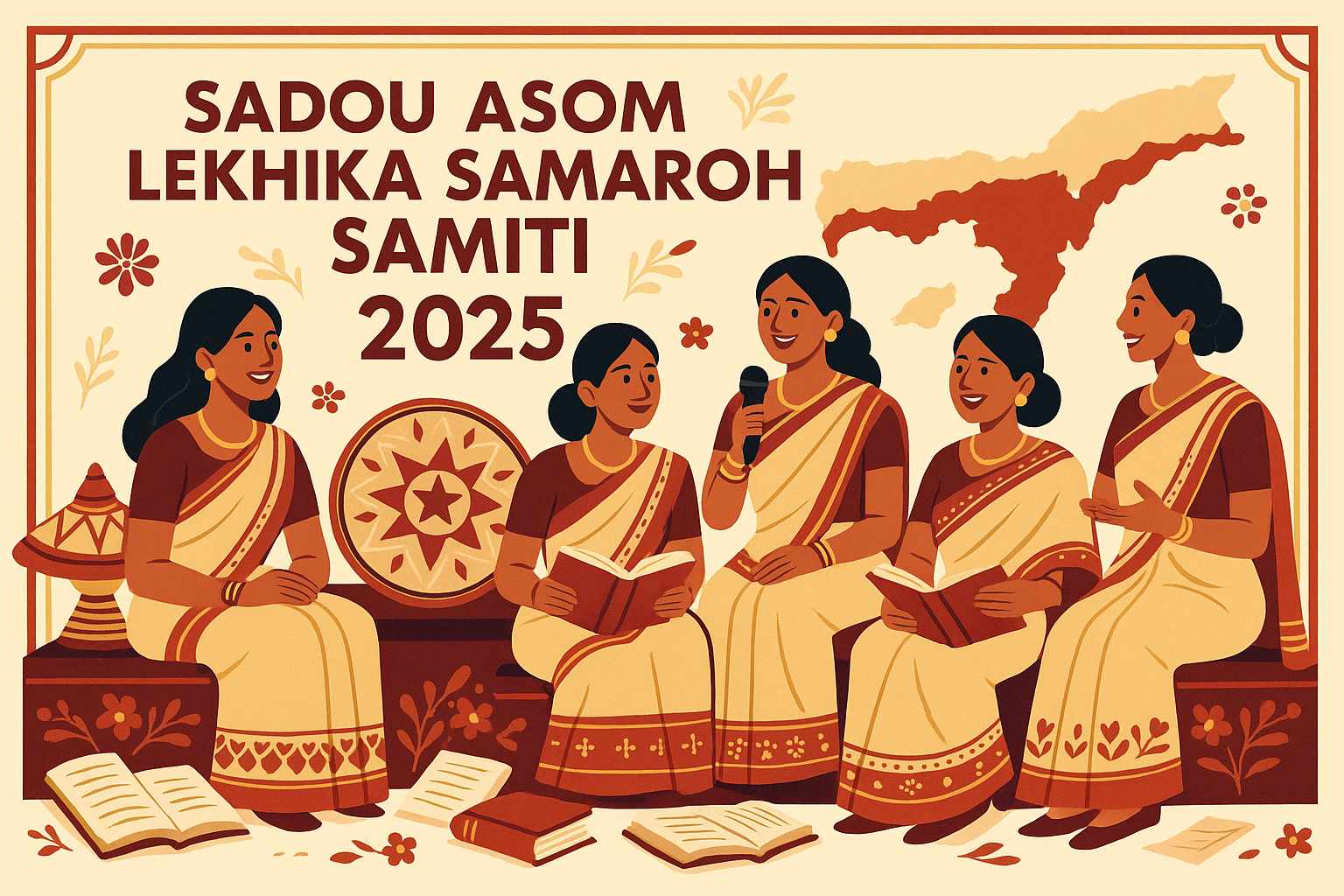
Sadou Asom Lekhika Samaroh Samiti is a women’s literary organisation founded at Tezpur in 1974. It created a statewide forum where women could write, publish, meet and take part in Assamese literary and cultural life. Founder Sheela Borthakur described this work as creating an atmosphere in which women, including writers outside established urban circles, could develop and share their voices.
The organisation is also rendered in English as the All Assam Women Writers’ Association or All Assam Women Writers’ Conference. Transliteration varies—Sadou or Sodou, Samiti or Samity—but these forms refer to the same body.
How the Samiti began
Historical reporting places its beginning in Tezpur in November 1974. Sheela Borthakur, then teaching at Darrang College, proposed a separate literary organisation for women at a local meeting. An archived account from the organisation dates the establishing meeting to 2 November 1974.
The first convention followed at Hem Barua Memorial Hall in Tezpur on 4–5 January 1975. The timing mattered: the United Nations had designated 1975 International Women’s Year, and debates about women’s education, public participation and creative work were gaining new institutional attention.
The Samiti did not appear from nowhere. Women had long contributed to Assamese oral traditions, reform movements, education and print. The new body provided a durable organisational network for work that had often been scattered or insufficiently recognised.
Sheela Borthakur’s role
Sheela Borthakur was the founder president and a long-serving organiser. Contemporary profiles describe her aim as helping women at the grassroots discover the power of writing and intellectual exchange. She viewed an organisation as a way to create opportunity and confidence, not as a claim that writers could be manufactured by committee.
It is more accurate to call her the founder or founder president than to attribute the organisation vaguely to “a few unnamed visionary women.” Other participants, office bearers, branch organisers, editors and members were essential to turning the proposal into a continuing institution.
What the organisation set out to do
An archived statement of the Samiti’s aims lists four connected priorities:
- support women’s education, culture and self-respect;
- develop self-expression through creative work;
- contribute to Assamese language, literature and culture;
- publish and preserve writing by women and the wider cultural heritage.
These aims combine literary activity with social organisation. Writing is treated not only as individual artistic achievement but also as a means of education, memory, participation and mutual recognition.
A platform for women writers
The Samiti’s branches and conferences gave emerging and established writers opportunities to read work, discuss literature, edit magazines, release books and meet readers. Local activity matters because a statewide literary culture cannot depend only on occasional events in Guwahati or on writers already connected with major publishers.
Membership does not mean that Assamese women write with one voice. Differences of language, region, community, class, generation and genre remain important. The organisation’s contribution lies in widening the forum, not in reducing women’s literature to a single theme.
Literary work and publications
Reporting on the organisation highlights Lekhikar Jibani, a multi-volume biographical project documenting women writers. Such reference work addresses a basic problem in literary history: authors can disappear from later accounts when their lives, bibliographies and publications are not systematically recorded.
Branches also produce magazines, poetry, fiction, essays and local commemorative publications. The exact catalogue changes over time, so broad claims about “thousands of books” should not be made without a dated institutional bibliography.
Conferences, seminars and collaboration
Conferences connect branch-level activity with wider literary discussion. They may include readings, lectures, book releases, awards, organisational meetings and debates about women’s social and economic concerns.
The Sahitya Akademi’s official annual reports document collaboration with the Samiti. A 2018 symposium in Tezpur addressed comparative literature, and a 2022 programme in Guwahati examined women writers’ contributions to Assamese literature. These records show continuing institutional work rather than only a historical legacy.
Branches and local literary life
Early-2000s reporting described more than 200 branches in Assam and some outside the state. An archived organisational statement from 2012 claimed a network of more than 360. These figures belong to different dates and definitions; they should not be presented as a verified current total.
What can be said confidently is that the branch structure remains active. Recent Assam reporting records local meetings, new branch formation, poetry-book releases, memorial awards and planning for branch conferences. A branch can provide a regular literary space that a biennial statewide conference alone cannot.
Preserving culture without freezing it
The Samiti’s work is often described as preserving Assamese culture through folklore, memoir, biography, poetry and fiction. Preservation here should not mean treating culture as a fixed collection of nostalgic images. Women writers also record change, disagreement, work, migration, language, violence, aspiration and ordinary life.
Literature preserves culture most honestly when writers can question inherited norms as well as celebrate them. A women’s literary organisation can therefore hold both continuity and critique.
Women’s writing and Assamese literary history
Separate organising can respond to unequal access to publication, public platforms and historical recognition. It does not imply that women’s writing exists outside Assamese literature. The stronger claim is the opposite: Assamese literary history is incomplete when women’s work is marginalised or remembered only through a few famous names.
Biographical documentation, local magazines and conferences help build the archives from which future histories are written. Their impact is gradual and institutional rather than a single dramatic event.
Awards and remembrance
Branches and central bodies use awards and memorial programmes to recognise writers, artists and organisers. Reporting has documented the Aideu Handique award and a commemorative award for good organisers associated with founder Sheela Borthakur’s memory.
Award names, schedules and office bearers can change. Readers seeking current nominations or event dates should consult the relevant branch or central organisation rather than relying on an undated summary.
What can be verified—and what needs caution
- Well supported: the organisation began in Tezpur in 1974; Sheela Borthakur was its founder president; it works through conferences and branches; it promotes women’s literary participation and publication.
- Date-sensitive: branch counts, current office bearers, award schedules and forthcoming conferences.
- Too broad without evidence: claims that women had no earlier place in Assamese literature, that one body single-handedly preserved Assamese culture, or that every branch follows identical programmes.
Careful wording respects the organisation more than inspirational exaggeration does.
Why the Samiti still matters
The Samiti demonstrates that literary life depends on infrastructure: meeting spaces, editors, branch organisers, archives, readers and institutions willing to collaborate. Talent matters, but so does sustained access to a public.
Its continuing branch activity also shows how a literary organisation can operate beyond a single generation. The most useful measure of its legacy is not a slogan about empowerment; it is the accumulated record of women writing, publishing, documenting one another and maintaining local literary communities.
Frequently asked questions
When was Sadou Asom Lekhika Samaroh Samiti founded?
It was established at Tezpur in November 1974. Its first convention was held on 4–5 January 1975.
Who founded it?
Writer, educator and social organiser Sheela Borthakur proposed the organisation and served as its founder president.
What does it do?
It supports women’s creative expression through branches, conferences, publications, literary discussions, documentation, awards and cultural programmes.
Is it only for established authors?
Its historical purpose includes creating opportunities for emerging and grassroots writers, though membership and participation procedures should be checked with the relevant branch.
How many branches does it have?
Historical sources report hundreds of branches, but totals vary by date. A current number requires confirmation from the organisation.