
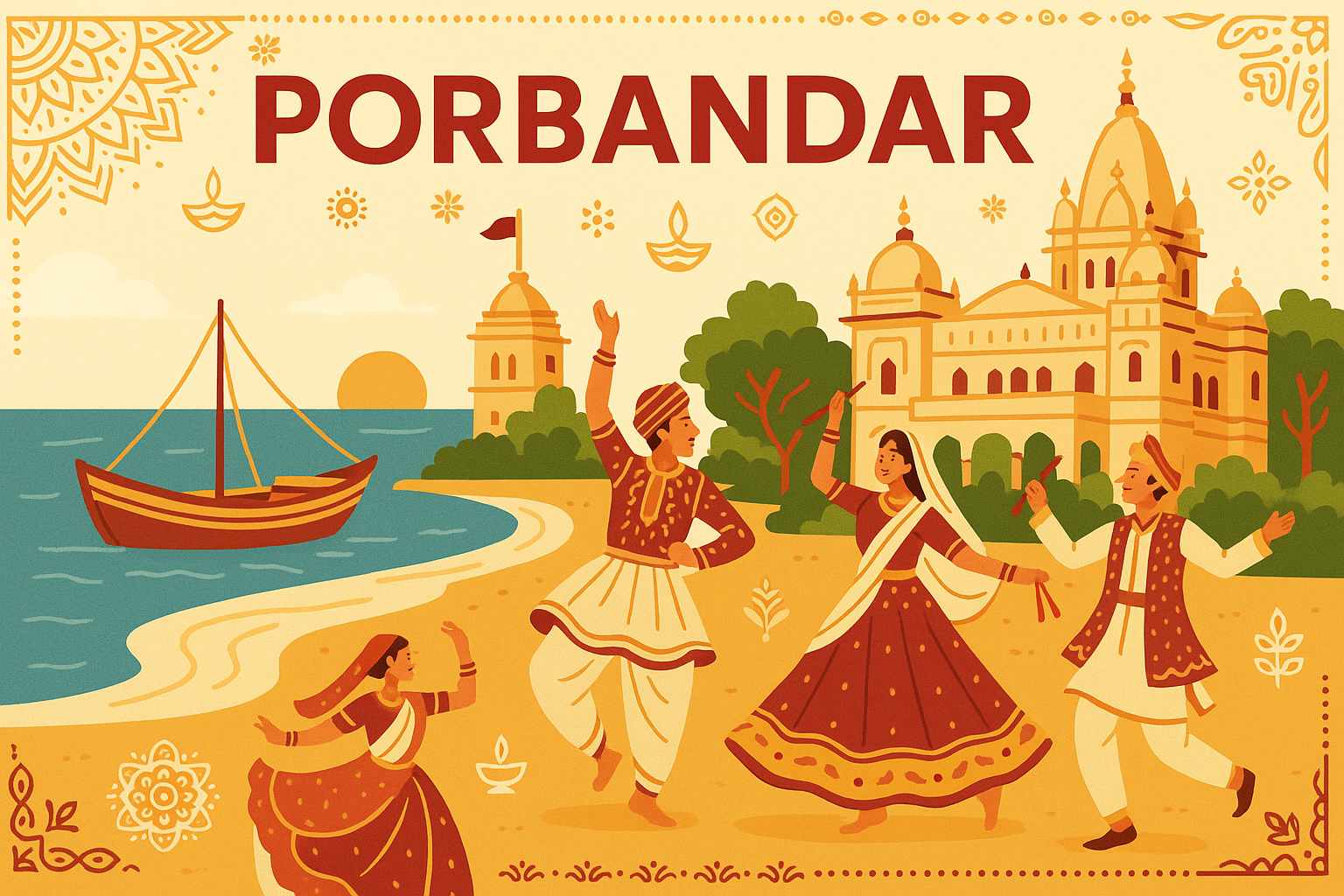
Porbandar is a port city on Gujarat’s Saurashtra coast, known above all as the birthplace of Mohandas Karamchand Gandhi. Its identity also includes the memorial to Gandhi and Kasturba, a long Jethwa princely history, the devotional association with Krishna’s friend Sudama, stone architecture, fishing and maritime life, coastal public spaces and urban bird habitat.
A useful guide separates documented history from sacred tradition and current visitor information. It also avoids treating the city as only a stop between Dwarka and Somnath.
Gandhi, Kasturba and Kirti Mandir
Mohandas Gandhi was born in Porbandar on 2 October 1869. His family’s ancestral house stands beside Kirti Mandir, a memorial dedicated to Gandhi and Kasturba Gandhi. The Official Porbandar district portal confirms the relationship between the memorial and birthplace.
The house and memorial are related but not identical: the ancestral residence is the birth site, while Kirti Mandir is the later commemorative building. The Ministry of Tourism guide describes exhibits and photographs tracing Gandhi’s life.
Calling the site a place where the ideals of nonviolence were “born” is poetic, not historical proof. Gandhi’s ideas developed through family, religion, education, legal work, South Africa, political struggle and many intellectual relationships.
History, tradition and evidence
Porbandar was the capital of a Jethwa-ruled princely state and a coastal trading centre. Maritime movement linked Saurashtra with other shores of the Arabian Sea, while political authority, port activity and urban form changed over time.
Tourism accounts sometimes push the city’s history back to the Harappan period without naming an excavation or archaeological report for the modern urban site. Evidence for ancient settlement and maritime exchange in the wider Saurashtra region should not be converted into a precise claim that present-day Porbandar itself was a Harappan port unless a cited archaeological source establishes it.
Likewise, “Sudamapuri” belongs to Porbandar’s powerful sacred and local identity. It should be presented as a traditional association with Sudama rather than a securely dated ancient municipal name verified through one continuous archive.
Sudama Mandir and the city’s devotional identity
Sudama Mandir commemorates the friendship of Krishna and Sudama. Gujarat Tourism dates its construction to 1902–1907 and describes its marble pillars, sculpted shikhara and small stepwell.
The temple’s importance comes from living devotion and the city’s association with Sudama. Describing the friendship narrative as sacred tradition respects its meaning without presenting every episode as archaeologically verified biography.
Jethwa rule and architecture
The Jethwa dynasty ruled the Porbandar region for centuries and left palaces, fortifications, civic buildings and patronage histories. Darbargadh belongs to this royal landscape, while Huzoor Palace reflects a later princely and coastal architectural setting.
Some royal properties may be private, restricted or visible mainly from public space. Their presence in travel articles does not guarantee entry. Visitors should confirm current access locally and respect barriers, residents and photography rules.
Porbandar district’s culture and heritage page notes a strong local preference for building in stone. That is more defensible than repeating the unsourced nickname “White City” as if it were an official historical title.
Port, fishing and coastal life
The port and Arabian Sea are not merely scenic background. Fishing, boats, trade, labour and coastal weather shape everyday life. The Ministry of Tourism’s Porbandar destination page highlights maritime heritage and the contemporary fishing industry.
Visitors should not romanticise working shores as empty leisure space. Follow local safety instructions, avoid obstructing fishing activity, and do not assume that every stretch of coast is suitable for swimming.
Chowpatty and the urban waterfront
Chowpatty is a public seafront near the city, used by residents and visitors for walking and gathering. Conditions change with weather, tides, maintenance and local regulation. Sunset descriptions are subjective; water safety and current advisories matter more than promotional promises of a pristine beach.
Porbandar Bird Sanctuary
The urban bird sanctuary protects a small freshwater habitat used by resident and migratory waterbirds. The Ministry of Tourism lists groups such as flamingos, pelicans, grebes, ducks, cormorants, herons, egrets, ibis and waders, but sightings vary by season and water conditions.
Observe quietly, remain on permitted paths, keep distance from birds and never treat a species list as a guarantee. Current opening arrangements should be checked with the responsible authority.
Places beyond the city centre
The wider district includes religious, natural and archaeological places such as Jambuvan Cave, Barda Wildlife Sanctuary and sites toward Miyani. Madhavpur and its Krishna-Rukmini tradition lie farther along the coast in the wider regional travel circuit, not in central Porbandar.
Travel distances, road conditions, sanctuary entry and temple access can change. Grouping every attraction under “Porbandar” should not obscure whether it is walkable in the city or requires a separate journey.
Culture, festivals and food
Navratri, Janmashtami and other festivals are important in local public and religious life. The district heritage page highlights Mer Dandiya Raas as a recognised cultural form. Practices vary between communities and years, so one tourism description cannot stand for the whole city.
Gujarati and Kathiawadi foods are widely available, alongside coastal cuisines. Articles should avoid promising that particular seafood or dishes will suit every visitor, restaurant or dietary practice; ask about ingredients and preparation.
Planning a responsible visit
- Use official district, monument, sanctuary and transport sources for current hours and access.
- Keep Gandhi’s birthplace distinct from the adjoining memorial building.
- Treat Sudama narratives as living sacred tradition and Jethwa history as a documentary subject.
- Do not enter private palace grounds or photograph people without consent.
- Respect worshippers, fishing work, birds, coastal hazards and waste rules.
- Allow a separate trip for district attractions outside the city centre.
Frequently asked questions
What is Porbandar best known for?
It is internationally known as Gandhi’s birthplace, while its history also includes Jethwa rule, a port economy, the Sudama tradition and a distinctive coastal landscape.
Is Kirti Mandir the exact house where Gandhi was born?
The ancestral house is the birth site; Kirti Mandir is the adjoining memorial dedicated to Gandhi and Kasturba.
Is Porbandar historically proven to be Sudamapuri?
Porbandar has a strong traditional identification with Sudama and a major temple dedicated to him. The sacred association should not be confused with continuous archaeological proof for every ancient-name claim.
Can visitors enter Huzoor Palace?
Do not assume access. Confirm current status locally and respect private or restricted property.