
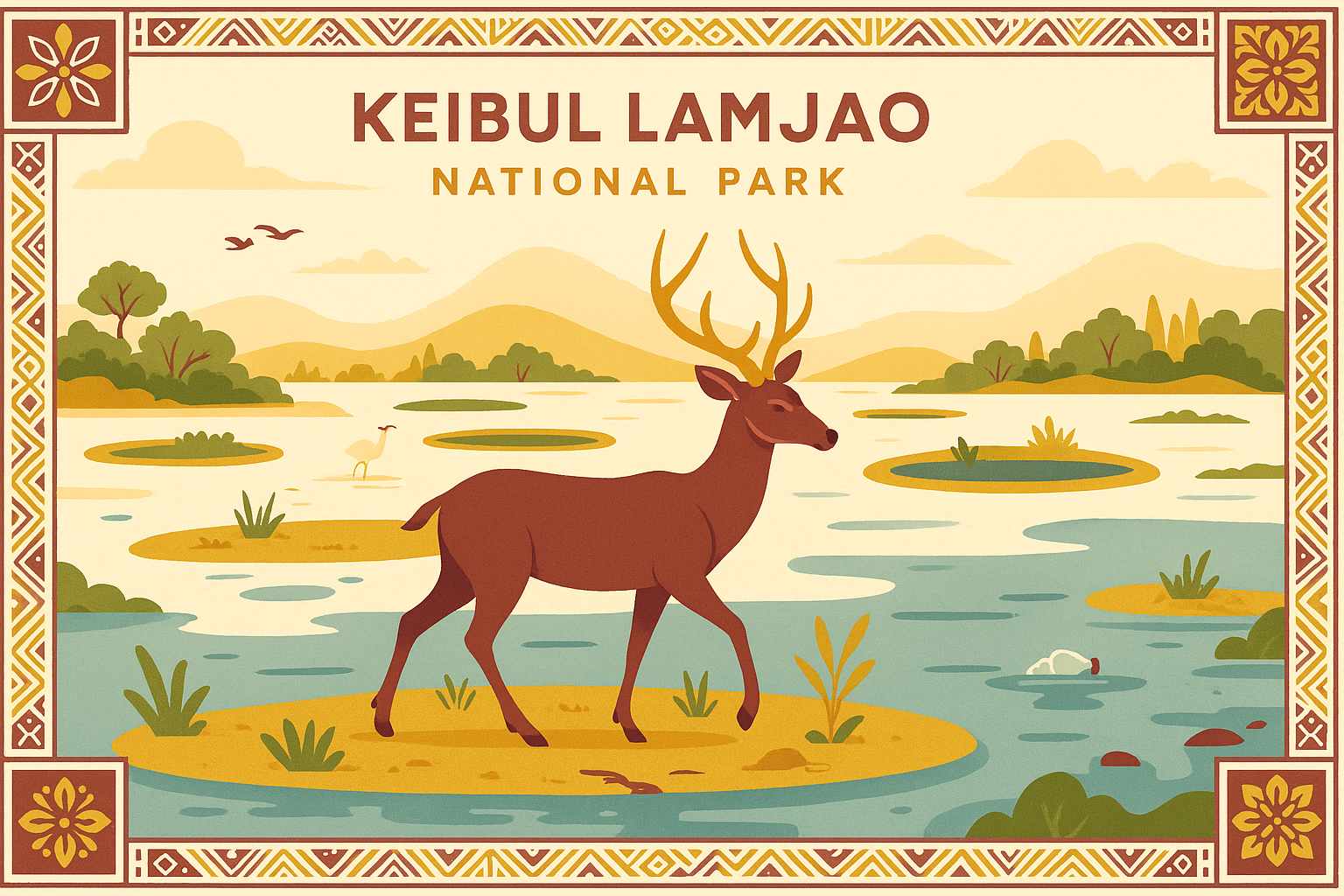
Keibul Lamjao National Park lies in the southern part of Loktak Lake in Manipur. Its best-known habitat is phumdi: floating and semi-floating mats of vegetation, organic matter and soil. These wetland meadows support the last wild population of the Manipur brow-antlered deer, locally called the Sangai.
The park is often called the world’s only floating national park. That memorable phrase is useful if it is explained carefully: the protected area is not a solid island drifting around the lake. Much of its habitat consists of thick, interwoven phumdi, alongside open water and hard-ground features.
Where is Keibul Lamjao?
The park is in Bishnupur district at the south-eastern side of Loktak Lake. Government and Wildlife Institute of India records give its notified area as about 40 square kilometres. Loktak is a Ramsar wetland of international importance and a major ecological and livelihood system for Manipur.
The park cannot be understood in isolation from the lake. Water levels, nutrient movement, fishing, vegetation, infrastructure and community livelihoods across Loktak influence the condition of Keibul Lamjao’s habitat.
What is phumdi?
Phumdi is a Manipuri term for heterogeneous masses of vegetation, decomposing organic material and soil particles. Thickness and composition vary. Some mats are thin and mobile; the more substantial meadows in and around Keibul Lamjao can support grasses, shrubs, wildlife and limited human activity.
Calling phumdi a “floating island” gives a quick visual image, but it can hide the fact that it is living wetland material with changing buoyancy, plant composition and contact with the lakebed.
How phumdi works
Historically, seasonal water-level change allowed substantial phumdi to settle toward the lakebed during low-water periods. In this phase, plants could obtain nutrients from bottom sediments. Rising water then increased buoyancy and lifted the mat.
Wildlife Institute of India research describes this floating-and-sinking cycle as important to phumdi growth and thickness. When water remains artificially high for long periods, mats may not settle and replenish in the same way. Their vegetation and load-bearing capacity can then change.
Why the Sangai depends on this habitat
The Sangai is the Manipur subspecies of Eld’s deer, scientifically named Rucervus eldii eldii. The Manipur Forest Department identifies Keibul Lamjao as its only wild home. The deer uses phumdi meadows for movement, feeding, shelter and breeding.
Its familiar description as the “dancing deer” refers to the impression created by its gait on yielding wet ground. The name should not make the habitat sound playful or effortless: movement across variable phumdi requires adaptation, and thinning mats can reduce safe habitat.
Recovery from a dangerously small population
The Forest Department recounts that the Sangai was considered extinct in 1951 and rediscovered at Keibul Lamjao in 1953. A 1975 count recorded only 14 animals. Protection and monitoring helped the known population increase over subsequent decades.
Census figures are date- and method-specific, so an old number should not be presented as the current population. A larger count also does not remove the risk of keeping an entire wild subspecies in one small, changing habitat.
From sanctuary to national park
Wildlife Institute records describe stages of protection beginning in the 1950s and 1960s. Keibul Lamjao was ultimately notified as a national park in 1977. The notification provided a stronger legal framework for protecting the Sangai and its habitat.
Protected status is essential but cannot by itself control lake-wide hydrology, pollution or every livelihood pressure. Effective conservation therefore requires coordination outside the park boundary.
The hydrology problem
Research links major habitat change to regulation of Loktak’s water regime after the Loktak Multipurpose Project and Ithai barrage. Earlier seasonal drawdown allowed phumdi to settle and renew nutrients. More constant high water can interrupt that cycle, contributing to thinner or less supportive mats.
This is a more precise explanation than saying the park is threatened simply by “climate change” or “tourists.” Climate variability may matter, but water management, catchment processes and infrastructure are direct management questions documented for this ecosystem.
Other pressures
- Catchment degradation and siltation: erosion and incoming sediment alter Loktak’s ecological processes.
- Pollution and nutrient loading: waste and runoff affect water quality and plant communities.
- Invasive or excessive vegetation: water hyacinth and changing plant composition can disrupt circulation and habitat.
- Resource pressure: fishing, plant collection, fuel needs and other uses must be managed with community livelihoods in view.
- Fire and disturbance: burning, noise, waste and poorly controlled visitation can damage habitat or disrupt wildlife.
- Single-population risk: disease, extreme events or habitat failure could affect a large share of the wild Sangai population at once.
Loktak Lake and Ramsar status
Loktak Lake was designated a Ramsar site in 1990. Ramsar recognition concerns the wider wetland, of which Keibul Lamjao is a protected southern component. It does not mean the national park is a separate Ramsar site with unrelated boundaries.
The Indian Ramsar information sheet describes Loktak’s value for flood moderation, water supply, fisheries and livelihoods as well as biodiversity. Conservation decisions therefore involve ecological and human needs rather than an empty “pristine wilderness.”
Keibul Lamjao Conservation Area proposal
India placed the Keibul Lamjao Conservation Area on UNESCO’s World Heritage Tentative List in 2016. The proposed landscape included the national park as a core area and parts of Loktak Lake and Pumlen Pat as a wider buffer.
Tentative listing is not World Heritage inscription. It records a property a country may consider nominating and helps frame future documentation and management; the park should not be described as an inscribed UNESCO World Heritage Site.
Conservation beyond one park
Wildlife agencies have examined establishing or strengthening an additional Sangai population in suitable habitat near Pumlen Pat. The aim is to reduce the risk of relying on one wild population and one ecological site.
Such work requires habitat assessment, genetic and veterinary planning, community consultation, long-term monitoring and protection. Moving deer is not a simple tourism or display project.
Community participation
People around Loktak depend on the wetland for fishing and other resources and hold detailed knowledge of its seasonal behaviour. Conservation that treats residents only as threats misses both rights and practical realities.
The Wildlife Institute and government management reviews emphasise consultation, eco-development and sustainable livelihood work. Participation should be evaluated by its real decision-making and livelihood effects, not merely by counting awareness events.
Other biodiversity
Keibul Lamjao protects more than the Sangai. Its mosaic of phumdi meadow, open water and nearby terrestrial habitat supports wetland plants, fish, reptiles, birds and mammals. The Sangai is a flagship species, meaning its conservation can focus attention and resources on a broader ecosystem.
Species lists vary with survey period and boundary. Visitors should avoid treating an unsourced long checklist as a guarantee of sightings.
Visiting responsibly
Access, opening conditions, boating, viewpoints and seasonal restrictions can change. Check current instructions from the Manipur Forest Department or authorised local managers before travelling, especially during monsoon, fire-risk periods or conservation closures.
- Use authorised routes, boats and guides where required.
- Keep distance from deer and nesting or resting wildlife.
- Do not play calls, feed animals or demand closer approaches.
- Carry waste out and avoid single-use plastic where possible.
- Do not enter phumdi or restricted habitat for photographs.
- Support local services without pressuring guides to break rules.
A Sangai sighting is never guaranteed. Responsible travel values the wetland even when wildlife remains hidden.
Common misconceptions
- The whole park is a free-floating island: it is a protected wetland mosaic with extensive phumdi, water and some hard ground.
- Phumdi is just water weed: it is a complex mass of vegetation, organic material and soil with variable thickness.
- Loktak and Keibul Lamjao are the same boundary: the national park occupies part of the much larger lake system.
- The park is already a World Heritage Site: the conservation area is on UNESCO’s Tentative List.
- A higher deer count means the threat is over: habitat concentration and hydrological change remain serious risks.
- Conservation means excluding all people: lake livelihoods and community participation are central management issues.
Frequently asked questions
Why is Keibul Lamjao called a floating national park?
Because much of its wildlife habitat is formed by phumdi—buoyant mats of vegetation, organic matter and soil within Loktak Lake.
What animal is the park famous for?
The Sangai, or Manipur brow-antlered deer, whose only wild population lives in this habitat.
How large is the park?
Official management sources describe a notified area of approximately 40 square kilometres.
What is the main conservation threat?
There is no single threat, but altered lake hydrology and its effect on phumdi thickness and renewal are fundamental concerns, alongside pollution, siltation, resource pressure and single-population risk.
Can visitors walk on the phumdi?
Visitors should stay on authorised routes and viewpoints. Phumdi thickness varies, habitat is fragile, and entering restricted areas can be unsafe and disruptive.
Sources and further reading
- Manipur Forest Department: protected areas, Sangai and phumdi
- Wildlife Institute of India: protected-area management evaluation
- Wildlife Institute of India repository: Keibul Lamjao habitat research
- Ramsar Sites Information Service: Loktak Lake information sheet
- UNESCO World Heritage Centre: Keibul Lamjao Conservation Area tentative-list record
- Ministry of Environment, Forest and Climate Change: Loktak Ramsar factsheet