
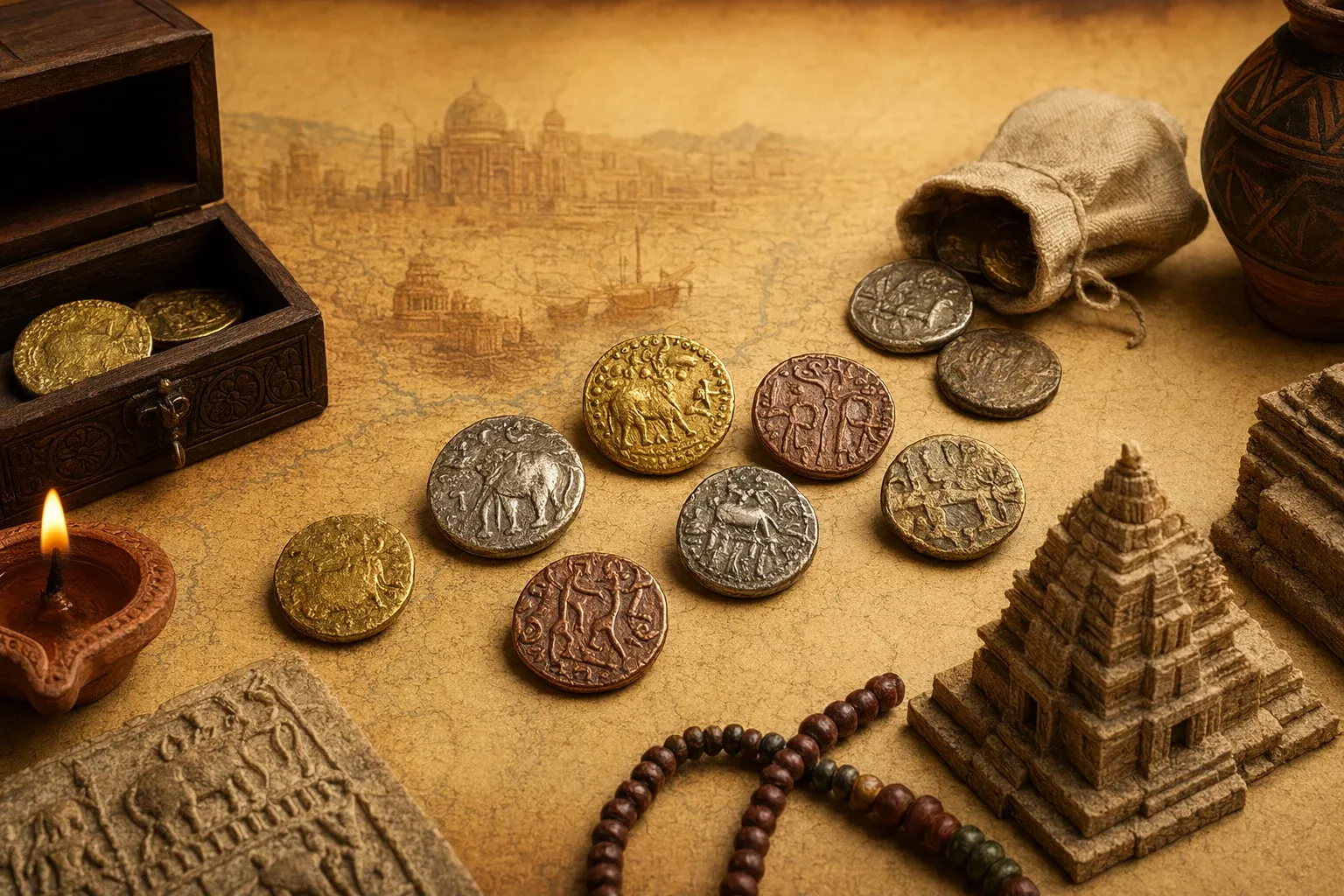
Ancient Indian coins are small, but they can reveal large historical patterns. They may show rulers, symbols, scripts, metals, trade links, religious imagery and political authority. A coin found in one region but made in another can suggest movement of goods, people or influence. A change in metal can hint at economic conditions. A new symbol can show changing public identity.
Still, ancient coins must be read carefully. One coin cannot explain an entire civilisation. It becomes stronger evidence when studied with archaeology, inscriptions, literature, settlement patterns and other coins from the same context.
Kings and authority
Many ancient coins announce authority. Some show ruler names, portraits, dynastic symbols or titles. Others use marks that may be political, religious or administrative. When a ruler places a name or symbol on coinage, the coin travels farther than a palace wall. It carries a message into markets and daily transactions.
This is why coins are useful for reconstructing political history. They can confirm names, suggest territory, show succession or reveal cultural contact. But titles can also be formal or exaggerated, so historians compare coins with other evidence before making strong claims.
Trade and movement
Coins move. They pass through hands, ports, markets, caravan routes and temple economies. Ancient Indian coins can therefore help trace trade networks and contact zones. Finds near ports, urban centres or long-distance routes may support what archaeology and texts suggest about exchange.
Metal sources, weight standards and coin styles can also show wider connections. For example, coins linked to northwestern India may show influences different from coins of the Deccan or far south. This does not mean culture was copied in a simple way. It means coins record contact, adaptation and local choice.
Symbols, scripts and beliefs
Ancient coins often carry symbols that require care: animals, trees, wheels, mountains, deities, rulers, fire altars, geometric marks or calligraphy. A symbol may be religious, political, dynastic or decorative depending on context. Beginners should avoid quick conclusions from one image.
Scripts are equally important. Brahmi, Kharosthi, Greek, Prakrit, Sanskrit and other traditions appear in different coin worlds. Reading a script correctly can change identification completely. If a legend is worn, it is better to say uncertain than to force a reading.
How to appreciate them responsibly
Ancient coins should be handled with respect. Do not clean them, remove patina or buy objects with suspicious origins. Heritage objects need ethical care. If a coin may be from an archaeological site, legal and reporting responsibilities may apply.
The joy of ancient Indian coins is not only in ownership. It is in learning how a small object connects kingship, craft, trade and culture. With patience, coins become quiet witnesses rather than treasure-hunt props.
Learning Indian coins responsibly
The responsible way to learn Indian coins is to treat each coin as evidence before treating it as treasure. A coin may be financially valuable, but its first value is informational: it can show language, authority, exchange, technology, belief, design taste and public memory. This habit keeps the subject interesting without turning it into hype.
Beginners should also remember that India’s coin history is regional and layered. A coin from one region, dynasty or century may follow a very different standard from another. Do not force every coin into one national timeline. Ask where it may have circulated, who issued it, what language or symbol it carries, and what other evidence supports that reading.
Good coin study is slow. Make a small record for every coin you examine: photographs of both sides, weight, diameter, visible date, script, symbol, metal colour, mint mark, edge and condition. If the coin belongs to your family, add the family memory separately and label it as memory, not proof. This protects both emotion and evidence.
It is also important to avoid harmful habits. Do not clean old coins, do not scratch them for metal testing, do not believe dramatic price claims without verification, and do not buy objects with suspicious origins. Coins connected to archaeological sites or protected contexts may involve legal and ethical responsibilities. Respect for heritage matters more than quick ownership.
Finally, connect coins with the wider world around them. Coins become easier to understand when compared with inscriptions, ports, trade routes, scripts, monuments, literature and material culture. That wider view helps a beginner see coins not as isolated collectibles, but as small, durable witnesses to Indian history.
A useful first collection can be very simple. Choose a theme such as one denomination across different years, coins from one family box, commemorative issues, or coins that show different scripts and symbols. Arrange them with notes instead of chasing only expensive examples. This makes learning steady and keeps the focus on observation, not speculation.
If you later ask an expert for help, your notes will save time. Clear photographs, measurements and provenance allow a numismatist to compare the coin more responsibly. They also make it easier to separate a genuine uncertainty from a dramatic but unsupported claim. In a subject full of viral rumours, careful documentation is a quiet superpower.
For Bhaktilipi readers, the goal is simple: learn enough to ask better questions. A coin can be enjoyed as design, handled as family memory, studied as evidence, or preserved for future research. When those uses are kept separate, the article topic becomes practical instead of confusing, and the reader leaves with a safer next step.
Where to go next
To connect coins with wider Indian history, you can also read our ancient port of Kuntasi, Kushano-Sasanian history, and Harappan art and adornments. These links are broader background, not required steps, and they help place coins beside other public historical evidence.