
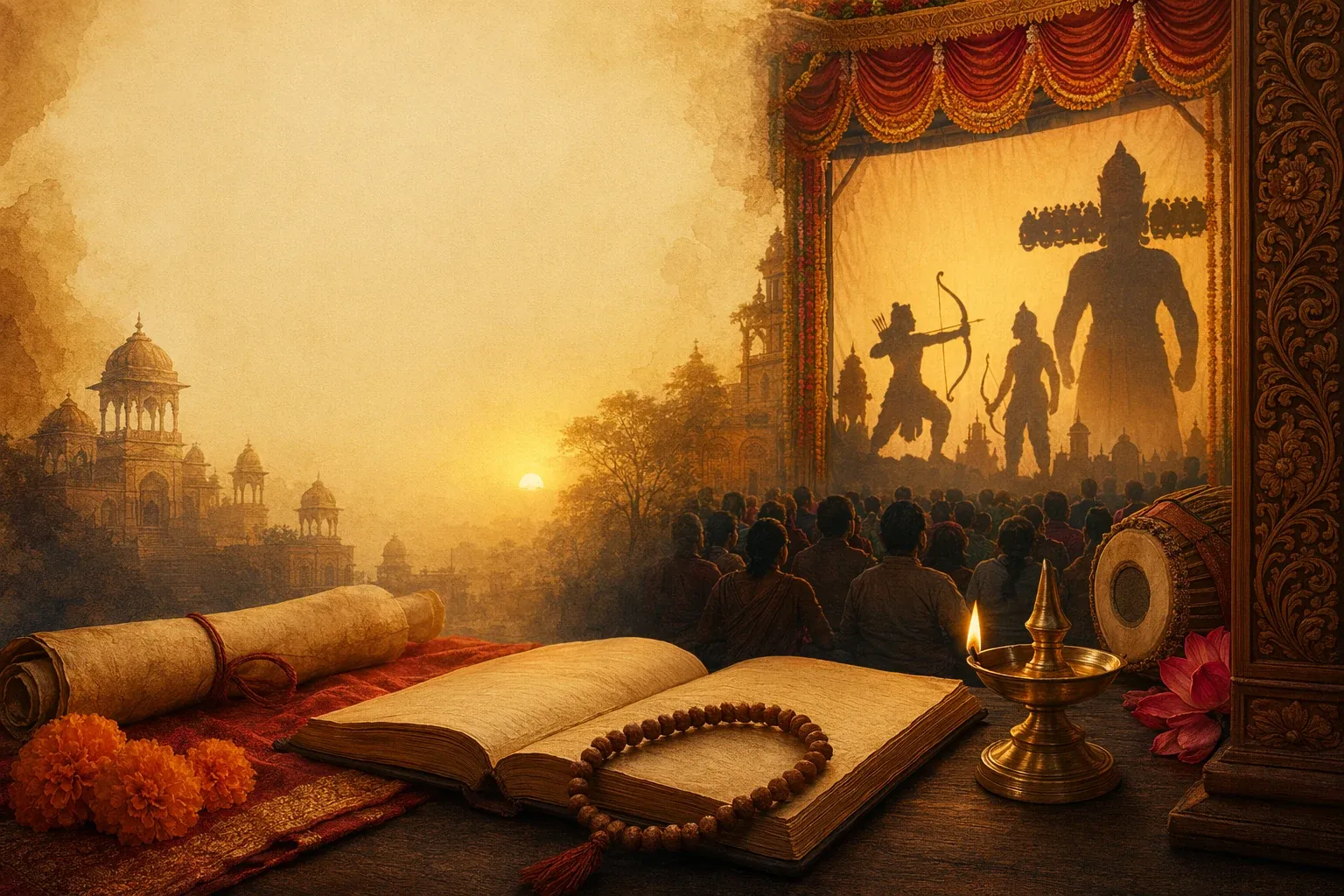
The origin of Ramlila should be explained carefully. The Ramayana story is ancient, but organised Ramlila performance traditions developed through many layers of storytelling, devotion, regional languages, local communities, and festival practice.
Many popular accounts connect North Indian Ramlila strongly with Tulsidas and the Ramcharitmanas. That association matters, but it is better to avoid pretending that one simple date or one single founder explains every Ramlila tradition.
The simple answer
Ramlila was not started in one simple moment everywhere. It grew from Ramayana storytelling, devotional performance, community theatre, and regional traditions, with Tulsidas and the Ramcharitmanas playing a major role in many North Indian memories of Ramlila.
Why Tulsidas is often mentioned
Tulsidas, the great poet-saint associated with the Ramcharitmanas, is often linked with the spread and shaping of Ramlila in North India. Because the Ramcharitmanas made Rama’s story deeply accessible in a popular devotional language, it became central to many performance traditions.
This does not mean every Ramlila in India can be reduced to one origin story. It means that Tulsidas is an important name when discussing the North Indian devotional world in which many Ramlila forms became famous.
Older storytelling and living practice
Before formal stages and modern sound systems, sacred stories travelled through recitation, oral narration, temple gatherings, katha, music, festivals, and local theatre. Ramlila belongs to this larger world of performed memory.
A living tradition can grow slowly. Communities repeat scenes, add local style, preserve beloved dialogues, train younger performers, and adapt to new spaces. History here is not only a list of dates; it is also the memory of practice.
How to speak responsibly about origins
A responsible answer respects tradition without making careless claims. It is fair to say that Ramlila is deeply connected with Ramayana devotion, that many North Indian traditions remember Tulsidas and the Ramcharitmanas, and that local forms developed through community participation.
This balanced answer is more useful than a dramatic claim. It helps beginners appreciate both devotion and history, while leaving room for regional variation and scholarly nuance.
Why Ramlila still matters today
Ramlila still matters because it keeps the Ramayana in public memory without requiring every viewer to begin with a long book. A child may first notice Hanuman’s energy, Ravana’s towering presence, Rama’s bow, or the lights of Dussehra; later, the same child can ask deeper questions about duty, courage, ego, and devotion.
It also protects a community habit of learning together. In a time when culture is often consumed alone on a phone, Ramlila gathers people in one place. Elders explain scenes, young performers learn roles, volunteers serve quietly, and the story becomes something shared rather than only watched.
A simple beginner checklist
When you watch or read about Ramlila, ask five simple questions: which Ramayana episodes are being shown, which local language or style is used, how the performance connects with Dussehra, what values the scene teaches, and how the organisers keep the event respectful and safe.
This checklist helps beginners avoid confusion. Ramlila is not only a date, not only Ravana Dahan, not only theatre, and not only religious ritual. It is a layered tradition where story, devotion, performance, public space, and family memory meet.
How to watch or discuss Ramlila respectfully
Ramlila is a living tradition, so it deserves more care than a quick “stage show” label. Many people attend it with devotion, family memory, and respect for Rama, Sita, Hanuman, Lakshmana, and the wider Ramayana world. Even when a local production looks simple, it may carry years of community effort.
A respectful viewer does not mock accents, costumes, masks, older sound systems, or slow pacing. The audience often knows the story already; they are not only waiting for suspense. They are participating in remembrance, festival atmosphere, moral reflection, and shared cultural memory.
Common mistakes to avoid
Do not reduce Ramlila to only Ravana Dahan. The burning of the effigy is famous, but the larger performance includes exile, devotion, friendship, difficult choices, battle, return, and the victory of dharma over adharma. The meaning becomes richer when the whole arc is remembered.
Do not assume every Ramlila looks the same. Some are dramatic and elaborate, some are devotional and slow, some use local dialects, some are linked with temples, and some are organised in public grounds by neighbourhood committees. Variety is part of the tradition.
Common beginner questions
Did Tulsidas start Ramlila?
Many traditions connect Tulsidas and the Ramcharitmanas with the growth of North Indian Ramlila, but the wider tradition has many layers.
Is Ramlila older than modern theatre?
Its roots are in older forms of storytelling, devotion, public performance, and festival practice, though modern staging has changed over time.
Why is the history hard to give in one date?
Because Ramlila grew through many communities, regions, languages, and performance styles rather than one single recorded event.
Related reading on Bhaktilipi
For more context, read What Is the Ramayana? and How to Read the Ramayana for Beginners on Bhaktilipi.
A calm takeaway
The simple way to understand Ramlila is to see story, devotion, theatre, music, community, and festival life working together. It keeps the Ramayana visible in public memory, especially for children and young readers who may first learn through scenes, songs, costumes, and questions.
A good beginner approach is to enjoy the colour and drama without losing the deeper point. Ramlila asks us to remember courage with humility, strength with restraint, and celebration with respect for the people who keep the tradition alive.