
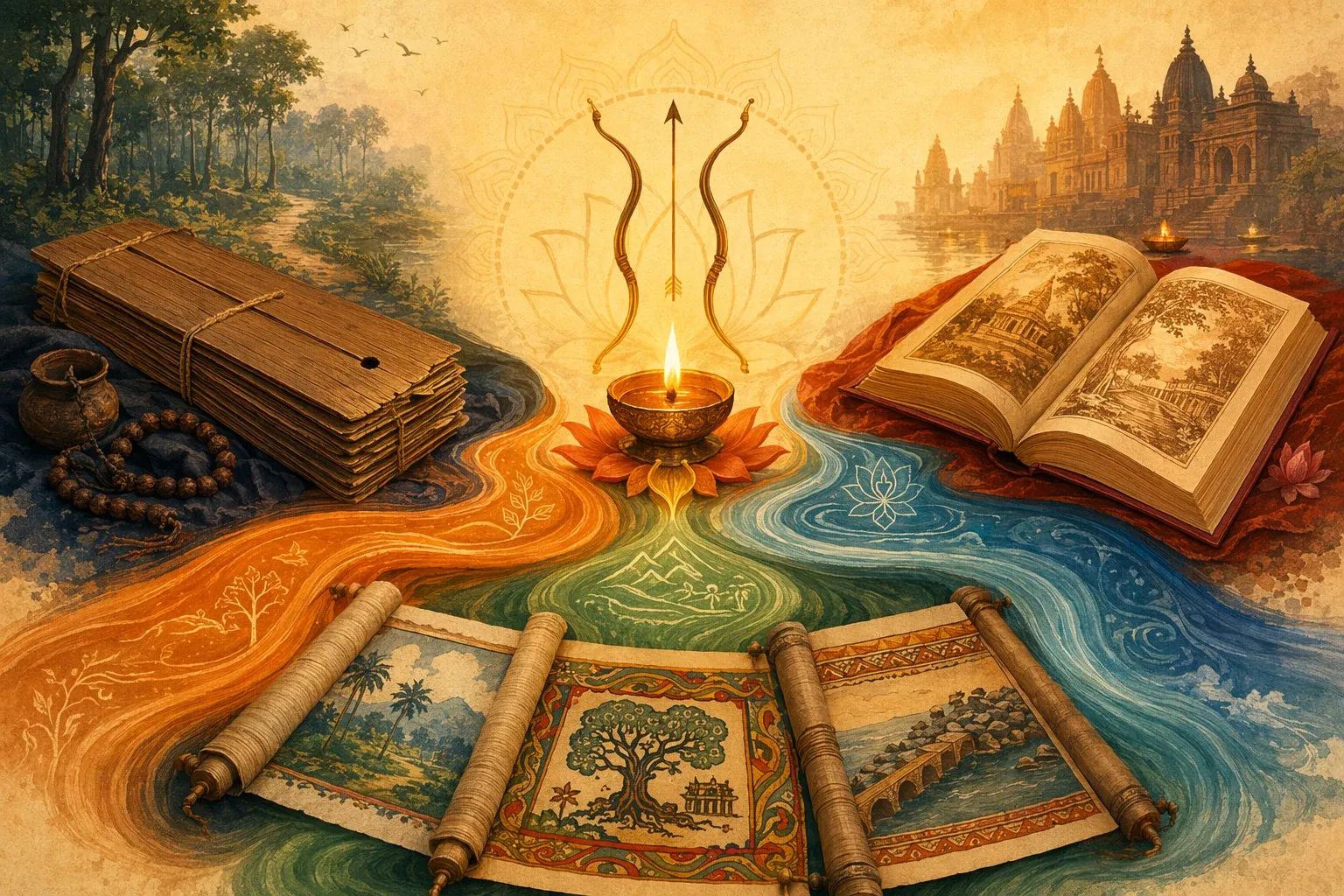
If you searched for 'ramayana and ramcharitmanas', this beginner-friendly Bhaktilipi guide is for you.
Reader questions behind this guide: What is the difference between Ramayana and Ramcharitmanas?; How many versions of Ramayana are there?; Which Ramayana is original?.
We will keep the explanation simple, respectful, and useful, while clearly separating tradition, interpretation, and modern historical discussion where needed.
Quick answer
The Valmiki Ramayana is the classical Sanskrit Ramayana traditionally attributed to Maharishi Valmiki. The Ramcharitmanas is a later Awadhi devotional retelling by Goswami Tulsidas.
Both are deeply respected, but they are not the same text. They differ in language, period, style, theological emphasis, audience, and devotional mood.
Valmiki Ramayana in Sanskrit
The Valmiki Ramayana is usually treated as the foundational Sanskrit epic version of Rama’s story. It has major sections called Kandas and presents Rama’s life in epic-poetic form.
For students, it is important because many later tellings respond to, adapt, translate, or reinterpret the Valmiki tradition.
Tulsidas and Ramcharitmanas
Goswami Tulsidas composed the Ramcharitmanas in Awadhi, a language closer to the people of North India than classical Sanskrit for many listeners of his time.
The Ramcharitmanas is especially beloved for bhakti. It has shaped katha, music, Ramlila, household devotion, and Hindi-region cultural memory.
Kamba Ramayanam and regional tellings
Kamban’s Tamil Kamba Ramayanam is one of the great regional Ramayana traditions. Other Indian languages also have important Rama stories and devotional retellings.
These versions show how India’s unity can work through diversity. The central devotion to Rama remains, while language, poetry, culture, and emphasis change.
Why versions differ
Versions differ because they speak to different communities, languages, devotional moods, and historical moments. Some episodes are expanded, softened, debated, or interpreted differently.
A difference does not automatically mean disrespect. In living traditions, retelling can be a form of love, memory, and teaching.
Which Ramayana is original?
If “original” means the earliest classical Sanskrit epic, beginners usually point to Valmiki Ramayana. If “original” means the version your family recites devotionally, the answer may depend on your tradition.
It is better to ask: what is my purpose—story understanding, Sanskrit study, bhakti reading, regional culture, or comparative learning?
How beginners can choose a legal edition
Start with a reputable translation or a simple retelling, then move toward fuller editions. Use libraries, trusted publishers, official apps, and legitimate stores.
Avoid unauthorized copies and random downloads. Respect for the Ramayana includes respect for translators, publishers, artists, and institutions preserving the text.