
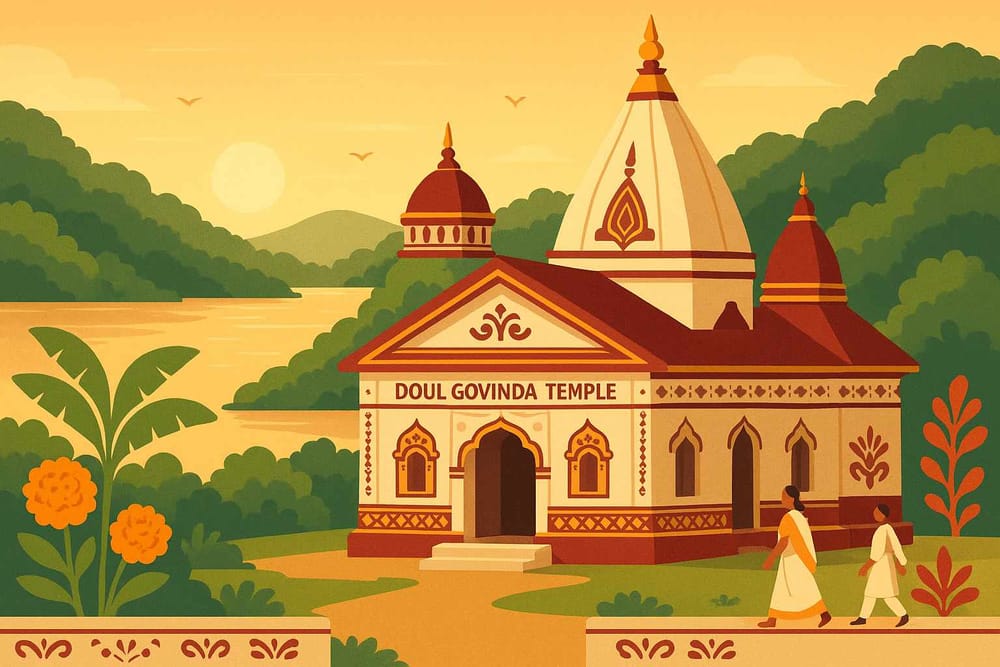
The Sacred History of Doul Govinda Temple: Royal Origins and Legacy
Imagine a gentle hill overlooking the majestic Brahmaputra, a place where a divine secret was once revealed not by a king's grand decree, but by the quiet devotion of a humble cow. This isn't just a story; it's the very soul of the Doul Govinda Temple in North Guwahati, Assam. This sacred space, perched on Chandra Bharati Hill, is more than just a temple; it's a living testament to faith, community, and a miracle that continues to touch hearts even today.
Forget what you might have heard about royal commands and majestic constructions. The story of Doul Govinda is far more personal, far more rooted in the soil of this land. It’s a story that reminds us that sometimes, the most profound spiritual legacies are built not by kings, but by the collective faith of the people.
A Divine Secret Revealed: The Humble Origins of the Temple
The tale begins, as many beautiful Indian legends do, with a cow. A local Brahmin noticed that one of his cows would wander off into the Sandhyasar forest every day. Curiously, it would always stand over a particular patch of Birina grass and pour out its milk. What was this mystery? Driven by this strange, divine occurrence, the villagers decided to dig at that very spot.
What they unearthed was not gold or treasure, but something infinitely more precious: a breathtakingly beautiful idol of Lord Krishna. It was as if the Lord himself had chosen this spot to reveal his presence. A devout man named Ganga Ram Barooah, understanding the significance of this discovery, took it upon himself to bring the idol to the sacred Chandra Bharati Hill, giving Lord Govinda a permanent home. This is why the temple feels so special—it wasn’t planned in a royal court but manifested through a divine sign and the pure devotion of common people. It is truly a "temple of the people."
The Royal Atmosphere, Not a Royal Command
While a specific king didn't build this temple, its story is deeply woven into the spiritual fabric of the time. The region flourished under the Pala kings and later, the Ahom dynasty, who were great patrons of Sanatana Dharma. Their support created an environment where devotion to Lord Krishna could blossom. In fact, archaeological findings hint that this area was once part of Kamrup Nagar, the capital of the Pala kings, connecting it to an ancient and glorious past.
The Ahom rulers, in particular, were instrumental in fostering a deep sense of cultural and religious pride across Assam. Their dedication to preserving our heritage laid the groundwork for spiritual centres like Doul Govinda to become pillars of community life. Exploring the legacy of such great rulers helps us understand the rich historical context in which our faith has thrived for centuries.
The Architecture: A Beautiful Mix of Tradition and Love
The temple you see today is a beautiful blend of history and heartfelt renovation. The original structure, built over 150 years ago with the contributions of countless devotees, was lovingly renovated in 1966. The design is a wonderful example of traditional Assamese architecture meeting modern sensibilities.
- A Serene Layout: The temple complex is designed to bring a sense of immediate peace. It features a sacred sanctum sanctorum (the Garbhagriha), large prayer halls for devotees to sit and immerse themselves in bhajans, and open spaces that allow for a tranquil spiritual experience.
- Artistry in Stone and Brick: The temple walls are not just structures; they are canvases that tell stories. You can find intricate carvings depicting scenes from Lord Krishna’s life—his playful childhood leelas, his divine love for Radha, and his cosmic wisdom. These carvings add layers of meaning to your visit.
- The Heart of the Temple: The idol of Lord Krishna, the very one discovered through the divine sign, is the heart and soul of the temple. Its exquisite artistry is a sight to behold, radiating a sense of peace and divine grace that you can feel deep within.
These beautiful stories, etched in stone and passed down through generations, are the treasures of our culture. At Bhaktilipi, we believe in sharing these timeless tales. If you wish to read more such devotional stories, you can explore our collection on the Bhaktilipi app.
A Living Legacy: Where Faith Comes Alive
The Doul Govinda Temple is not a silent monument; it's a vibrant, living centre of faith. The air here is always thick with prayers, chants, and the fragrance of incense. The temple truly comes alive during festivals, especially Doul Utsav (Holi) and Janmashtami. During Doul Utsav, the entire hill is drenched in colours, music, and celebration. Devotees from all over Assam gather here to play with colours and seek the blessings of Lord Govinda. It’s a joyous spectacle that beautifully captures the spirit of devotion and community.
Answering Your Curiosities About Doul Govinda Temple
Many of us have questions about this sacred place. Let's explore some of them together.
So, who really established the Doul Govinda Temple?
The temple wasn't built by a single royal figure. Its true founders were the local community and a devotee named Ganga Ram Barooah, who were inspired by the miraculous discovery of Lord Krishna's idol. It was their collective effort and faith that gave the Lord his home on the hill.
What is the most significant festival celebrated here?
Without a doubt, it is the Doul Utsav, celebrated during Holi. It is a grand, multi-day festival filled with vibrant rituals, cultural programs, and joyous celebrations. This festival attracts thousands of devotees, making it a cornerstone of the Vaishnavite tradition in Assam.
What makes this temple so unique?
Its uniqueness lies in its origin story. It is a temple born from a divine sign and built by the people. This, combined with its serene location on a hill by the Brahmaputra, creates a deeply spiritual and peaceful atmosphere that feels very personal and welcoming to every visitor.
How does the temple connect to Assamese culture?
The temple is a cultural and spiritual hub for the region. Its festivals, rituals, and architectural style are all deeply intertwined with Assamese traditions. It stands as a proud symbol of the state's rich Vaishnavite heritage and the unwavering faith of its people.
Honor the Legacy, Feel the Connection
The Doul Govinda Temple is a timeless symbol of how faith can bring a community together to create something truly beautiful. Its story reminds us that divinity can be found in the simplest of things and that the strongest foundations are built with love and devotion.
Whether you visit in person to seek blessings or simply learn about its history from afar, you become a part of its living legacy. Preserving and cherishing such sacred places ensures that the stories of our faith continue to inspire generations to come.
About Bhaktilipi
At Bhaktilipi, we are dedicated to being your trusted companion on your spiritual journey. We bring you authentic devotional literature and timeless stories that connect you to the heart of India's rich spiritual traditions.
Why Choose Bhaktilipi?
We provide meaningful insights into devotional practices, temple histories like that of Doul Govinda, and rituals that inspire and educate. We strive to bring the sacred knowledge of our ancestors to your fingertips in a way that feels personal and genuine.
Stay Connected with Our Community
To continue exploring India's sacred traditions, subscribe to our newsletter and follow our journey on social media. Let’s keep the flame of devotion burning brightly together!
A passionate group of people dedicated to preserving India's knowledge of Dharma, Karma, and Bhakti for ourselves and the world 🙏.
Comments
Related in
Doul Govinda Temple FAQs: Get Answers Now
There are some places where you don't just go, you arrive. The journey itself becomes a part of the darshan. Imagine a gentle ferry ride, the vast, calming expanse of the Brahmaputra River around you, and the first glimpse of a serene temple nestled on the northern bank.
The Sacred Legacy: Doul Govinda Temple's History Emerges
Imagine standing on the gentle slopes of Chandra Bharati hill in North Guwahati, with the mighty Brahmaputra river flowing peacefully nearby. You can almost hear the soft chanting and the distant temple bells mingling with the river breeze. This is the feeling you get at the Doul Govinda Temple, a
The Divine Legacy: Doul Govinda Temple's History-Significance Explored
There are some journeys that begin long before you take the first step. My trip to the Doul Govinda Temple felt like one of those. It began with the gentle lapping of the Brahmaputra’s waters against the ferry, a rhythmic chant that seemed to calm the soul. As the