
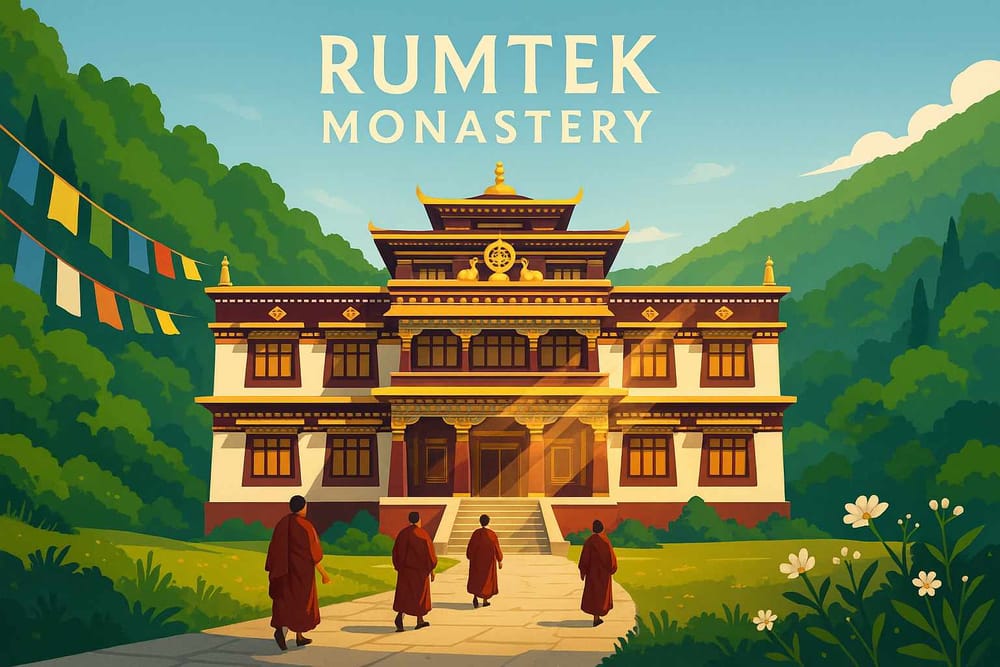
The Sacred Architecture and History of Rumtek Monastery - A 2025 Guide
Some journeys are planned with an itinerary, and some are guided by the heart. My visit to Rumtek Monastery was definitely the latter. As you leave the hustle of Gangtok behind, the winding roads climbing higher into the hills don't just change the landscape; they change something within you. The air gets crisper, the world quieter, and then, nestled against a backdrop of majestic green mountains, Rumtek appears. It’s not just a building; it’s a living, breathing centre of peace, a beacon of Tibetan Buddhism that has stood resilient for centuries.
Perched at an altitude of about 1,500 meters, this sacred gompa is more than just the largest monastery in Sikkim. It is the spiritual home, the main seat of the Karma Kagyu lineage, and a place that holds stories of faith, exile, and rebirth. Let's walk through its hallowed gates together and uncover the layers of its profound history and breathtaking architecture.
The Enduring Legacy of Rumtek: A Tale of Two Monasteries
To understand Rumtek, you need to know its story isn't just one story, but two. The first chapter began way back in the 16th century when the 9th Karmapa, Wangchuk Dorje, established the original monastery. For years, it served as a vital centre for Buddhist teachings. However, time and circumstance led to its decline, and it lay in ruins for a long time.
The second, more recent chapter, is a powerful story of hope. In 1959, after fleeing Tibet, the 16th Karmapa, Rangjung Rigpe Dorje, found refuge in Sikkim. He saw this place and knew it was where the dharma's flame needed to be rekindled. With the support of the Sikkimese royal family and the Indian government, he rebuilt Rumtek in the 1960s, creating an exact replica of his original seat, the Tsurphu Monastery in Tibet. This act wasn't just construction; it was the preservation of a sacred lineage and a culture against all odds.
Exploring the Divine Architecture: Where Every Detail Has a Meaning
Stepping into the Rumtek complex feels like entering another world. The architecture is a stunning example of traditional Tibetan design, a symphony of vibrant colours, intricate woodwork, and profound symbolism. It’s a place where art and spirituality are inseparable.
- The Main Structure: The monastery's main building is a feast for the eyes. Adorned with colourful murals and frescoes depicting deities and mandalas, it houses a large prayer hall. The moment you step inside, the low hum of chants and the scent of butter lamps create an atmosphere of deep reverence. The magnificent golden roof is not just for beauty; it symbolises the crown of the Karmapa, the head of the lineage. This style of sacred building is a hallmark of Himalayan spiritual centres, much like the serene Pemayangtse Monastery, another gem in Sikkim.
- Symbolism in Every Corner: Nothing here is accidental. The layout, the colours, and the motifs all carry deep meaning. You'll find the eight auspicious symbols of Buddhism intricately woven into the design. The entire complex, which includes a monastic college, monks' quarters, and a stupa, is designed to be a mandala—a spiritual map of the cosmos. It’s a reminder that divinity can be found in structure and form, a principle seen in many great Indian temples, including the powerful Kamakhya Temple in Assam.
Seeing these ancient traditions so lovingly preserved reminds one of the importance of keeping our spiritual heritage alive. It’s this very passion that drives us at Bhaktilipi. We believe that by sharing these timeless stories and traditions, we help enrich lives. Explore our collection of devotional literature on Bhaktilipi.in to connect with your roots.
The Golden Stupa: A Heart of Pure Devotion
Within the monastery complex lies a structure of immense spiritual power—the Golden Stupa. This magnificent stupa, adorned with pure gold and precious gems, is not just a work of art. It holds the sacred relics of the 16th Karmapa, making it the spiritual epicentre of Rumtek.
You will see monks and pilgrims circumambulating the stupa, spinning prayer wheels, and chanting softly. There's a palpable energy of devotion here. The stupa serves as a powerful reminder of life’s impermanence and the eternal goal of enlightenment. Standing before it, you can't help but feel a sense of profound peace and humility.
Planning Your Visit to Rumtek Monastery in 2025
If you feel called to experience this spiritual sanctuary, here is some practical information to help you plan your journey.
- Reaching the Monastery: Rumtek is located about 23-24 kilometres from Gangtok. The drive itself is beautiful, taking around 45 minutes to an hour. You can easily hire a local taxi, which will cost you somewhere between ₹800 to ₹1200 for a round trip.
- Best Time for a Visit: The weather is most pleasant from October to May. These months offer clear skies and comfortable temperatures, perfect for exploring the monastery and enjoying the panoramic views of the surrounding valley.
- Monastery Timings: The monastery is generally open for visitors from 9:00 AM to 6:00 PM. However, the prayer hall has specific hours, usually from 6:00 AM to 12:00 PM and then from 3:00 PM to 6:00 PM. If you can, try to attend the morning prayer ceremony around 6:00 AM for a truly magical experience.
Frequently Asked Questions (FAQs) About Rumtek Monastery
Many visitors have questions before they embark on their journey. Here are some answers to help you feel prepared.
The Story Behind Rumtek's Creation
The monastery has a rich history. The original was founded in the 16th century by the 9th Karmapa, Wangchuk Dorje. The magnificent structure we see today, however, was rebuilt in 1966 by the 16th Karmapa, Rangjung Rigpe Dorje, as a new home for his lineage after leaving Tibet.
What to Wear and Photography Rules
As it is a sacred place, it's important to dress modestly. Please make sure your shoulders and knees are covered. Photography is usually allowed in the courtyards and outer areas, but it is strictly restricted inside the main prayer hall and near the Golden Stupa to maintain the sanctity of the space. There might be a small fee of around ₹50 for using a camera.
Festivals and Celebrations at the Monastery
Rumtek comes alive during Tibetan Buddhist festivals. The most significant are Losar (Tibetan New Year) and the annual Gutor Cham dance, held just before Losar. These events are a vibrant display of culture, with monks performing masked dances to ward off evil spirits. Planning your visit around these times offers a truly unforgettable cultural immersion.
Is there an Entry Fee?
Entry to the monastery is typically free for all visitors, allowing everyone to experience its tranquil atmosphere without any barriers.
A visit to Rumtek Monastery is more than just sightseeing; it is an experience that touches the soul. It leaves you with a sense of peace and a deeper appreciation for the timeless traditions that continue to thrive in the heart of the Himalayas.
To stay connected with more such enlightening stories and delve deeper into our shared heritage, follow Bhaktilipi on Facebook, Instagram, and YouTube. Knowing devotion enriches life!
A passionate group of people dedicated to preserving India's knowledge of Dharma, Karma, and Bhakti for ourselves and the world 🙏.
Comments
Related in
Experiencing Peace: Stay at Rumtek Monastery- 2025 Guide
Have you ever felt a longing to switch off the world's noise and listen to the whispers of your own soul? I felt that pull, a deep yearning for silence and spirituality, and it led me to the hills of Sikkim, to the sacred grounds of Rumtek Monastery.
Rumtek's Surroundings-Location Weather Monasteries-Your 2025 Guide
Imagine the whisper of a thousand prayer flags carried on a crisp mountain wind, each one carrying a silent prayer towards the heavens. This is the first feeling that greets you as you approach Rumtek Monastery. It’s more than just a destination; it's an experience that calms
Visiting Rumtek Monastery- Guide to Stays- Spiritual Sites Near You
Imagine waking up, not to the blare of an alarm clock, but to the gentle, soul-stirring hum of monks chanting in the distance. This isn't a dream; it's a reality for those who visit the serene hills of Rumtek in Sikkim. There are some places that