
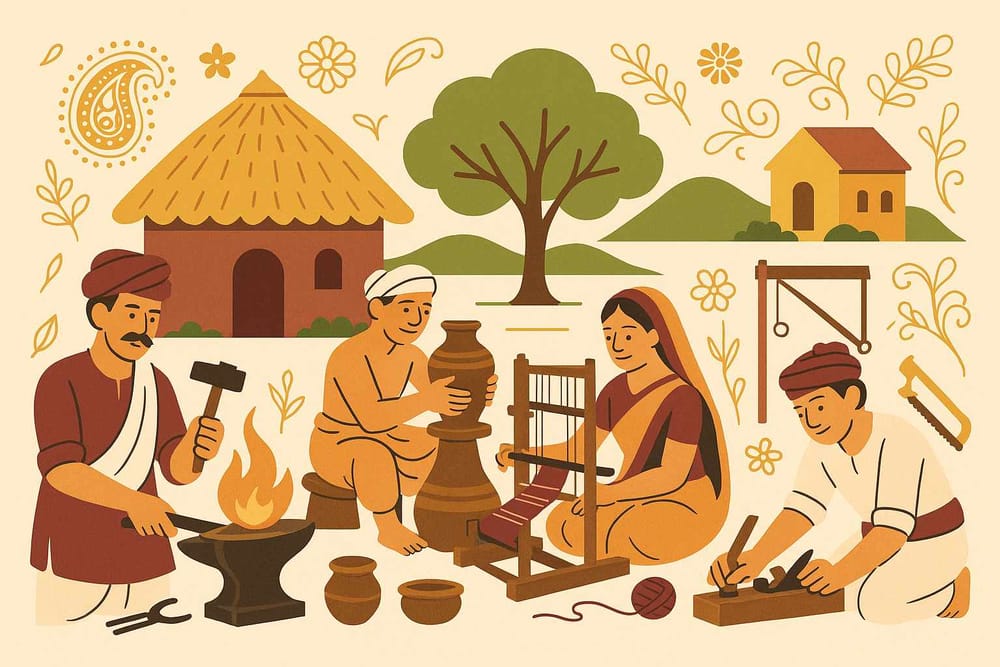
The Role of Bara Balutedar in Traditional Indian Society- Explained
Have you ever paused to think about how our ancestral villages functioned so seamlessly, like a well-oiled machine? Long before the hustle and bustle of modern economies, there existed a beautiful, intricate system that was the very soul of rural life. This was the Bara Balutedar system, a framework of twelve hereditary service providers who formed the backbone of their communities, especially in regions like Maharashtra. It wasn't just a system of work; it was a promise of mutual support, a web of relationships that ensured every family had what they needed to thrive.
Let's take a journey back in time to understand this remarkable social structure, not just as a historical concept, but as a living testament to the Indian ethos of community and interdependence.
The Historical Roots: How the Village Became a Family
The Bara Balutedar system didn't just appear overnight. It grew organically from the soil of medieval India, born out of the necessity for agrarian villages to be completely self-sufficient. Imagine a time when the nearest town was a long journey away. Everything the village needed, from farming tools to spiritual guidance, had to be sourced from within. This system was the practical answer. It assigned specific, essential roles to different communities based on their ancestral skills, ensuring that every crucial task was handled by an expert.
This structure was deeply woven into the fabric of the joint family system and supported by local governance. Each role was passed down from one generation to the next, preserving not just a profession, but a legacy of craftsmanship and knowledge. This hereditary nature created stability, but it also reflected the rigid social norms of that era, binding individuals to their caste-based occupations. It was a world where your work was your identity, and your contribution was your value to the community.
The Twelve Pillars: Roles and Responsibilities of Each Balutedar
The term 'Bara Balutedar' literally translates to 'twelve service providers.' These twelve roles were the pillars that held up the entire village economy and social life. Each one was indispensable, creating a beautiful chain of dependence.
- Sutar (Carpenter) & Lohar (Blacksmith)
These were the engineers of the village. The Sutar crafted wooden ploughs and built homes, while the Lohar forged the iron tools that tilled the soil. Their workshops were the hubs of innovation, directly fuelling the agricultural heart of the community. - Kumbhar (Potter)
The Kumbhar was the artist who shaped the earth into essential vessels. From the large pots (matkas) that stored cool drinking water to the diyas that lit up festivals, their creations were part of daily life and sacred rituals. - Nhavi (Barber) & Parit (Washerman)
These Balutedars took care of the community's personal needs. The Nhavi was not just a barber but also played a key role in important life-cycle ceremonies, while the Parit ensured the village was clad in clean clothes, a symbol of purity and well-being. - Chambhar (Cobbler/Leatherworker)
The Chambhar skillfully worked with leather to create footwear that protected the feet of farmers in the fields. They also made other essential leather goods, showcasing incredible resourcefulness and craft. - Joshi (Astrologer) & Gurav (Priest)
They were the spiritual guides of the village. The Joshi would chart horoscopes and determine auspicious timings for weddings and festivals, while the Gurav took care of the village temple, performing daily worship and maintaining the sacred space. Their guidance connected the villagers to the divine. - Mahar & Mang
These communities held crucial responsibilities for village security and communication. The Mahar acted as village watchmen, messengers, and land arbitrators, while the Mang were skilled in making ropes from natural fibres and often served as musicians during ceremonies, adding life and soul to the celebrations. - Teli (Oil Presser) & Koli (Water Carrier/Fisherman)
These roles were vital for sustenance. The Teli extracted oil from seeds for cooking and lighting lamps, while the Koli managed water transport and provided fish, diversifying the village's food resources.
The Social and Economic Fabric of Village Life
What truly made this system unique was its economic model. It largely operated on a barter system, a world away from today's currency-driven transactions. Instead of being paid in money, the Balutedars received a share of the village's agricultural harvest, known as 'baluta'. This wasn't just a payment; it was a share in the collective prosperity. This fostered an incredible sense of belonging and mutual respect.
The farmer relied on the blacksmith for his tools, the blacksmith relied on the potter for his household pots, and everyone relied on the priest for spiritual peace. This interdependence built strong community bonds that went beyond mere economics. However, it's also important to acknowledge that this system was tied to the social hierarchy of caste, which limited social mobility and created inequalities.
At Bhaktilipi, we believe that understanding these intricate systems helps us appreciate the depth of our traditions. Exploring our past is a way to connect with the values that have shaped us. If you're keen to dive deeper, you can explore the rich cultural history and traditions of systems like the Bara Balutedar with us.
The Fading Echoes: Why the System Declined
With the arrival of British colonial rule, things began to change. Their centralized administration and new legal systems started to erode the autonomy of the self-governing villages. The industrial revolution brought mass-produced goods, reducing the dependency on local artisans. A potter's handmade earthenware now had to compete with factory-made vessels.
Furthermore, social reform movements rightfully challenged the rigid, caste-based nature of these roles, advocating for equality and freedom of choice in profession. The final shift came with the move to a monetary economy. The old barter system gave way to cash transactions, and by 1958, the Bara Balutedar system was officially abolished. Though it no longer exists in its original form, its legacy lingers in the skills, surnames, and cultural practices of rural India.
Understanding the Bara Balutedar System Better
It’s natural to have questions about such a complex and old system. Many wonder what the Bara Balutedar system truly was at its core. Simply put, it was a traditional, caste-based service framework in Indian villages where twelve distinct groups of artisans and service providers supported the community's economy and lifestyle.
People often ask about the specific roles these Balutedars played. They were the very lifeblood of the village, ensuring its day-to-day functioning. From the carpenter and blacksmith who made essential tools to the priest who guided rituals, each one had a specialized and respected role that met a specific need of the community.
Why was this system considered so important for centuries? Its significance lay in how it fostered economic interdependence and social harmony. It created a balanced, self-sufficient society where every profession was seen as a vital contribution to the collective well-being of the village. The functioning was beautifully simple: each Balutedar offered their unique services in return for a share of the harvest or other essential goods, creating a strong, localized economy built on trust rather than currency.
While the system is no longer in practice today, having faded with social reforms and modernization, we can still learn so much from it. The Bara Balutedar system teaches us profound lessons about community collaboration, the inherent value of every profession, and the beauty of living interdependently. It is a powerful reminder that a thriving society is one where everyone contributes and everyone is valued.
Conclusion: A Legacy of Interdependence
The Bara Balutedar system is more than just a chapter in our history books. It is a beautiful and poignant reminder of a time when communities thrived on shared responsibility and mutual respect. While we have moved on to a modern, globalized world, the essence of this system—the idea that we are all connected and dependent on one another—remains timeless. By understanding and honouring this legacy, we pay tribute to the spirit of cooperation that has been the true strength of Indian society for centuries.
About Us
Bhaktilipi is your digital companion for preserving and sharing timeless bhakti literature across regions and languages. We bring authentic devotional stories, texts, and traditions to modern readers in a simple and accessible way. Explore the beauty of India’s rich spiritual heritage with us. Learn More
Stay Connected
For more insightful content that connects you to your roots, subscribe to our YouTube channel, follow us on Facebook, and join us on Instagram. Stay inspired by timeless wisdom delivered right to your screen!
A passionate group of people dedicated to preserving India's knowledge of Dharma, Karma, and Bhakti for ourselves and the world 🙏.