
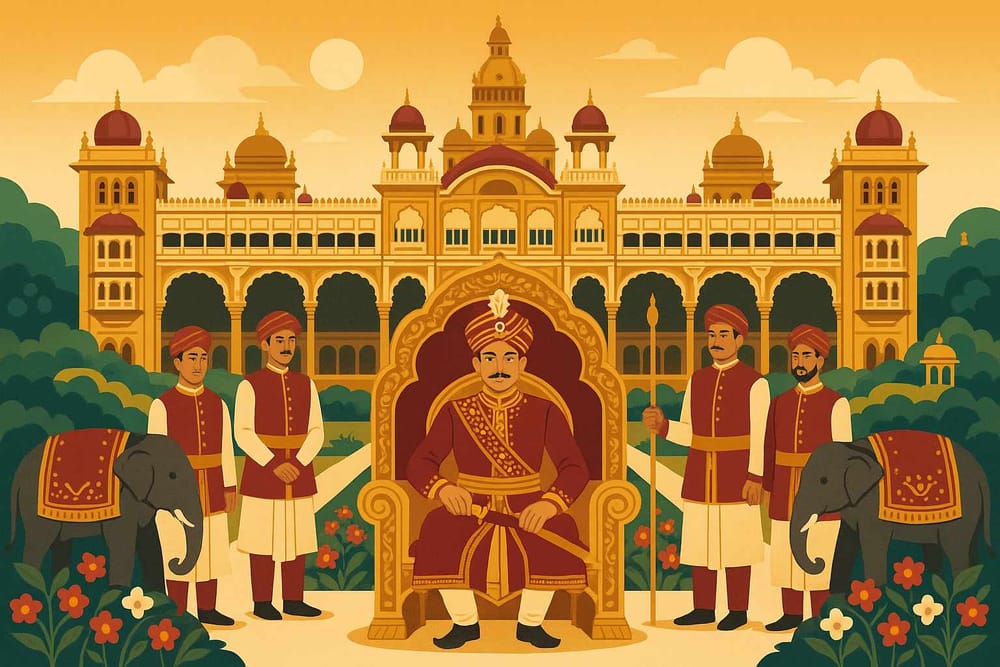
The Majestic Maharaja of Mysore- Legacy and Influence Explained
Close your eyes for a moment and picture this: a palace, not just made of stone and mortar, but shimmering with a hundred thousand lights against the night sky. Imagine the sound of classical Carnatic music filling the air, and a grand procession that tells stories of a history stretching back centuries. This isn't just a scene from a storybook; it's the living, breathing legacy of the Maharajas of Mysore, a dynasty that didn't just rule a kingdom but nurtured its very soul.
For over 500 years, from 1399 to 1950, the Wadiyar dynasty guided the destiny of Mysore. Their story isn't just about battles and treaties; it's a beautiful tale of art, culture, social reform, and a vision that was far ahead of its time. They were more than kings; they were guardians of tradition and architects of a prosperous future.
The Wadiyar Dynasty: More Than Just Rulers, They Were Custodians of Dharma
The journey of the Wadiyars began as vassals of the great Vijayanagara Empire. When that empire began to wane, they rose to establish Mysore as a powerful and culturally rich kingdom in southern India. Their rule was a testament to resilience, even facing a brief period of interruption by Hyder Ali and Tipu Sultan before being restored to the throne.
But what truly sets them apart is their deep-rooted commitment to their people's welfare. Their governance was a masterclass in balancing tradition with progress. This wasn't just royalty; it was a responsibility they carried with immense grace. The cultural landscape they shaped in Karnataka is a vibrant testament to their vision.
A Golden Age Under a 'Raja Rishi'
If one ruler personified the spirit of Mysore, it was Maharaja Nalvadi Krishnaraja Wadiyar IV. He was lovingly called the 'Raja Rishi' or the philosopher-king, a title that perfectly captured his essence. His reign was so just and progressive that even Mahatma Gandhi praised his kingdom as "Ramarajya" – the ideal state.
He wasn't just building a kingdom; he was building a society. He championed social reforms, taking bold steps to ban untouchability and child marriage. He understood that a society can only progress when its women are empowered, and he introduced scholarships for widowed women to help them rebuild their lives. His focus was on creating a state where every citizen felt respected and had the opportunity to thrive.
Weaving a Rich Tapestry of Art, Education, and Modernity
The Maharajas of Mysore were incredible patrons of the arts. The Mysore court became one of the most renowned centres for Carnatic music, attracting the finest musicians and artists from all over the country. They didn't just preserve art; they helped it evolve, commissioning new literary works and supporting traditional crafts that might have otherwise been lost to time.
Their vision for a modern state was equally remarkable. Here are some of the pillars of their legacy:
- Pioneers in Education: The Maharajas believed that education was the key to progress. They made primary education compulsory and established numerous schools and colleges, including the prestigious University of Mysore, ensuring that knowledge was accessible to all.
- Champions of Infrastructure: Long before it was common, they brought modernity to their people. In 1905, thanks to their forward-thinking policies, Bangalore became the first city in all of Asia to be fully electrified using hydroelectric power. This transformed not just homes, but also industries.
- Economic Prosperity for All: They implemented significant reforms in administration, agriculture, and industry. This wasn't about enriching the crown; it was about creating a prosperous state that improved the daily lives of farmers and workers, making Mysore a model for others to follow.
It is truly inspiring to see how the influence of Maharajas has shaped Indian culture far beyond their own kingdoms, leaving behind lessons in governance and patronage.
The Enduring Legacy in Modern Mysore
Even after India's independence in 1947, when the last ruling Maharaja, Jayachamaraja Wadiyar, gracefully ceded his kingdom to the new nation, the royal family's influence did not fade. It simply transformed. Today, the current Maharaja, Yaduveer Krishnadatta Chamaraja Wadiyar, continues to be a respected figure, preserving the city's rich heritage.
This legacy is most spectacularly visible during the annual Dasara festival. The grandeur and traditions of the celebration, with the Maharaja at its heart, are a direct link to the royal past. The Dasara exhibition, started way back in 1880, continues to be a platform to showcase progress and culture, just as the Maharajas envisioned.
The magnificent Mysore Palace, the beautiful Brindavan Gardens, and the countless educational institutions stand as proud monuments to their vision. The Maharajas of Mysore didn't just build structures; they built a future. Their contributions are woven into the very fabric of the region, influencing everything from its art and music to its progressive social values.
Stories like these, of leaders who combined power with wisdom and responsibility, are timeless treasures. At Bhaktilipi, we believe in preserving and sharing such inspiring narratives. Our digital platform is a gateway to the devotional literature and stories that form the bedrock of our culture, ensuring they continue to inspire generations to come.
To delve deeper into India's rich spiritual and cultural heritage, we invite you to explore our content. You can find more such enriching stories by subscribing to our YouTube channel, following us on Instagram, and liking our page on Facebook. Join our community as we celebrate the essence of bhakti together!
A passionate group of people dedicated to preserving India's knowledge of Dharma, Karma, and Bhakti for ourselves and the world 🙏.
Comments
Related in
The Maharaja of Mysore- A Regal Legacy Defines Indian Royalty
There are some places in India where history isn't just in books; you can feel it in the air you breathe. Mysore is one such city. As you walk its clean, wide streets, with the majestic Chamundi Hills watching over you, you get a sense that you are
The Royal Legacy-Maharaja of Mysore: Life and Times Revealed
There are some places in India that feel like a living storybook, where every corner whispers tales of a glorious past. Mysore is one such city. When you walk its streets, you can almost feel the gentle weight of history, the fragrance of sandalwood, and the echoes of royal grandeur.
The Majestic Life of the Maharaja of Mysore: Explores Royal History
When you hear the name 'Mysore,' what comes to your mind? Is it the sweet fragrance of sandalwood, the shimmer of rich silk sarees, or the image of a palace lit up like a jewel against the night sky? For me, and for so many others, Mysore is