
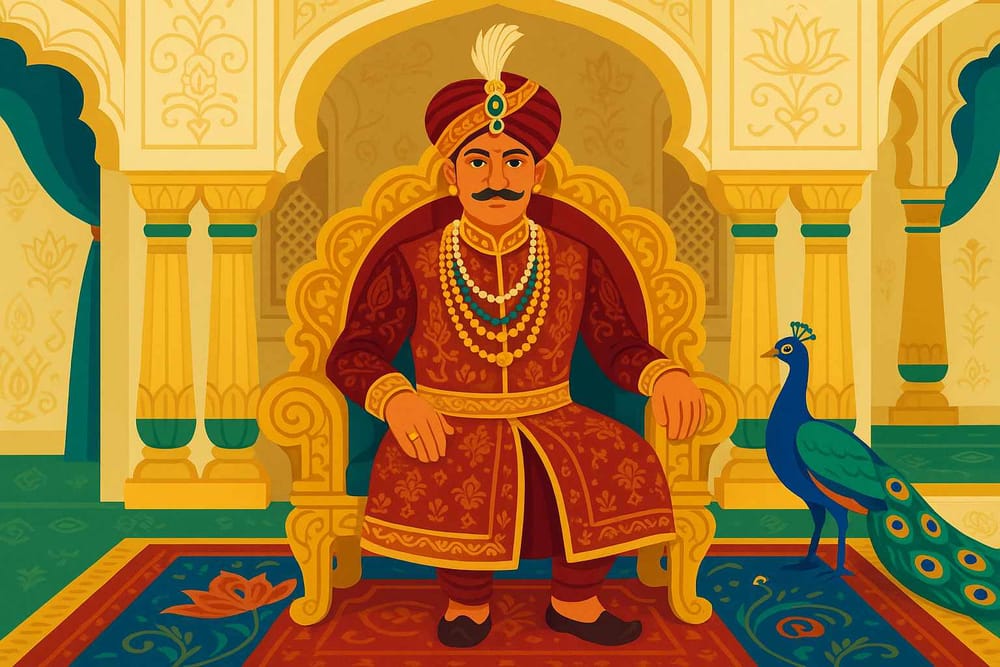
The Maharaja of Mysore- A Regal Legacy Defines Indian Royalty
There are some places in India where history isn't just in books; you can feel it in the air you breathe. Mysore is one such city. As you walk its clean, wide streets, with the majestic Chamundi Hills watching over you, you get a sense that you are walking through a living storybook. This story, filled with grandeur, devotion, and visionary leadership, is the legacy of the Maharaja of Mysore and the illustrious Wadiyar dynasty.
For over five hundred years, they didn't just rule a kingdom; they nurtured a culture. They built a legacy that shines as brightly today as the thousands of lamps that light up the Mysore Palace during Dasara. Let's take a heartfelt journey into this regal world.
The Wadiyars: More Than Rulers, They Were Custodians of Culture
The title "Maharaja" itself, meaning "great king" in Sanskrit, carries a weight of responsibility and reverence. The Wadiyar dynasty, who ruled Mysore from 1399 all the way to 1950, embodied this title perfectly. They are one of the very few royal families in India to have guided their kingdom for such an incredibly long time. Under their care, Mysore blossomed into the "Cultural Capital of Karnataka," a place where art, music, and spirituality were not just hobbies, but the very soul of the state.
Their rule was a masterclass in blending parampara (tradition) with progress, all while staying deeply connected to their Hindu roots. The story of the Maharajas is, in essence, the story of Mysore itself.
A Journey Through Time: The History of Mysore's Maharajas
The tale begins in 1399 with Yaduraya Wadiyar, who laid the foundation of this great kingdom. In the early years, the Wadiyars were astute rulers, forming a crucial alliance with the powerful Vijayanagara Empire, which helped them strengthen their position. Like many royal lineages in our country's rich past, their journey was one of strategic prowess and resilience. You can explore more about the broader context of royal histories in our piece on exploring the legacy of the Maharaja.
History took a turn during the time of Hyder Ali and his son Tipu Sultan, but after the Fourth Anglo-Mysore War in 1799, the British restored the kingdom to the Wadiyars. It was during this period that rulers like Maharaja Krishnaraja Wadiyar III showed incredible skill in navigating the complex pressures of British colonial rule while fiercely protecting Mysore's unique identity and sovereignty.
Building a 'Ramarajya': The Golden Era of Mysore
Every dynasty has a ruler whose reign is remembered as a golden age. For Mysore, that was Maharaja Nalwadi Krishnaraja Wadiyar IV (1902-1940). He wasn't just a king; he was a true visionary, lovingly called "Rajarshi" or the philosopher-king. His governance was so progressive and people-centric that even Mahatma Gandhi was moved to call his kingdom a "Ramarajya"—the ideal state.
His contributions were not just buildings and dams, but foundations for a modern, prosperous society:
- Pillars of Education: Understanding that knowledge is the greatest power, he established the University of Mysore in 1916, the first university of its kind in a princely state. This opened the doors of higher education for countless people and remains a prestigious institution to this day.
- Engineering Marvels for the People: He commissioned the magnificent Krishnaraja Sagar (KRS) Dam, an engineering feat that transformed agriculture in the region by providing consistent irrigation. It was a symbol of how royalty could directly work to alleviate the struggles of the common farmer.
- A Vision for a Modern State: Under his rule, Mysore became a beacon of progress. He established essential institutions like the Mysore Medical College, promoted industrialisation, and ensured his state was one of the first to provide modern healthcare and infrastructure to its citizens.
The Mysore Palace: A Dream Carved in Stone
No talk of Mysore's legacy is complete without picturing the breathtaking Amba Vilas Palace, more popularly known as the Mysore Palace. It is more than just a building; it is the heart of Mysore's pride. Designed in the Indo-Saracenic style, it beautifully marries Hindu, Islamic, Rajput, and Gothic architectural elements, creating a spectacle of harmony and grandeur.
To see it lit up by nearly 100,000 bulbs on a Sunday evening or during the Dasara festival is a sight that stays with you forever. It feels like a celestial palace has descended on Earth. Inside, the intricate carvings, stained-glass ceilings, and the magnificent Golden Throne tell silent stories of a glorious past.
Dasara: When the City Worships with its Royalty
The Mysore Dasara is not just a festival; it's an emotion that sweeps through the entire state. This 10-day celebration, started by Raja Wadiyar I in 1610, honours the victory of Goddess Chamundeshwari over the demon Mahishasura. It is a vibrant display of culture, devotion, and tradition.
The world-famous Jamboo Savari, a grand procession of decorated elephants with the lead elephant carrying the idol of the Goddess, is the highlight. The royal family continues to play a significant ceremonial role, reminding everyone of the deep bond between the rulers' devotion and the people's faith. It’s a beautiful spectacle where royalty and public come together in shared reverence.
If these tales of devotion and royal patronage fascinate you, imagine a digital space where countless such stories from our rich culture come alive. That's what we at Bhaktilipi strive to create. We are dedicated to preserving and sharing timeless devotional literature and stories that connect us to our roots.
Explore more about our heritage with us. Stay updated by subscribing to our newsletter, and join our community on Facebook, Instagram, and YouTube for a deeper spiritual journey.
A Legacy That Lives On: From Kingdom to Modern India
When India became a republic, the era of princely states came to an end. The last ruling Maharaja, Jayachamarajendra Wadiyar, handled this transition with immense grace and dignity. He served as the Rajpramukh of Mysore State, continuing his service to the people in a new role. He was a great scholar and patron of both Indian and Western classical music, showing the dynasty's continuing love for the arts.
Today, the legacy is carried forward by the current titular Maharaja, Yaduveer Krishnadatta Chamaraja Wadiyar. He continues to be a cultural ambassador for Mysore, actively participating in rituals and working to preserve the incredible heritage of his family.
Answers to Your Curiosities about the Maharaja of Mysore
What is the core story behind the Maharajas of Mysore?
The history of the Maharaja of Mysore is the story of the Wadiyar dynasty, who ruled for an astonishing period of over 500 years, from 1399 until 1950. Their reign is celebrated for its remarkable patronage of arts and culture, wise administrative reforms, and a deep commitment to the welfare of their people, which firmly established Karnataka's rich cultural identity.
What lasting impact did the Maharajas have on Indian society?
Their contributions were truly foundational. The Maharajas of Mysore were pioneers of progressive governance. They didn't just rule; they built a model state by championing education for all, establishing modern infrastructure like dams and railways, and fostering industries. Their focus on social welfare and cultural enrichment left an indelible mark on society.
What makes the Mysore Palace so special?
The Mysore Palace, or Amba Vilas Palace, is a true architectural jewel. What makes it so unique is its seamless blend of different styles—Indo-Saracenic, Hindu, Islamic, and Gothic—creating a visual masterpiece. It's not just a structure but a living museum, famous for its opulent interiors and the magical sight of its full illumination during the Dasara festival, which is an experience of a lifetime.
Why are the Mysore Maharajas such an enduring symbol of Indian royalty?
They represent the ideal of Indian royalty—a perfect blend of grandeur, cultural richness, and a deep sense of duty towards their subjects. Their legacy is not just about opulent palaces but about their immense contributions to education, arts, and society. They showcase a commitment to public welfare that continues to command respect and admiration.
Who was the final ruling Maharaja of Mysore?
The last ruling Maharaja of Mysore was Jayachamarajendra Wadiyar, who reigned from 1940 to 1950. After India gained independence, he gracefully transitioned into a new role as the Rajpramukh (governor) of Mysore state. A man of great learning and a connoisseur of music, he ensured his family's legacy of cultural patronage continued even after his reign.
A Timeless Legacy of Royalty and Culture
The Maharaja of Mysore is more than a historical title; it's a symbol of a legacy that continues to inspire. The Wadiyar dynasty showed the world how tradition and progress could walk hand in hand. From the architectural splendour of the Mysore Palace to the spiritual vibrancy of the Dasara celebrations, their virasat is woven into the very fabric of Karnataka's identity. This regal story is a beautiful reminder of India's rich history and the enduring charm of Mysore, the city of palaces.
A passionate group of people dedicated to preserving India's knowledge of Dharma, Karma, and Bhakti for ourselves and the world 🙏.
Comments
Related in
The Majestic Maharaja of Mysore- Legacy and Influence Explained
Close your eyes for a moment and picture this: a palace, not just made of stone and mortar, but shimmering with a hundred thousand lights against the night sky. Imagine the sound of classical Carnatic music filling the air, and a grand procession that tells stories of a history stretching
The Royal Legacy-Maharaja of Mysore: Life and Times Revealed
There are some places in India that feel like a living storybook, where every corner whispers tales of a glorious past. Mysore is one such city. When you walk its streets, you can almost feel the gentle weight of history, the fragrance of sandalwood, and the echoes of royal grandeur.
The Majestic Life of the Maharaja of Mysore: Explores Royal History
When you hear the name 'Mysore,' what comes to your mind? Is it the sweet fragrance of sandalwood, the shimmer of rich silk sarees, or the image of a palace lit up like a jewel against the night sky? For me, and for so many others, Mysore is