
The Artistic Soul of Shantiniketan-Nandalal Bose's Style Explained
Imagine a place where the morning breeze whispers poetry and the very soil seems to nurture art. This was Shantiniketan, the beautiful dream of Gurudev Rabindranath Tagore. And in this creative haven, one artist, fondly called Master Moshai by his students, breathed new life into India's artistic soul. That man was Nandalal Bose, a pioneer who taught us that art is not just for galleries, but a part of our daily life, our prayers, and our identity.
His story isn't just about paints and canvases; it’s about a deep connection with the motherland, a quiet revolution that brought back the glory of Indian art when it was most needed. Let’s take a walk through the world he created, a world filled with grace, simplicity, and immense spirit.
The Artistic Touch of a True Visionary
What makes a Nandalal Bose painting so special? It's the feeling it evokes. It feels like home. His art wasn't just a copy of what he saw; it was a beautiful blend of India's rich past and its living, breathing present. He created a unique style that was truly his own, yet belonged to every Indian.
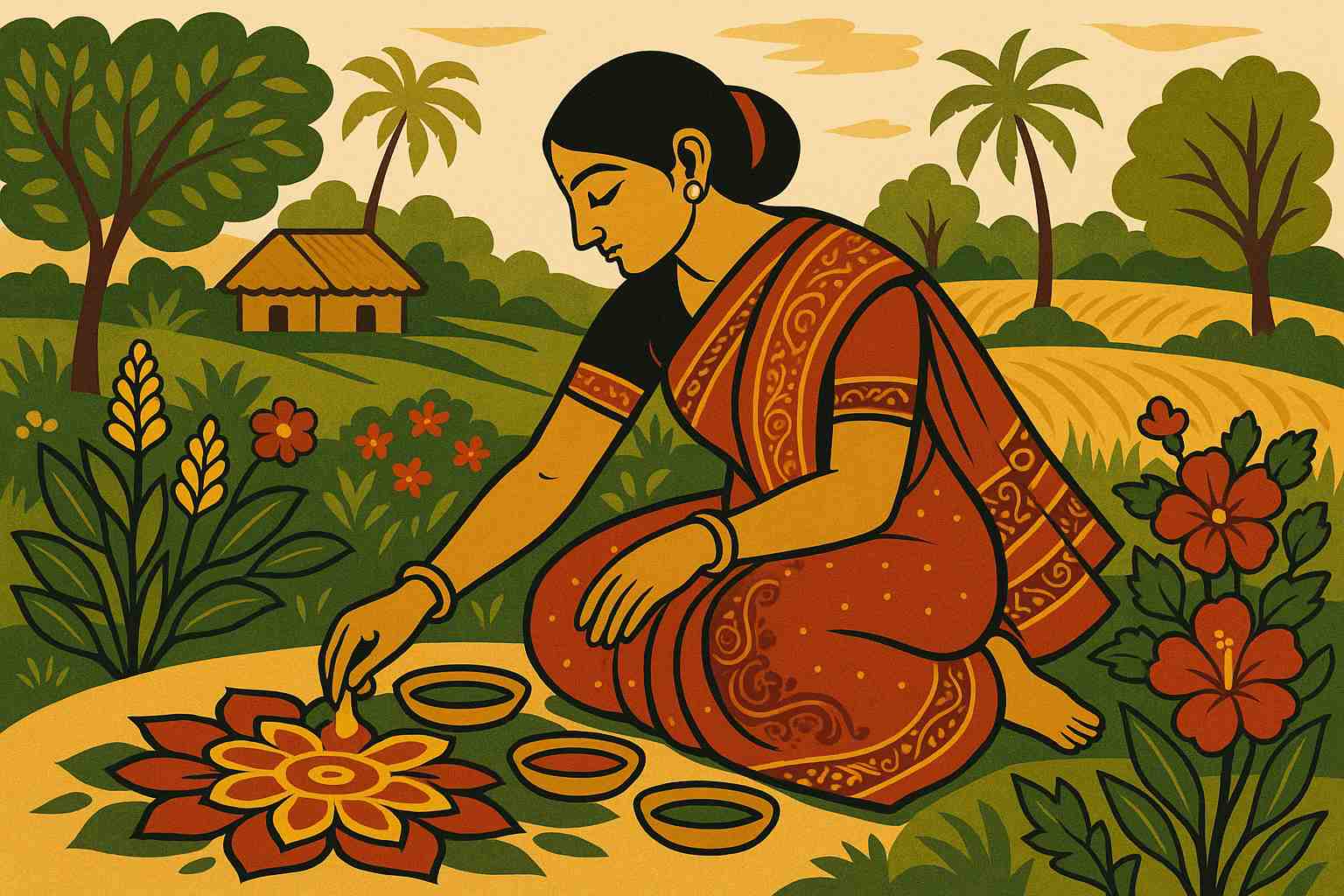
- A Conversation Between Folk and Classical Art: Nandalal Bose had this incredible gift of blending the simplicity of our village folk art with the elegance of classical traditions. He saw the beauty in a village woman's alpana as much as he admired the murals of Ajanta. This unique fusion gave his work a timeless quality, making it feel both ancient and modern at the same time. His approach celebrated the diverse artistic heritage of West Bengal and beyond.
- Colours of the Indian Soil: He chose colours that felt like they were born from the Indian earth itself—the warm ochre of a sadhu's robe, the deep, rich green of monsoon-soaked fields, and the gentle white of a blooming lotus. He preferred natural textures and indigenous materials, making his art feel organic and deeply rooted in our land.
- Stories in Every Stroke: Whether it was a scene from the Mahabharata or a simple depiction of a Baul singer, his paintings told stories. Inspired by ancient murals and Mughal miniatures, his work was filled with intricate details and profound symbolism. His art was more than just decoration; it was a form of spiritual expression, a visual narrative much like the ancient art of Pattachitra, where every line tells a tale.
- An Explorer of Forms: Master Moshai never limited himself. From delicate wash paintings that seemed to float on paper to powerful woodcuts and monumental murals, he experimented with everything. His journey with Rabindranath Tagore to China and Japan in 1924 opened his eyes to new techniques, which he lovingly brought back and taught at Shantiniketan.
The Beating Heart of the Bengal School of Art
During a time when India was struggling for its identity under colonial rule, a group of artists decided to look inwards for inspiration. This was the beginning of the Bengal School of Art, and Nandalal Bose was at its very heart. He, along with his guru Abanindranath Tagore, championed an art that was unapologetically Indian.
This movement was a rebellion against the stiff, Western academic style. It was a call to return to our roots, to our stories, our gods, and our people. As a teacher and mentor, Nandalal Bose guided a generation of artists, encouraging them to find their own voice while respecting our shared heritage. His art became a symbol of cultural pride and national identity, quietly fanning the flames of the freedom movement.
Shantiniketan and Kala Bhavana: Where Art Became Life
In 1921, Gurudev Tagore invited Nandalal Bose to become the principal of Kala Bhavana, the art school at Visva-Bharati. It was a match made in heaven. Here, under the open skies and amidst serene surroundings, Bose's philosophy truly blossomed. He believed that art should not be confined to a classroom; it should be part of every festival, every celebration, and every corner of life.
He and his students decorated the campus with beautiful frescoes and murals, turning Shantiniketan into a living art gallery. He fostered an environment where emotional depth was valued more than mere technical perfection. He wasn't just a teacher; he was a guru who nurtured legendary artists like Benode Behari Mukherjee and Ramkinkar Baij, instilling in them a deep love for Indian traditions.
Art for a Nation’s Awakening
Nandalal Bose’s contribution went far beyond paintings. When India was writing its destiny, he was given the sacred task of illustrating the original manuscript of the Constitution of India. His art adorns the pages of this holy book of our nation, a testament to his stature and his connection to the Indian ethos.
Who can forget his iconic black and white linocut of Mahatma Gandhi, walking with his staff on the Dandi March? That simple image captured the spirit of an entire nation. It was powerful, direct, and full of emotion. Through such works, he showed that art could be a powerful tool for social and political awakening.
Understanding the Master’s Enduring Legacy
To truly appreciate Nandalal Bose is to understand the soul of modern Indian art. Many wonder what made his style so unique and deeply rooted in our culture. It was his ability to see the divine in the everyday—in the rhythm of rural life, in the heart of our mythology, and in the beauty of nature. He seamlessly blended these themes into a visual language that felt both personal and universal.
His close association with Shantiniketan was the key that unlocked his full potential. The freedom and philosophical environment provided by Rabindranath Tagore allowed him to create an educational system that celebrated our heritage while encouraging bold experimentation. This is why he is rightfully called a pioneer, a bridge between our glorious artistic past and our modern aspirations.
The Archaeological Survey of India rightly declared his works as "art treasures" in 1976. But for us, his greatest treasure is the legacy of pride, authenticity, and spiritual connection he left behind. His art reminds us to look for beauty in simplicity and to find strength in our own traditions.
Preserving Our Cultural Soul with Bhaktilipi
Just as Nandalal Bose dedicated his life to preserving and reimagining India's artistic traditions, we at Bhaktilipi are committed to a similar cause. We believe that stories of our culture, devotion, and heritage deserve a special place in today's digital world.
Our platform, Bhaktilipi.in, is a space where you can connect with timeless devotional literature and stories that inspire and enlighten. If the journey of artists like Nandalal Bose touches your heart, you will find a home with us. We strive to share authentic content that bridges the gap between sacred traditions and the modern reader.
Stay connected with our efforts to keep our culture alive. Subscribe to our newsletter for more inspiring stories, and follow us on Facebook and Instagram for daily doses of devotion and culture. Join our community and enrich your spiritual journey with us.
A passionate group of people dedicated to preserving India's knowledge of Dharma, Karma, and Bhakti for ourselves and the world 🙏.