
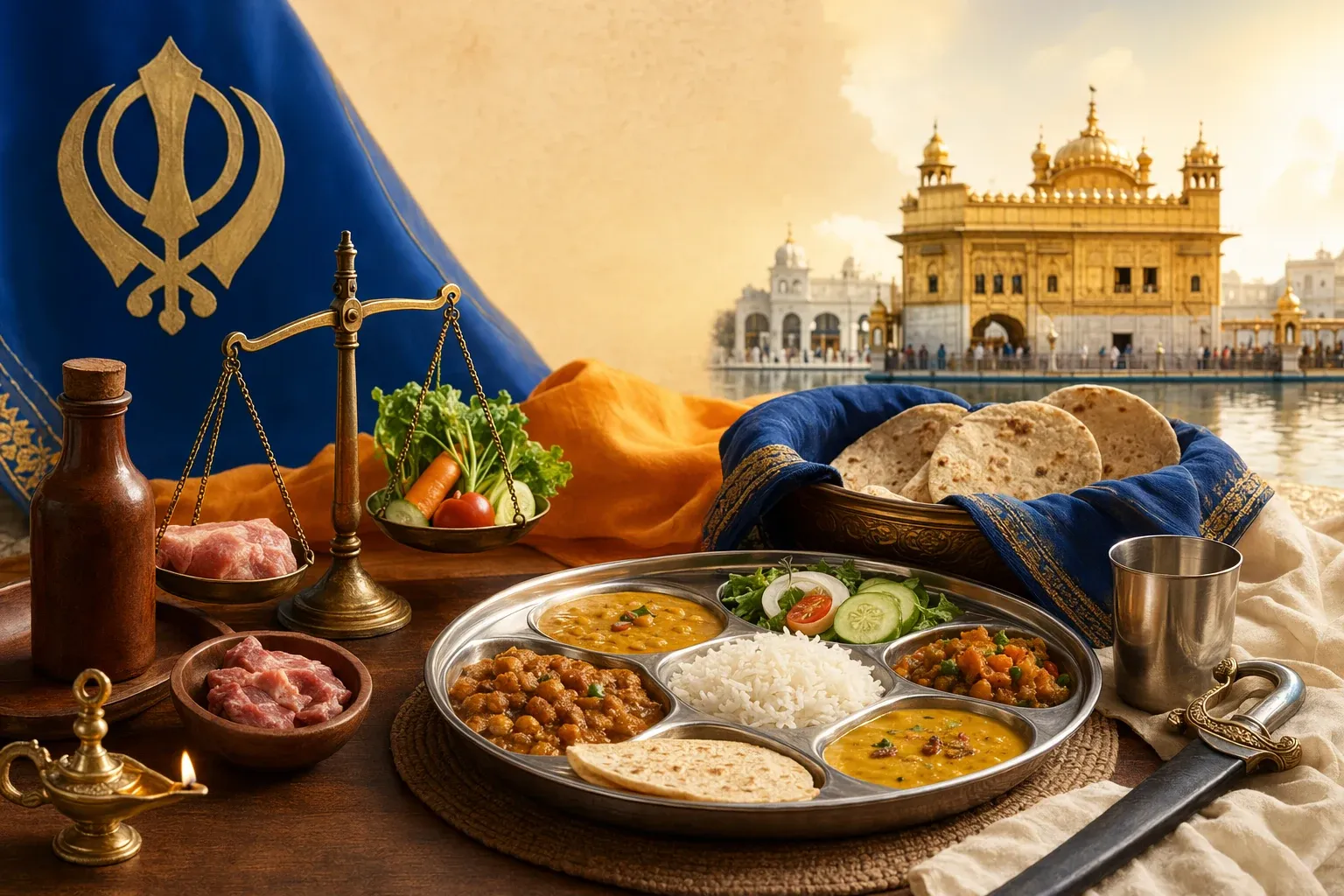
Sikh food questions often get oversimplified online. The honest beginner answer is that langar is vegetarian so everyone can eat together, intoxicants are discouraged, and meat questions are discussed with nuance across communities and codes of conduct.
This guide explains the topic respectfully without turning Sikh practice into gossip about what one person eats. Food, discipline, equality, and community all need to be understood together.
Sikhism food questions need nuance. Langar in gurdwaras is normally vegetarian so everyone can eat together, but Sikh communities and individuals may differ in personal practice around meat. Intoxicants are generally discouraged because they cloud discipline and awareness. Respectful language matters because food easily becomes a place for stereotypes.
Simple answer
The short meaning is this: Sikhism food questions need nuance. Langar in gurdwaras is normally vegetarian so everyone can eat together, but Sikh communities and individuals may differ in personal practice around meat. Intoxicants are generally discouraged because they cloud discipline and awareness. Respectful language matters because food easily becomes a place for stereotypes. For a student, this is the safest starting point because it avoids two common mistakes. One mistake is to reduce Sikhism to clothing or food habits. The other is to blur Sikhism into another tradition and ignore its own voice.
Sikhism is learned through sangat, scripture, music, service, memory, and disciplined living. That means the tradition is not only about private belief. It asks what kind of person we become in family life, public life, work, study, and moments of difficulty.
Tradition, interpretation, and historical context
In Sikh tradition, the Gurus are the guiding teachers, and Guru Granth Sahib is honoured as the eternal Guru. Teachings are received not as random inspirational lines, but through devotion, kirtan, reflection, and ethical living. This traditional layer deserves respect because it explains how Sikhs themselves understand the path.
Interpretation asks how the teaching shapes daily life. For example, one person may connect seva with volunteering at langar, another with helping neighbours, another with honest work and sharing earnings. The value remains rooted in Sikh teaching, but the application can appear in many ordinary situations.
Historical context asks how the tradition developed in Punjab, how the Gurus shaped community institutions, and how later Sikh identity responded to social and political pressures. This does not weaken faith. It simply helps readers avoid flat, one-line claims about a rich living tradition.
Key points to remember
- Langar is commonly vegetarian for inclusion, not because every Sikh must be vegetarian in all contexts.
- Many Sikhs avoid alcohol and intoxicants as part of disciplined living.
- Some Sikh groups maintain stricter dietary practices than others.
- Questions about halal or kutha meat should be handled carefully because community interpretations can be sensitive.
Short answer with nuance
Start with the plain idea before adding details. Short answer with nuance is important because it gives readers a handle on the topic without forcing them to memorise everything at once. A good beginner explanation should answer the basic question, then show why the answer matters in real life.
Langar and vegetarian food
This section needs careful language. Sikh tradition has its own vocabulary and emotional world, so translations help but never carry the whole feeling. Words such as Guru, sangat, seva, Khalsa, Gurbani, and langar are best explained with examples instead of being reduced to dictionary meanings.
Meat and community interpretations
One practical example is the gurdwara. It is not only a building. It is a place where scripture, music, community, food, and service come together. Even when this article is about a different Sikhism topic, the gurdwara helps beginners see how teaching becomes practice.
Alcohol and intoxicants
Another useful example is langar. People from different backgrounds sit and eat together. That one act quietly teaches equality, humility, and service. It also shows why Sikh values should not be explained only as abstract beliefs; they are meant to be practiced.
How to ask respectfully
For modern readers, this topic is still relevant because young people are asking identity questions: What do I believe? How should I treat others? How do I stay disciplined? What does community mean? Sikhism answers these questions with devotion joined to action.
Common mistakes to avoid
- Do not describe Sikh identity as a costume or a cultural decoration.
- Do not treat all Sikh families as if they follow every practice in exactly the same way.
- Do not blur Sikhism into another religion; shared history does not erase distinct identity.
- Do not quote scripture or tradition without context when the topic needs careful explanation.
Common questions
Can Sikhs eat meat?
Some Sikhs eat meat and some do not. Practice varies by family, community, and discipline, so it is better not to give one careless answer for everyone.
Is Sikhism vegetarian?
Sikhism is not simply a vegetarian religion, but langar is usually vegetarian so that people from many backgrounds can eat together.
Can Sikhs eat pork?
There is no single beginner answer that covers every Sikh community and family practice. It is more respectful to ask about the person’s own observance than assume.
Can Sikhs drink alcohol?
Alcohol and intoxicants are generally discouraged because they weaken discipline, awareness, and responsible living.
Why this matters today
For young readers, Sikhism offers more than facts for a school answer. It gives a model of devotion that should become courage, service, honest living, and respect for human dignity. Whether someone is Sikh or simply learning about Indian traditions, this is a valuable way to understand the subject.
The careful path is to learn with humility. Listen to Sikh voices, understand the role of Guru Granth Sahib, notice the importance of community, and avoid turning living faith into stereotypes. When we do that, the topic becomes clearer and more respectful at the same time.
The heart of the food question is not only “allowed or not allowed”; it is discipline, inclusion, humility, and respect.