
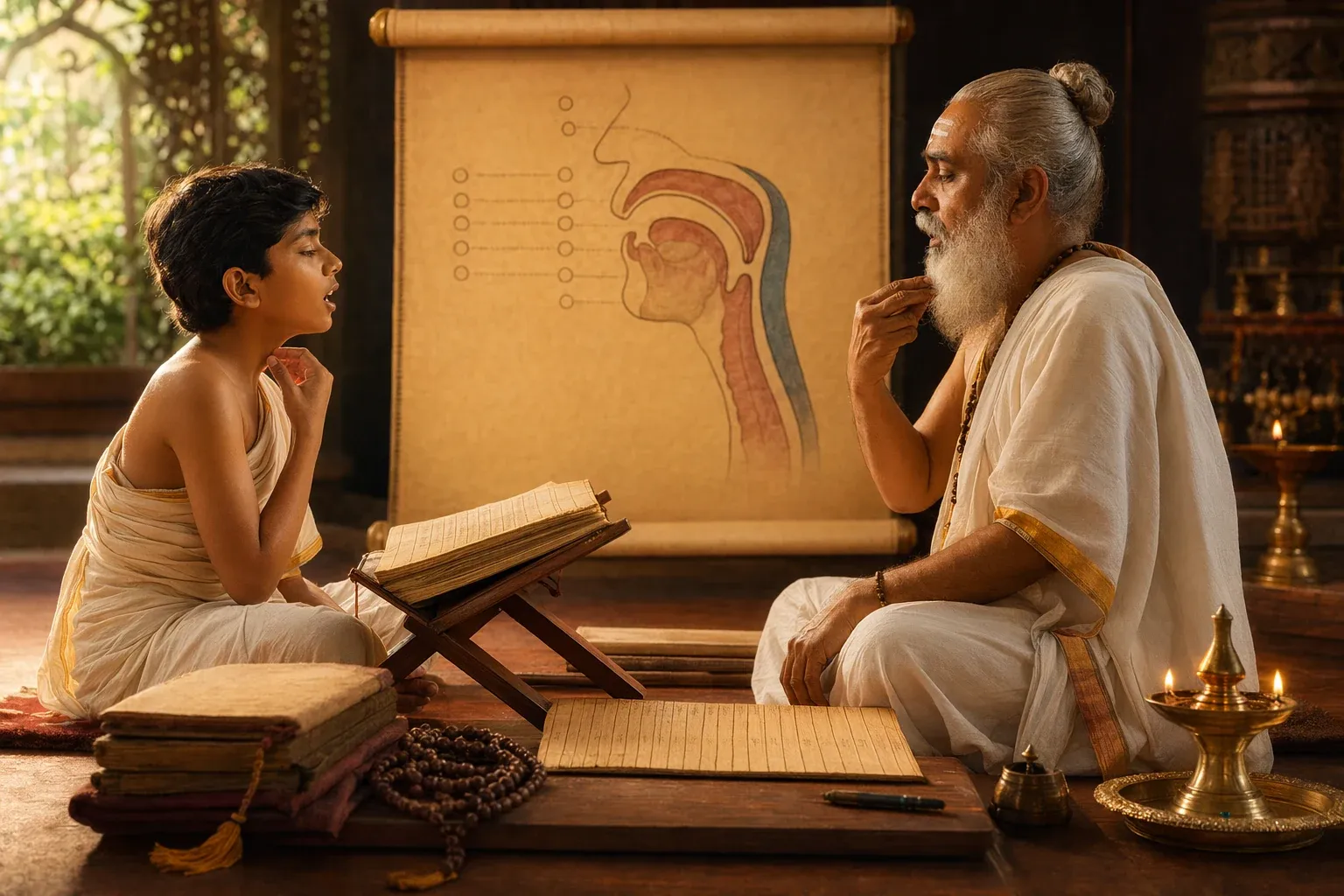
Shiksha is the Vedanga that deals with pronunciation, phonetics, and the careful discipline of sound. If the Vedas were preserved for centuries through recitation, then sound could not be treated casually. A syllable had to be clear. A vowel had to be held correctly. Accent and rhythm had to be remembered with precision. Shiksha gave learners a way to understand and practice that oral accuracy.
For a beginner, the simplest explanation is this: Shiksha asks how sacred words should be spoken so that they are heard, remembered, and transmitted correctly. It is not only about having a beautiful voice. It is about attention to the building blocks of speech: letters, vowels, consonants, length, stress, tone, and flow.
What does Shiksha mean?
Shiksha comes from a root connected with learning and instruction. As one of the six Vedangas, it belongs to the group of supporting disciplines used for Vedic study. The six Vedangas are Shiksha, Vyakarana, Chandas, Nirukta, Kalpa, and Jyotisha. Each supports a different need: sound, grammar, metre, word meaning, ritual method, and timing.
Shiksha’s special concern is sound. Before a student can analyze a word or apply a ritual rule, the student must be able to pronounce and hear the word correctly. In an oral culture, this was essential. A text was not only something written on a page. It lived in trained memory, teacher-student recitation, and repeated listening.
Why pronunciation mattered so much
In everyday life, small pronunciation changes can alter meaning or cause confusion. In Vedic recitation, the concern was even greater because sound was part of sacred preservation. The tradition treated the spoken form of the Veda with great care. If a sound changed repeatedly over generations, the received text could slowly drift.
Shiksha helped guard against that drift. It taught learners to notice details that casual speech often ignores. Is the vowel short or long? Is a consonant dental, retroflex, palatal, or guttural? Is a syllable pronounced with the correct accent? Does the voice rise, fall, or remain level in the expected place? These questions may sound technical, but they served a cultural purpose: keeping recitation stable.
The main areas of Shiksha
Traditional explanations of Shiksha often discuss letters, accent, quantity, effort, modulation, and continuity. In beginner language, these can be understood as the sound unit, the pitch or stress pattern, the length of pronunciation, the physical effort of speech, the tonal quality, and the joining of sounds.
Letters matter because Sanskrit sounds are organized by where and how they are produced in the mouth. Quantity matters because a short vowel and a long vowel are not the same in recitation. Accent matters because Vedic chanting preserves pitch patterns that are older than ordinary spoken reading. Continuity matters because words in Sanskrit often join through sandhi, so a learner needs to know how sounds meet without losing clarity.
Shiksha and oral memory
The Vedic tradition developed remarkable methods of memorization. Students did not simply read silently. They listened, repeated, corrected, and recited in structured ways. Some recitation patterns moved forward and backward through words to protect sequence and accuracy. This made memory more reliable than ordinary repetition.
Shiksha supported that training by making sound conscious. When learners know why a sound is produced in a certain way, they can correct mistakes more carefully. A teacher can point not only to a wrong word, but to a wrong length, accent, or mouth position. Over time, this creates a disciplined ear as well as a disciplined voice.
A simple everyday analogy
Imagine learning a song in a language you do not speak fluently. If you change the tune, shorten long notes, blur syllables, and ignore pauses, the song may still seem similar to you, but someone trained in that tradition will hear the difference immediately. Now imagine that the song is not entertainment but a carefully preserved sacred text. The need for accuracy becomes easier to understand.
This analogy is not perfect, because Vedic recitation has its own rules and authority. But it helps beginners see why sound mattered. Shiksha is like the careful listening discipline that prevents a living oral tradition from becoming vague.
How Shiksha differs from grammar and metre
Beginners sometimes confuse Shiksha with Vyakarana or Chandas. The difference is simple. Shiksha asks how sounds are pronounced. Vyakarana studies grammar: how words are formed and how sentences work. Chandas studies metre: the rhythmic structure of verses.
The three are connected but not identical. A verse may have correct metre but poor pronunciation. A word may be grammatically understood but badly recited. A chant may have the right words but the wrong sound length or accent. The Vedanga system separated these concerns so that students could study each with care. For a wider introduction, see Bhaktilipi’s guide to the Vedas and Sanskrit for beginners.
Respect and caution in learning
Because Vedic chanting belongs to living traditions with teachers, lineages, and rules, beginners should approach it respectfully. Reading about Shiksha can build appreciation, but it is not the same as receiving training from a qualified teacher. Some chants have specific contexts, restrictions, or methods of learning. A responsible student does not treat sacred recitation as a casual performance.
That caution should not discourage learning. It simply places learning in the right spirit. You can study the history of the Vedangas, listen to authorized educational demonstrations, learn basic Sanskrit sound categories, and understand why oral preservation was so disciplined. If you wish to chant seriously, seek proper guidance rather than imitating random clips.
Why Shiksha still matters
Shiksha matters today because it reminds us that knowledge is not only stored in books. It can also be carried by voice, memory, breath, and trained attention. In a world of quick copying and careless quotation, the discipline of accurate transmission feels surprisingly modern. It asks us to slow down and honor detail.
It also shows the sophistication of ancient Indian learning. The people who preserved Vedic recitation paid close attention to phonetics long before modern recording devices. They built systems that helped communities remember sound with extraordinary care. For students of Indian culture, Shiksha opens a window into that achievement.
The best beginner summary is therefore simple: Shiksha Vedanga is the study of correct Vedic sound. It explains why pronunciation, accent, and disciplined listening mattered so deeply. Through Shiksha, speech becomes a vehicle of memory, respect, and continuity.