
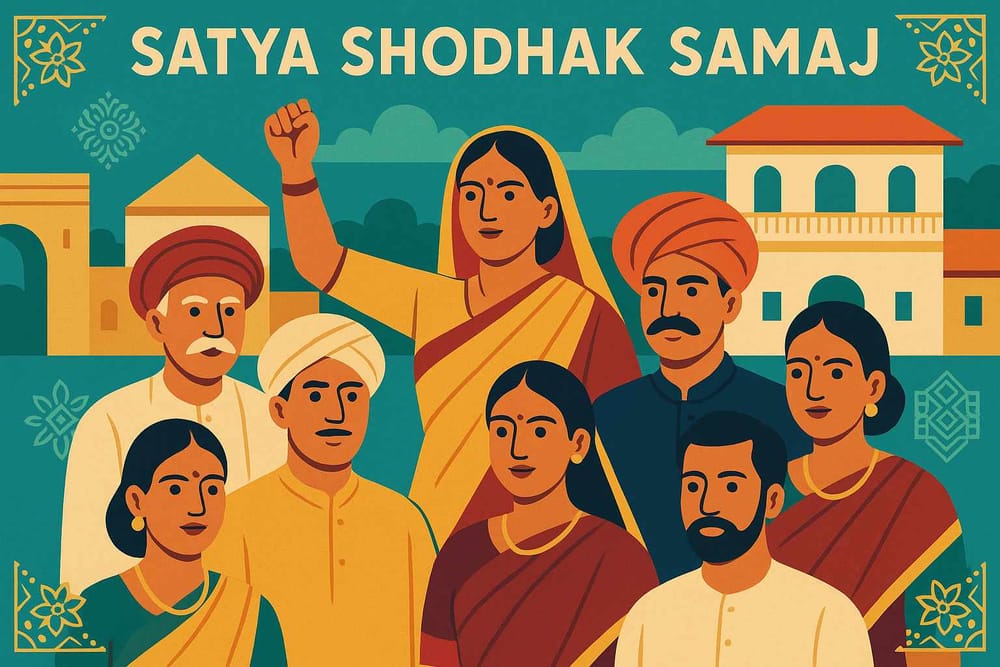
Satya Shodhak Samaj- Legacy and Impact Explored
There are moments in history that don’t just change rules; they change hearts. They don't just break chains; they awaken souls. Picture a time in 19th-century India, where for so many, life’s path was cruelly decided the moment they were born. The weight of caste discrimination and social injustice was a burden carried by generations. In this suffocating silence, a powerful voice of reason and courage emerged. This was the voice of the Satya Shodhak Samaj, or the "Society of Truth Seekers," a movement that lit a lamp of hope in the darkest of corners.
Founded in 1873 by the visionary Jyotirao Phule, this was more than just an organisation. It was a heartfelt promise to create a society where every person, regardless of their birth or gender, could stand tall with dignity. It was a call to question age-old orthodox practices and embrace a future built on equality and rational thought. This is the story of that promise and its everlasting impact.
From the Shadows of Injustice: Why the Samaj was Born
To truly understand the Satya Shodhak Samaj, we must first feel the world it was born into. The 19th century was a time of deep social divides. The caste system wasn't just a social structure; it was a rigid wall that locked millions out of education, opportunities, and even basic human respect. For women, the walls were even higher, with practices like child marriage and a complete denial of learning keeping them in the shadows.
It was in this environment that Jyotirao Phule, deeply moved by ideas of equality and justice, felt a burning need for change. He saw that the key to unlocking human potential was education. He believed that knowledge was the one tool that could empower people to see their own worth and break free from oppression. Together with his incredible wife, Savitribai Phule—who would become one of India's first and most inspiring female teachers—they began a revolution. They opened schools for girls and children from lower-caste communities, an act of defiance that changed countless lives.
The Samaj was unique because it encouraged people to build a direct, personal connection with morality and truth, without the need for priestly intermediaries. It was a movement that taught self-respect, urging people to seek knowledge for themselves and build a society on their own terms.
The Enduring Legacy: A Ripple Effect Through Time
The work started by the Phules didn't end with them. It created ripples that continue to shape the India we live in today. The impact of the Satya Shodhak Samaj is not just in history books; it's in the very fabric of our modern society.
- Awakening a New Identity: The Samaj did something profound—it gave the marginalised a voice and a renewed sense of self. It taught them to reject oppressive rituals and stand with dignity, fostering a powerful sense of community and solidarity that allowed them to organise and fight for their rights.
- Education as the Great Equaliser: The unwavering focus on education transformed lives. By opening the doors of schools to everyone, especially girls and Dalits, Jyotirao and Savitribai Phule started a movement of empowerment that continues to inspire. Savitribai's pioneering efforts for women's education helped lay the groundwork for future generations of female leaders, a spirit of progress we see reflected in modern initiatives like the work of women writers' committees that shape our cultural landscape.
- A Rational and Humane Culture: The movement introduced a refreshing dose of rationalism into faith. It promoted simple, inexpensive wedding ceremonies to save families from crippling debt and championed progressive ideas like inter-caste marriages and widow remarriage, building a more compassionate and practical society.
- Inspiring the Giants of Tomorrow: The ideals of equality and justice championed by the Samaj deeply inspired future leaders like the great Dr. B.R. Ambedkar and Periyar's Self-Respect Movement. Its core principles of social justice are echoed in the very soul of the Indian Constitution, a testament to its profound and lasting influence. The legacy of such movements, much like the historic contributions of a Maharaja's legacy, continues to influence the trajectory of our modern culture.
The Satya Shodhak Samaj reminds us that real change begins with courage, compassion, and an unshakeable belief in the equal worth of every human being. Its story is a powerful chapter in our nation's journey, one that encourages us to continue building a more just and inclusive world.
At Bhaktilipi, we believe in the power of such timeless stories to inspire our present. Exploring our past helps us understand who we are and the values that connect us. If the story of the Satya Shodhak Samaj resonates with you, we invite you to discover more such narratives that preserve our rich cultural and spiritual heritage.
Join our community to explore devotional literature and inspiring stories that connect with today's world. Subscribe to our newsletter and follow us on Facebook, Instagram, and YouTube for more enriching content.
Frequently Asked Questions About the Satya Shodhak Samaj
Many people are curious about this transformative movement. Here are some common queries, answered to help you understand its importance better.
What exactly was the Satya Shodhak Samaj?
Think of it as a society for social reform, established by Jyotirao Phule in Maharashtra in 1873. Its fundamental mission was to dismantle the oppressive caste system and foster a society where everyone was treated with equality and dignity.
Who was the visionary founder behind this movement?
The heart and soul of the Satya Shodhak Samaj was Jyotirao Phule, a remarkable social reformer who dedicated his life to challenging caste-based discrimination and fighting for social justice for all.
What was the ultimate goal it hoped to achieve?
The primary aim was to completely uproot caste discrimination. To achieve this, the Samaj focused on promoting education, equality, and, most importantly, a sense of self-respect among communities that had been oppressed for centuries.
How did it contribute to women's rights in India?
The organisation was truly ahead of its time, placing immense emphasis on education and equal rights for women. It actively supported widow remarriage and fought against harmful practices like child marriage, paving the way for female empowerment.
Why is the Satya Shodhak Samaj so significant in Indian history?
Its importance cannot be overstated. The Samaj laid the foundational bricks for social equality movements across India. By courageously challenging the caste system and championing values of fairness and justice, it fundamentally altered the course of our nation's social history.
Does the movement still exist today?
While the original organisation may not be active in the same form, its spirit and legacy are very much alive. Its principles continue to inspire countless modern movements, activists, and policymakers who work tirelessly for social justice and equality in contemporary India.
A passionate group of people dedicated to preserving India's knowledge of Dharma, Karma, and Bhakti for ourselves and the world 🙏.
Comments
Related in
Revisit Satya Shodhak Samaj- A Legacy of Equality
Imagine a flame lit in the dark, a single voice that rises against a chorus of injustice. This isn't just a story from a book; it's the living legacy of the Satya Shodhak Samaj, the "Truth-Seeking Society." It was a movement born not in
Satya Shodhak Samaj Legacy- A 2025 Examination
Some stories are not just written in books; they are etched into the very soul of a nation. They are stories of courage, of a fight against injustice, and of a dream for a better tomorrow. The story of the Satya Shodhak Samaj, the "Truth-Seekers' Society," is
Satya Shodhak Samaj Principles: A 2025 Guide
कभी-कभी इतिहास की कुछ घटनाएं सिर्फ कहानियां नहीं होतीं, बल्कि एक मशाल की तरह होती हैं जो आज भी हमारा रास्ता रोशन करती हैं। ऐसी ही एक मशाल है महात्मा