
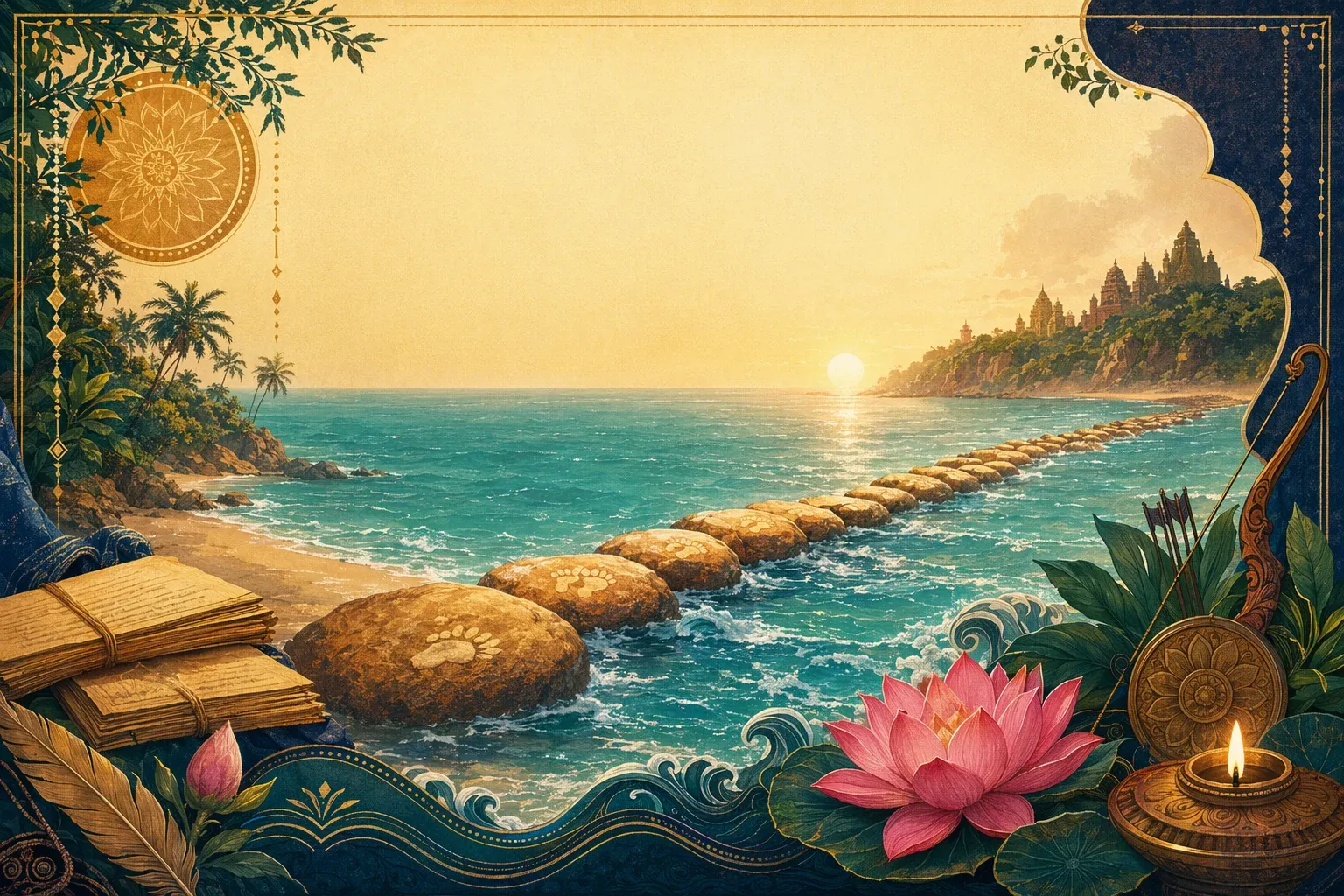
If you searched for 'ramayana bridge', this beginner-friendly Bhaktilipi guide is for you.
Reader questions behind this guide: What is the Ramayana bridge?; Who built Ram Setu?; Where is Ram Setu today?.
We will keep the explanation simple, respectful, and useful, while clearly separating tradition, interpretation, and modern historical discussion where needed.
Quick answer
In the Ramayana, Ram Setu is the bridge built by Rama’s Vanara army to reach Lanka and rescue Sita from Ravana. It is also called Rama Setu or Adam’s Bridge in modern geography discussions.
For devotees, Ram Setu is sacred and connected with Rama’s mission. For cultural learners, it is one of the epic’s most memorable symbols of teamwork, faith, and determination.
What Ram Setu means in the story
After Hanuman finds Sita in Lanka, Rama’s army must cross the ocean. The challenge looks impossible: how can an army reach an island kingdom across the sea?
The bridge becomes the answer. It turns devotion into collective action, showing that dharma often requires organised effort, not only personal emotion.
Nala, Nila, and the Vanara sena
Ramayana traditions often mention Nala and Nila in connection with building the bridge. The Vanara sena contributes together, carrying stones and working under Rama’s leadership.
The beauty of this episode is that many hands serve one righteous purpose. Even small contributions become meaningful when joined to dharma.
Where the bridge is associated geographically
Ram Setu is traditionally associated with the chain of shoals between Rameswaram in India and the region near Sri Lanka. Many pilgrims connect Rameswaram deeply with Rama’s journey.
Because geography, geology, and sacred memory are discussed differently, it is safest for beginners to say the place is traditionally associated with the Ramayana bridge.
Faith and modern discussions
Modern debates sometimes ask whether satellite images or geology “prove” the Ramayana. These discussions can become heated and oversimplified.
A respectful approach is to avoid exaggeration. The bridge is sacred in tradition and important in cultural memory; scientific claims should be made only with proper evidence and careful language.
Why the bridge became a cultural symbol
Ram Setu symbolises crossing the impossible. Rama’s army does not give up because the sea is wide. They organise, trust, and build.
For young readers, the lesson is practical: faith should become effort. Big goals need teamwork, patience, leadership, and courage.
To connect this with nearby ideas, see Hanuman in the Ramayana: Devotion, Courage, and Lessons for Today and How to Read the Ramayana for Beginners: Books, Order, and Simple Tips.
What to remember
Ram Setu is not only a search-engine curiosity. It belongs to one of the most emotional parts of the Ramayana—the movement from grief and searching to action and rescue.
Read the episode with reverence, but also with care. Sacred geography deserves both devotion and responsibility.