
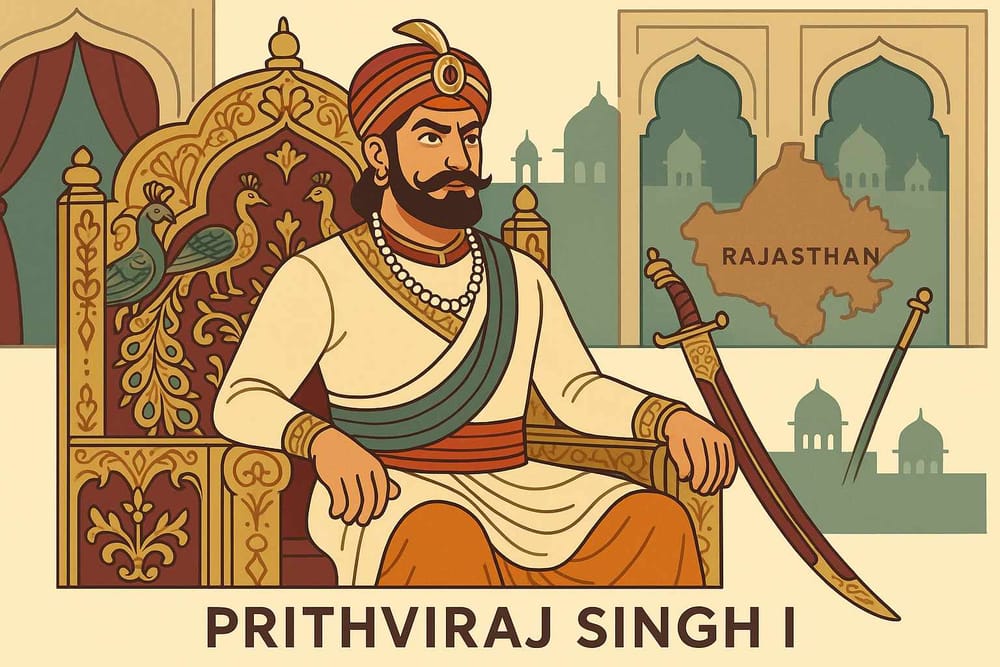
Prithviraj Singh I in Rajasthan-Legacy Explored
In the vibrant tapestry of Rajasthan's history, some threads shine brighter than others. These are the stories of kings who were not just warriors, but also visionaries and devout souls. Today, let’s journey back to the 16th century to uncover the saga of a ruler whose legacy is etched into the very foundation of the Kachwaha clan—Maharaja Prithviraj Singh I of Amber. His is a tale not just of battles won, but of a kingdom strengthened by faith and foresight.
A New Dawn for Amber
When Prithviraj Singh I ascended the throne of Amber in 1503, it was a time of great change. He wasn't just another king inheriting a crown; he was a leader destined to breathe new life into his kingdom. Unlike many rulers whose stories are only about conquests, Prithviraj Singh I's reign was deeply intertwined with his spiritual beliefs. He was a man of immense faith, a devout follower of Lord Krishna.
His devotion was so profound that it shaped his rule. He was guided by his spiritual teacher, Krishna-das, who gifted him two sacred idols: one of Narasimha and another of Sitaram. The idol of Sitaram wasn't just for his personal temple; it became the spiritual head of the Amber army, carried into every battle. Imagine the sight—an army marching not just with weapons, but with their faith leading the way. This beautiful blend of spiritual strength and military might became the hallmark of his reign.
The Valor at Khanwa: A Stand for Rajputana
A true Rajput's mettle is tested on the battlefield, and Prithviraj Singh I proved his valor in one of the most significant battles in Indian history—the Battle of Khanwa in 1527. When the great Rana Sanga of Mewar formed a confederacy of Rajput kings to stand against the invading Mughal army of Babur, Prithviraj Singh I didn't hesitate.
He led his Kachwaha forces with immense courage, standing shoulder-to-shoulder with other brave rulers. He wasn't just a soldier; he was one of Rana Sanga’s most trusted commanders. This historic event wasn't merely a battle for territory; it was a united stand for Dharma and the honour of Rajputana. His participation cemented his reputation as a fearless warrior committed to protecting his land and his people. The stories of such great rulers remind us of the deep-rooted influence of Maharajas in shaping our culture.
A Legacy of Unity: The "Baro Kotri" System
Perhaps Prithviraj Singh I's most lasting contribution was his brilliant administrative foresight. He had many sons, and in those times, succession was often a bloody affair that could tear kingdoms apart. To avoid this, he devised a unique system that would ensure both peace and the continued strength of his clan.
- The Twelve Chambers of Power: He created the "Baro Kotri" or the "twelve chambers." He divided his kingdom's estates among nine of his sons and other close relations, establishing them as feudal lords. This wasn't just giving away land; it was a masterstroke of political strategy.
- Strengthening the Clan from Within: By doing this, he embedded his bloodline across the feudal structure of Rajasthan. This ensured that the Kachwaha clan's power was not concentrated in one place but spread across the region, making it more resilient. These families became the highest aristocracy of what would later become the kingdom of Jaipur, ensuring his legacy endured for centuries.
It is in these timeless tales of wisdom and leadership that we find our connection to the past. At Bhaktilipi, we believe that understanding these stories is a form of devotion in itself. If you wish to immerse yourself in the devotional and historical narratives that define our culture, explore the vast collection on Bhaktilipi.in, a space created to preserve these very treasures.
Frequently Asked Questions About Prithviraj Singh I's Legacy
Many people are curious about this remarkable king and his impact. Let's explore some common thoughts.
What made Prithviraj Singh I such a significant ruler for Amber?
His significance comes from his ability to revitalise Amber. He infused the kingdom with political energy, military strength, and deep spiritual grounding. He transformed Amber from a regional power into a key player in the larger politics of Rajputana, setting the stage for its future glory as Jaipur.
How did his personal faith influence his kingdom?
His devotion to Krishna was not a private affair. By making the Sitaram idol a part of his army, he spiritually united his soldiers and his people. This act showed that he ruled not just by might, but by divine blessing, a concept that resonated deeply with the ethos of the time and brought a unique sense of purpose to his kingdom.
What exactly was the "Baro Kotri" system he created?
The "Baro Kotri" was a forward-thinking feudal system. Instead of leaving his sons to fight over the throne, Prithviraj Singh I granted them their own estates or 'jagirs'. This not only prevented internal conflict but also created a powerful network of loyal Kachwaha nobles who would support the main throne of Amber for generations to come. It was a blueprint for lasting power.
Is he related to the more famous Prithviraj Chauhan?
This is a common point of confusion. No, they are two different historical figures from different eras and dynasties. Prithviraj Chauhan was a ruler of the Chauhan dynasty in the 12th century, famous for his battles with Muhammad Ghori. Prithviraj Singh I was a Kachwaha ruler of Amber in the 16th century. Both were heroic, but their stories are distinct chapters in Rajasthan's grand history.
An Enduring Inspiration
The legacy of Prithviraj Singh I is a powerful reminder that true leadership is a blend of courage, wisdom, and faith. He was a warrior who fought bravely, a king who governed wisely, and a devotee who ruled with a pure heart. His life teaches us that a kingdom's true strength lies not just in its forts and armies, but in its unity and its connection to a higher purpose.
Honouring leaders like him helps us appreciate the rich heritage we have inherited. His story is more than just a page in a history book; it is a guiding light for anyone who values integrity, bravery, and unwavering dedication to one's people and land.
Connect with Our Heritage
Stories like these are the soul of our culture. At Bhaktilipi, we are dedicated to bringing you closer to the devotional and historical epics that shape our identity. We offer a space to explore, learn, and connect with your roots in today's digital world.
For more enriching stories and spiritual insights, follow us on Facebook, Instagram, and YouTube. Join our community and keep the flame of tradition alive.
A passionate group of people dedicated to preserving India's knowledge of Dharma, Karma, and Bhakti for ourselves and the world 🙏.
Comments
Related in
The Legacy and Impact of Prithviraj Singh I: Explores His Enduring Influence
Some names aren't just names; they are echoes of an entire era. They carry the weight of courage, the melody of poetry, and the very spirit of a nation. Prithviraj Chauhan is one such name—a name that, even after centuries, fills our hearts with a sense of
Prithviraj Singh I's Legacy: Examine His Impact
In the grand tapestry of Indian history, some threads shine so brightly they become legends, while others, woven with equal courage and devotion, remain in the quiet shadows. We all know the name Prithviraj Chauhan, the valiant hero of the 12th century. But have you ever heard of another great
Prithviraj Singh I: Architect of Deeg Fort-Legacy Defined
Some places in India don't just exist in stone and mortar; they breathe stories. They hold memories of a time when visionaries walked the earth, turning impossible dreams into reality. One such place, a true jewel in Rajasthan's crown, is the Deeg Palace. It's