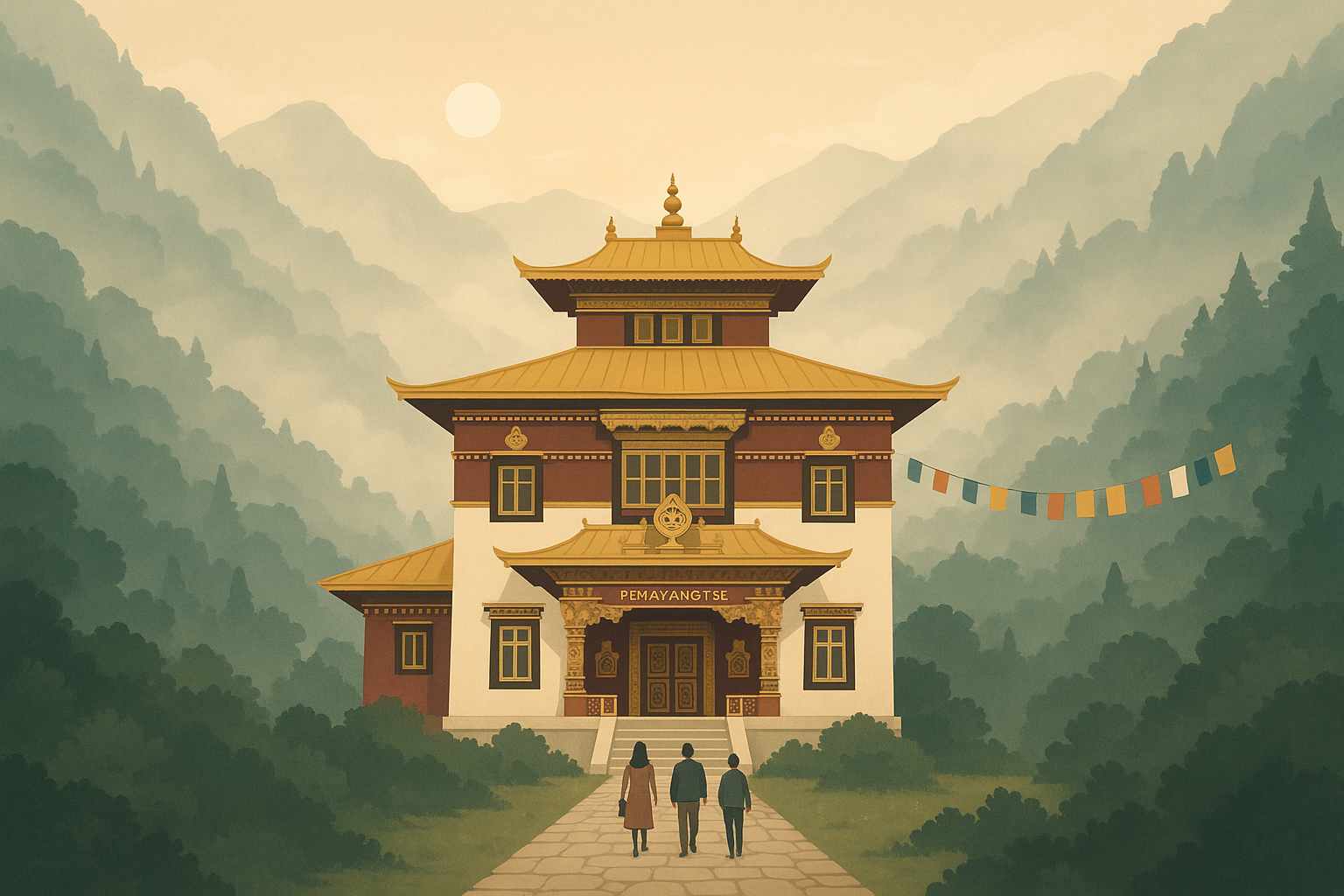
Pemayangtse Monastery, also called Sangchen Pemayangtse, is one of Sikkim’s oldest and most important Buddhist monasteries. It stands near Pelling and Rabdentse in today’s Gyalshing district, looking across the western Sikkim landscape toward the Himalayan ranges.
The monastery is not simply a scenic stop. It is a living religious institution of the Nyingma tradition, connected to the formation of the former Kingdom of Sikkim and to continuing prayer, education and community life. A responsible account therefore separates documented history from devotional interpretation and treats visitor access as something to confirm, not assume.
History and the Nyingma tradition
The Government of Sikkim’s heritage tourism page identifies Pemayangtse as one of the state’s oldest monasteries and says it was originally established by Lhatsun Chempo. He was one of the revered lamas involved in the consecration of Sikkim’s first Chogyal in 1642.
Pemayangtse belongs to the Nyingma school of Tibetan Buddhism. Official accounts describe it as a premier monastery that was entrusted with religious functions for Sikkim’s former monarch. This helps explain why its history is interwoven with both monastic authority and the institutions of the old kingdom.
Popular articles often assign a single precise construction year to the whole complex. The safer account is that Pemayangtse’s religious foundation is associated with Lhatsun Chempo and that the monastery developed across later periods. Buildings, artworks and institutions do not necessarily share one date.
What the name means
“Pemayangtse” is commonly translated as “Perfect Sublime Lotus.” The name has spiritual significance, but a translation alone does not explain the monastery’s full history or practice. The state heritage account also records that the institution was established for “pure monks,” known there as Ta-Sang.
Older descriptions connect that category to inherited ideas about ritual qualification and monastic status. It is better to preserve the historical term without turning it into a modern judgement about people or communities.
The monastery and Sikkim’s former monarchy
The consecration of the first Chogyal at Yuksom is a central event in Sikkim’s political and religious history. The Government of Sikkim’s Ecclesiastical Affairs history names Pemayangtse among six premier monasteries founded with the blessing of the three pioneer lamas associated with that event.
Pemayangtse later performed religious functions for the monarchy. This does not make every legend about palace and monastery demonstrable fact, but it does show that the institution occupied an important ceremonial position in the former kingdom.
Architecture, paintings and sacred objects
The monastery’s multi-storey structure contains wall paintings, sculptures and images connected with Guru Padmasambhava. The Government of India’s tourism-planning material notes its wall paintings, sculpture and a gold-plated image of Guru Padmasambhava.
These are sacred works in an active monastery, not only museum objects. Interior access and photography rules can change, and some spaces or rituals may not be open to visitors. Follow instructions given on site and never use flash or photograph worshippers without permission.
The Sang-tok-palri masterpiece
A major work inside Pemayangtse is the intricate wooden representation of Sang-tok-palri, described by the Government of Sikkim as the heavenly palace of the Maha Guru and a masterpiece created by Dungzin Rimpoche. It is often represented as a tiered celestial realm filled with figures and architectural detail.
The work is best approached as a devotional vision embodied through craftsmanship. Calling it merely a tourist attraction misses its religious setting; extravagant claims about exact dimensions or years of labour should not be repeated without a reliable catalogue or conservation record.
A living monastery
Pemayangtse continues to host prayer and religious gatherings. A 2025 notice issued through Sikkim’s Information and Public Relations Department described a ten-day Leu Dun Bum-Ther Monlam Chenmo at the monastery and asked participants to maintain a plastic-free, vegetarian environment. The specific dates are past, but the notice documents the institution’s continuing ritual and community role.
Festival dates follow religious calendars and local announcements. Do not plan a visit around an old article’s fixed February or March dates; consult a current government or monastery notice instead.
Pemayangtse and Rabdentse
Rabdentse was the second capital of the former Kingdom of Sikkim. Its ruins lie within walking distance of Pemayangtse, according to the state heritage portal. The two places form a valuable historical itinerary, but they are distinct sites: the monastery is a living religious institution, while Rabdentse is an archaeological and former royal site.
The Government of Sikkim’s tourism planning report identifies the Rabdentse ruins as being under the Archaeological Survey of India. Visitors should follow the separate rules and opening arrangements for each place.
Location and landscape
Pemayangtse is near Pelling in western Sikkim. The official state destination guide places it less than a kilometre from Pelling and describes Pelling as being around 10 kilometres from Gyalshing. Road conditions and measured distances can vary by route, so live navigation and local transport advice are more useful than a timeless journey-duration promise.
The hilltop setting can offer broad mountain and countryside views when weather permits. Clouds, rain and seasonal visibility mean that no article should guarantee a clear view of Khangchendzonga.
How to visit respectfully
- Confirm current opening hours, entry arrangements, road conditions and local advisories shortly before travelling.
- Dress modestly, speak quietly and yield space to monks and worshippers.
- Ask before photographing interiors, ceremonies or people; obey every no-photography sign.
- Do not touch murals, statues, manuscripts or the Sang-tok-palri model.
- Walk around sacred structures only in the direction indicated locally.
- Carry waste out, avoid single-use plastic where requested and do not bring food into restricted areas.
- Do not describe a private religious experience as though it were guaranteed for every visitor.
Planning the wider heritage route
Pemayangtse and Rabdentse can be considered together, but allow enough time to experience each on its own terms. Sanga Choling Monastery and other religious places around Pelling have their own histories, rules and routes; they should not be collapsed into one generic “monastery circuit.”
Weather, landslides and road works can affect travel in the hills. Use current Sikkim government and district notices, licensed local transport and on-site guidance. The older duplicate article’s quoted fees, universal daily hours and absolute photography ban have been removed because no current official source verifies them as permanent rules.
Frequently asked questions
Why is Pemayangtse Monastery important?
It is one of Sikkim’s oldest premier monasteries, belongs to the Nyingma tradition and historically performed religious functions for the former monarchy. It remains a living institution.
Who founded Pemayangtse?
The Government of Sikkim attributes its original establishment to Lhatsun Chempo, one of the lamas associated with the consecration of Sikkim’s first Chogyal.
What is Sang-tok-palri?
At Pemayangtse it is an elaborate wooden representation of the Maha Guru’s heavenly palace, credited in the state heritage account to Dungzin Rimpoche.
Is Rabdentse part of the monastery?
No. The former-capital ruins are nearby and historically connected to the same royal landscape, but they are a separate heritage site.
Can visitors take photographs inside?
Do not assume so. Rules may differ by room, object, ceremony and date. Check signs and ask the monastery before taking any interior photograph.