
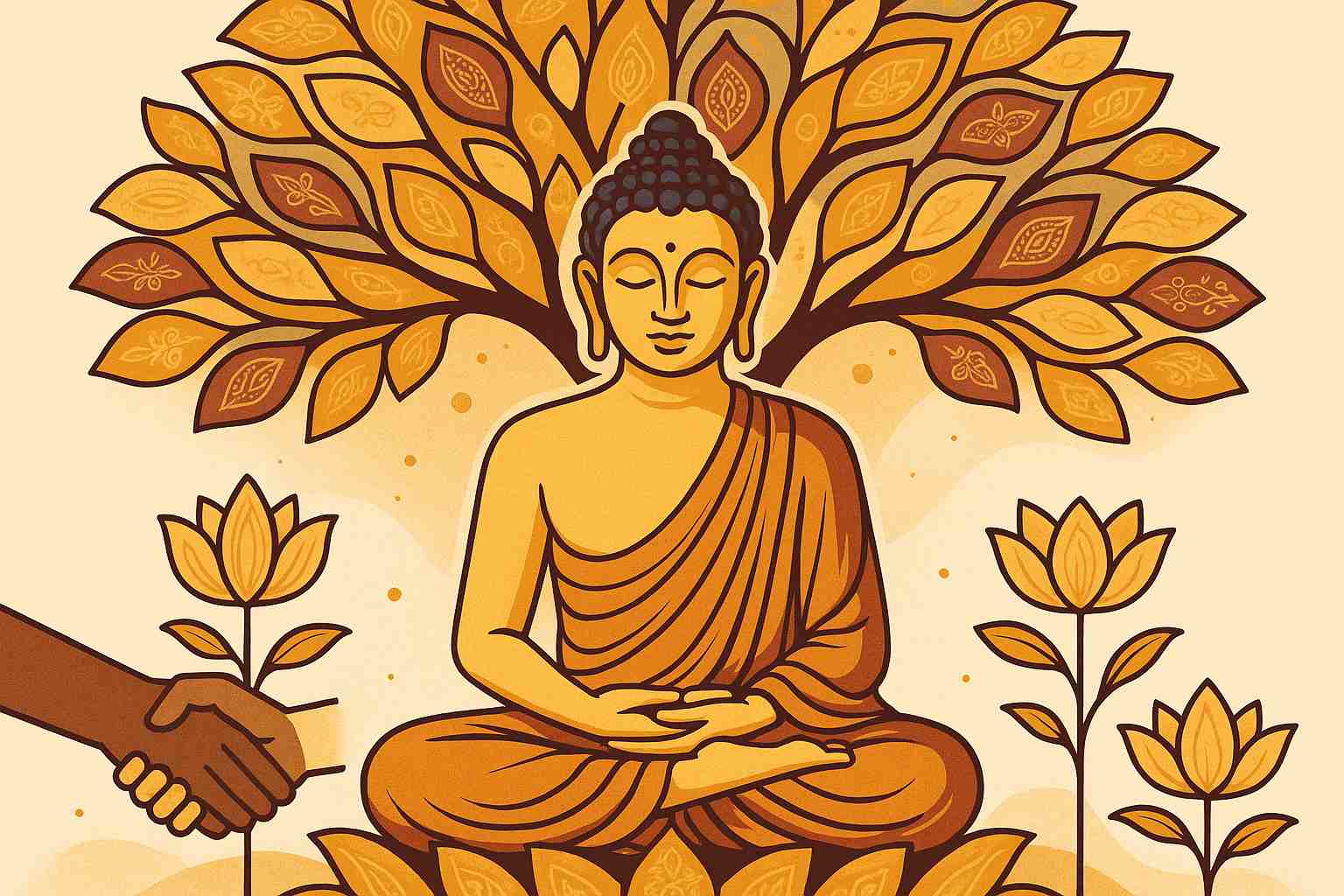
Navayana Buddhism- Explores a New Perspective
In the vast tapestry of Indian spirituality, faith is often a legacy we inherit, a path our ancestors walked. But sometimes, faith becomes a choice—a powerful, conscious decision to forge a new path. It becomes a statement, a revolution. This is the story of Navayana Buddhism, the "New Vehicle," a stream of thought that reimagines ancient wisdom to fight modern injustice. It’s a journey that began not in a quiet monastery, but in the heart of a struggle for human dignity.
The Dawn of a New Path: Dr. Ambedkar's Vision
To understand Navayana, we must first understand the man behind it: Dr. B.R. Ambedkar. He wasn't just the architect of our Constitution; he was a visionary who felt the deep wounds of the caste system personally. Born into a community deemed "untouchable," he saw how faith could be used to justify oppression. He searched for a spiritual home that embraced liberty, equality, and fraternity—values he held sacred.
His search led him to the teachings of the Buddha. He saw in Buddhism a rational, ethical, and egalitarian philosophy that stood in stark contrast to the rigid hierarchies of the caste system. So, in 1956, in a historic event in Nagpur, he, along with hundreds of thousands of his followers, embraced Buddhism. This wasn't just a conversion; it was a mass reclamation of identity and self-respect. This monumental act gave birth to Navayana Buddhism, a path crafted for the modern world, focusing on solving real-world problems.
The Core of Navayana: Justice Over Nirvana
So, what makes Navayana Buddhism different? It fundamentally shifts the focus from individual enlightenment (nirvana) to collective social liberation. Dr. Ambedkar wasn't just adopting an old religion; he was reinterpreting it to serve humanity in a new way. He believed that spiritual growth is meaningless if society remains shackled by inequality.
Here are some of the foundational ideas that make Navayana a unique vehicle for change:
- Reinterpreting the Four Noble Truths: In traditional Buddhism, the First Noble Truth is that "life is suffering." Navayana interprets this suffering not as an inherent part of existence, but as a direct result of social structures like caste discrimination, poverty, and inequality. The solution, therefore, is not just inner peace but a relentless struggle for social justice.
- A Critical Look at Karma and Rebirth: Dr. Ambedkar boldly rejected the traditional concepts of karma and rebirth. He argued that for centuries, these ideas had been misused to justify the caste system, telling people their low status was a result of past-life actions, thus trapping them in a cycle of helplessness. Navayana encourages people to focus on their actions in *this* life to create a just society for everyone.
- Emphasis on Rationality and Action: Navayana discourages blind faith and complex rituals. Instead, it promotes a rational, scientific approach to life, encouraging education and direct social action. The guiding principles are found in the "22 vows" that Dr. Ambedkar administered, which include pledges to reject the caste system, refuse to worship traditional Hindu deities, and live a life based on the Buddha's principles of equality and compassion.
How is Navayana Different from Mahayana and Theravada?
Many of us are familiar with Theravada Buddhism, which focuses on personal liberation through monastic discipline, or Mahayana Buddhism, which emphasizes the path of the Bodhisattva, a being who delays their own nirvana to help all others. Navayana charts a third course.
While all paths spring from the Buddha's teachings, their goals diverge. Think of it this way: if Theravada is about lighting your own lamp and Mahayana is about lighting the lamps of others, Navayana is about rebuilding the entire house so everyone's lamp can burn brightly and safely. It's less about metaphysical questions and more about creating a just and equitable society here and now. It’s a pragmatic, action-oriented philosophy designed to dismantle oppressive systems.
If you're curious to explore this further and understand the nuances, Bhaktilipi offers insightful articles that break down complex philosophies. For a deeper dive, you can read our piece on Navayana: A Modern Perspective on Buddhism Explained. It’s a great starting point to see how this revolutionary path took shape.
A Living Legacy: Navayana's Impact on Modern India
The rise of Navayana Buddhism has had a profound and lasting impact on Indian society, especially among Dalit communities. It has provided a powerful new identity, fostering a sense of pride, self-worth, and unity. For millions, it was the first step towards breaking free from centuries of mental and social slavery.
Today, Navayana is not just a religion; it's a vibrant social and political movement. Its principles inspire art, literature, and activism across the country. It has brought the conversation around caste to the global stage and continues to empower younger generations who seek a spiritual path that is both intellectually satisfying and socially responsible. It is primarily practiced in India but has gained attention worldwide for its powerful message of social justice.
A Path for Our Times
Navayana Buddhism is a powerful reminder that faith can be a dynamic force for good. It teaches us that spirituality isn't about escaping the world but about engaging with it and transforming it for the better. Dr. Ambedkar's vision was to create a society where every individual could live with dignity, free from oppression.
At Bhaktilipi, we believe in sharing stories and philosophies that inspire and connect. Understanding movements like Navayana helps us appreciate the diverse ways people find meaning and strive for a better world. To continue your exploration, we invite you to read more on how Navayana offers a fresh perspective on ancient wisdom.
Ultimately, the "New Vehicle" carries a timeless message: the path to true liberation is paved with equality, compassion, and a relentless pursuit of justice for all.
A passionate group of people dedicated to preserving India's knowledge of Dharma, Karma, and Bhakti for ourselves and the world 🙏.
Comments
Related in
Exploring the Navayana - Buddhism's Modern Path
In our hearts, many of us carry a quiet longing—a desire for a spiritual path that doesn’t ask us to leave our minds at the door. We seek a faith that speaks not only of inner peace but also of justice and dignity in the world around us.
Exploring Spiritual Heritage-Navayana and Iconic Temples in Faridabad
Sometimes, we think we know a city. We see the tall buildings, the busy roads, the rush of daily life, and we assume that’s the whole story. I used to think of Faridabad that way – a bustling industrial hub, a close cousin to Delhi. But beneath this modern surface,
Exploring the New Path-Navayana Buddhism Explained
In the vast spiritual landscape of India, we often search for a path that speaks not just to our souls, but also to our everyday reality. We look for a belief system that feels just, fair, and relevant to the world we live in. Imagine a spiritual journey that began