
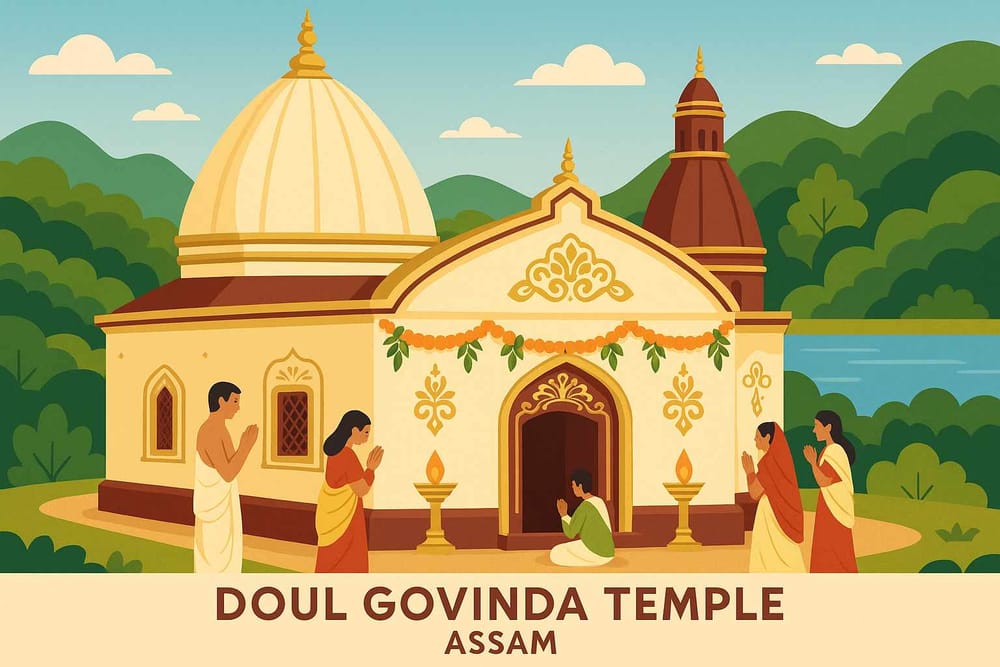
Kings Build Doul Govinda Temple-Explore the Legacy
There's a special kind of peace that settles over you when you're by the banks of the mighty Brahmaputra in North Guwahati. As the river flows, it seems to carry with it centuries of stories. And nestled right there, at the foothills of Chandra Bharati hill, is a place that holds one of the most beautiful of these stories: the Doul Govinda Temple. When you stand before its serene structure, you might wonder, "Which great king built this magnificent mandir?" It's a natural question to ask, as we often link grand temples to royal patronage. But the story of Doul Govinda is a little different, and in many ways, far more magical. It's a story that begins not with a royal decree, but with a devotee's love and a divine miracle.
The Heart of the Legend: How Lord Govinda Arrived in North Guwahati
The journey of the deity we worship today didn't start in a palace. It began with a pious man named Ganga Ram Barooah. He brought the sacred idol of Lord Krishna from a place called Sandhyasar, near Nalbari. But how the idol was found there is a tale that gives you goosebumps.
Local legends, passed down through generations, speak of a Brahmin's cow that would wander into the Sandhyasar forest and mysteriously pour its milk over a specific spot every single day. Curious and awestruck, the villagers decided to dig at that very spot. What they unearthed was not treasure, but something infinitely more precious – the beautiful idol of Lord Krishna. It was a sign, a divine blessing for the land. This very idol, discovered through a miracle, was the one Ganga Ram Barooah enshrined, beginning the legacy of the Doul Govinda Temple.
The Hands That Built the Temple: A Tapestry of Faith and Patronage
So, if not one single king, who built the temple? The truth is, the Doul Govinda Temple is a testament to the power of collective faith (shraddha) and community effort. The original structure, built over 150 years ago, was a humble place of worship, born from the devotion of the people. It was their contributions, their labour, and their unwavering belief that gave Lord Govinda his first home here.
Of course, the great royal dynasties of the region played a crucial role. The Ahom kings, such as Rudra Singha and Shiva Singha, were great patrons of Vaishnavism and built many temples across Assam. Before them, King Parikshit Narayan of the Koch dynasty had his capital near this very site. While they may not have laid the foundation stone of this specific temple, their support for the Vaishnavite culture created an environment where a sacred place like Doul Govinda could flourish and be sustained. Their patronage nurtured the spiritual soil of Assam, allowing the seeds of devotion planted by ordinary people to grow into a magnificent tree.
This pattern of royal patronage shaping spiritual landscapes is a beautiful part of our country's history. It reminds us of other great rulers, like those from the Chaulukya dynasty, whose devotion left an indelible mark on their kingdoms.
A Glimpse into the Temple's Soul: Architecture and Daily Worship
The temple you see today was beautifully renovated in 1966, blending the traditional Assamese Namghar style with modern elements. It has a peaceful sanctum sanctorum (the Garbhagriha) and a large hall where devotees can sit, pray, and feel connected to the divine. It’s not about overwhelming grandeur, but about a simple, heartfelt aesthetic that welcomes everyone.
The real magic, however, is in its daily life. The air fills with the sound of bells during the morning prayers, the idol is lovingly bathed, and in the evening, the Arati ceremony with its chorus of devotional songs (kirtans) can transport you to another world. Offerings of "Bhoga" and "Sarai" are made to the Lord, and the "Prasada" distributed afterwards feels like a true blessing. It’s a living, breathing centre of faith.
When the Temple Comes Alive: The Grandeur of Doul Utsav
While the temple is peaceful year-round, it transforms into a vibrant sea of joy during Holi, celebrated here as Doul Utsav. For five days, thousands of pilgrims from every corner of the state gather here. The air is thick with the scent of 'faku' (coloured powder) and the sounds of laughter and devotional music. It’s a spectacular sight, a festival that truly captures the playful and loving spirit of Lord Krishna. Janmashtami, the Lord's birthday, is another festival celebrated with immense enthusiasm and devotion.
These celebrations are more than just festivals; they are a thread that ties the community together, a tradition that has been kept alive with love for over a century and a half. This dedication to preserving our heritage is something we deeply cherish at Bhaktilipi. We believe that stories of faith, like that of the Doul Govinda Temple, are the soul of our culture. By reading and sharing these timeless tales on Bhaktilipi.in, we keep these traditions alive for the next generation.
Understanding the Legacy of Doul Govinda
Many visitors come with questions, curious about the deep history of this sacred place. People often ask what makes this temple so unique. It’s the combination of its miraculous origin story, its serene location on the Brahmaputra's banks, and its foundation built on community faith rather than a singular royal command.
If you're wondering about the best way to reach the temple, the journey itself is part of the experience. You can travel by road through North Guwahati, or take a scenic ferry ride across the Brahmaputra, watching the city and the hills from the water. This peaceful boat journey often feels like the perfect way to prepare your mind for the spiritual solace that awaits.
The true significance of the Doul Govinda Temple lies in its role as the heart of Vaishnavite culture in Assam. It’s a spiritual anchor for countless devotees, a place where history, faith, and culture meet, reminding us that the most enduring legacies are often built not with stone and gold, but with pure devotion and love.
A passionate group of people dedicated to preserving India's knowledge of Dharma, Karma, and Bhakti for ourselves and the world 🙏.
Comments
Related in
Doul Govinda Temple: History and Architecture Define Sacred Site
Imagine standing on a gentle hill, with the mighty Brahmaputra river flowing serenely below. A soft breeze carries the faint sound of temple bells, and a feeling of profound peace settles in your heart. This isn't just a dream; it's the everyday reality at the Doul
Doul Govinda Temple FAQs: Get Answers Now
There are some places where you don't just go, you arrive. The journey itself becomes a part of the darshan. Imagine a gentle ferry ride, the vast, calming expanse of the Brahmaputra River around you, and the first glimpse of a serene temple nestled on the northern bank.

Holi 2025 at Doul Govinda Temple-Guwahati: Your Complete Guide
There's a certain magic that fills the air in Assam as spring arrives. The gentle breeze carries the sweet scent of new blossoms and the faint, rhythmic sound of the khol and taal. On the northern bank of the mighty Brahmaputra, nestled on the Chandra Bharati Hill, lies