
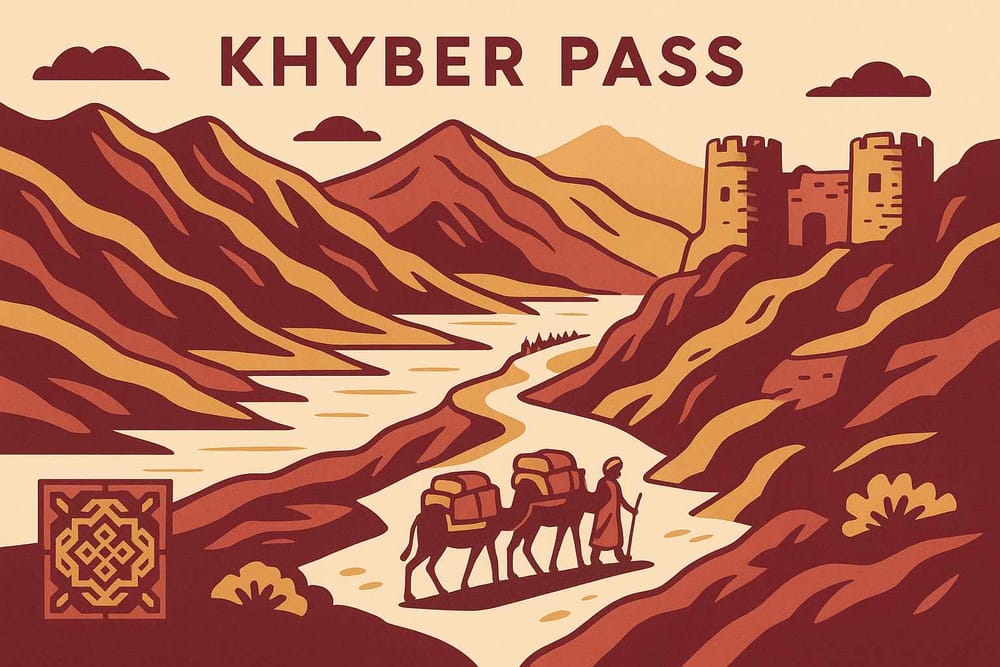
Khyber Pass Historical Significance - UPSC 2025 Insights
Imagine standing between towering, rugged mountains, a gust of wind carrying stories from a time long past. This isn't just any mountain pass; this is the Khyber Pass, a legendary corridor carved through the mighty Hindu Kush. For centuries, it has been more than just a 53-kilometre stretch of land; it has been the very artery connecting Central Asia to the soul of the Indian subcontinent. It has seen the dust of mighty armies, heard the soft footsteps of monks, and felt the weight of treasures traveling along the Silk Road. For anyone preparing for the UPSC 2025, understanding the Khyber Pass isn't just about memorizing facts; it's about listening to the echoes of our own complex and vibrant history.
A Corridor of Conquests and Culture
The Khyber Pass was not just a route; it was the stage upon which history unfolded. Its strategic location made it the natural gateway for anyone with ambitions of entering the fertile plains of India. This is why many people wonder which powerful empires used this pass for invasions. The answer is written across the pages of our history books.
- The Footsteps of Invaders: From the ancient Persians under Darius I to Alexander the Great's ambitious march, this pass has felt the tread of conquerors. Later, figures like Mahmud of Ghazni, Muhammad Ghori, and the founder of the Mughal Empire, Babur, all used this very route to shape the destiny of the subcontinent. Each invasion wasn't just a military campaign; it was a cultural churn, introducing new ideas, languages, and governance that have left an indelible mark on India.
- The Path of Faith and Ideas: But the pass was not only for warriors. It was also a conduit for peace and spirituality. It was through this rugged terrain that the profound teachings of Buddhism traveled from India into Central Asia and beyond. In the centuries that followed, it also became a primary route for the spread of Islam into the subcontinent, weaving new threads into our diverse cultural fabric.
The Great Game and Its Enduring Strategic Value
One must ask why the Khyber Pass is so strategically important, both then and now. The answer lies in its geography. It is the most direct and accessible link between the heart of Asia and the vastness of South Asia. Whoever controlled the Khyber Pass, controlled the flow of trade, the movement of armies, and the security of the entire region.
During the 19th century, it became the focal point of the "Great Game," a tense geopolitical rivalry between the British Empire and Tsarist Russia. The British, ever protective of their "jewel in the crown," India, heavily fortified the pass to guard against any potential Russian advance. They built roads, railways, and forts like the imposing Jamrud Fort, understanding that this narrow pass held the key to an empire. Even today, its significance hasn't waned. It remains a vital trade artery between Pakistan and Afghanistan and played a crucial role as a supply route during recent global conflicts, proving that geography’s hold on destiny is timeless.
The Economic Heartbeat of the Silk Road
The Khyber Pass was a glittering jewel on the ancient Silk Road. For centuries, it was through this very passage that caravans laden with silk from China, spices from India, and gems from Central Asia made their way to markets in the Middle East and Europe. This constant flow of goods didn't just create wealth; it fostered a magnificent exchange of cultures. The echoes of these interactions can still be seen in the art, architecture, and traditions of the regions surrounding the pass. This vibrant history reminds us how interconnected our world has always been, and how the pursuit of knowledge and resources has always driven humanity forward, much like the great historical forces that shaped cities like the sacred city of Amritsar, which also stood at a crossroads of culture and history.
Connecting with Our Past to Illuminate Our Future
Studying the Khyber Pass for an exam is one thing, but connecting with the soul of its story is another. It teaches us about resilience, adaptation, and the beautiful intermingling of cultures that defines our subcontinent. At Bhaktilipi, we are dedicated to preserving these timeless stories and the deep spiritual wisdom they hold. We believe that understanding our history is a form of devotion in itself.
Bhaktilipi is your digital sanctuary for devotional literature and sacred stories, reimagined for today’s seeker. We help you explore the profound narratives that have shaped our traditions, offering inspiration and clarity.
- Access authentic spiritual texts and their meanings anytime, anywhere.
- Discover the deep cultural and historical roots of our spiritual practices.
- Find wisdom that can guide you not just in exams like the UPSC, but in life itself.
We invite you to continue this journey of discovery with us. Follow our stories and join our community on:
Conclusion: The Khyber Pass as a Teacher
The Khyber Pass is more than a chapter in a history book; it is a timeless teacher. It shows us how geography can write the destiny of nations and how the exchange of ideas is as powerful as the clash of armies. For every UPSC aspirant, its story is a powerful reminder that our past is not a distant, forgotten land. It is a living presence that informs our present and shapes our future. As you prepare for 2025, let the lessons from this ancient gateway inspire you to understand the beautiful, complex, and interconnected tapestry of our Indian heritage.
A passionate group of people dedicated to preserving India's knowledge of Dharma, Karma, and Bhakti for ourselves and the world 🙏.