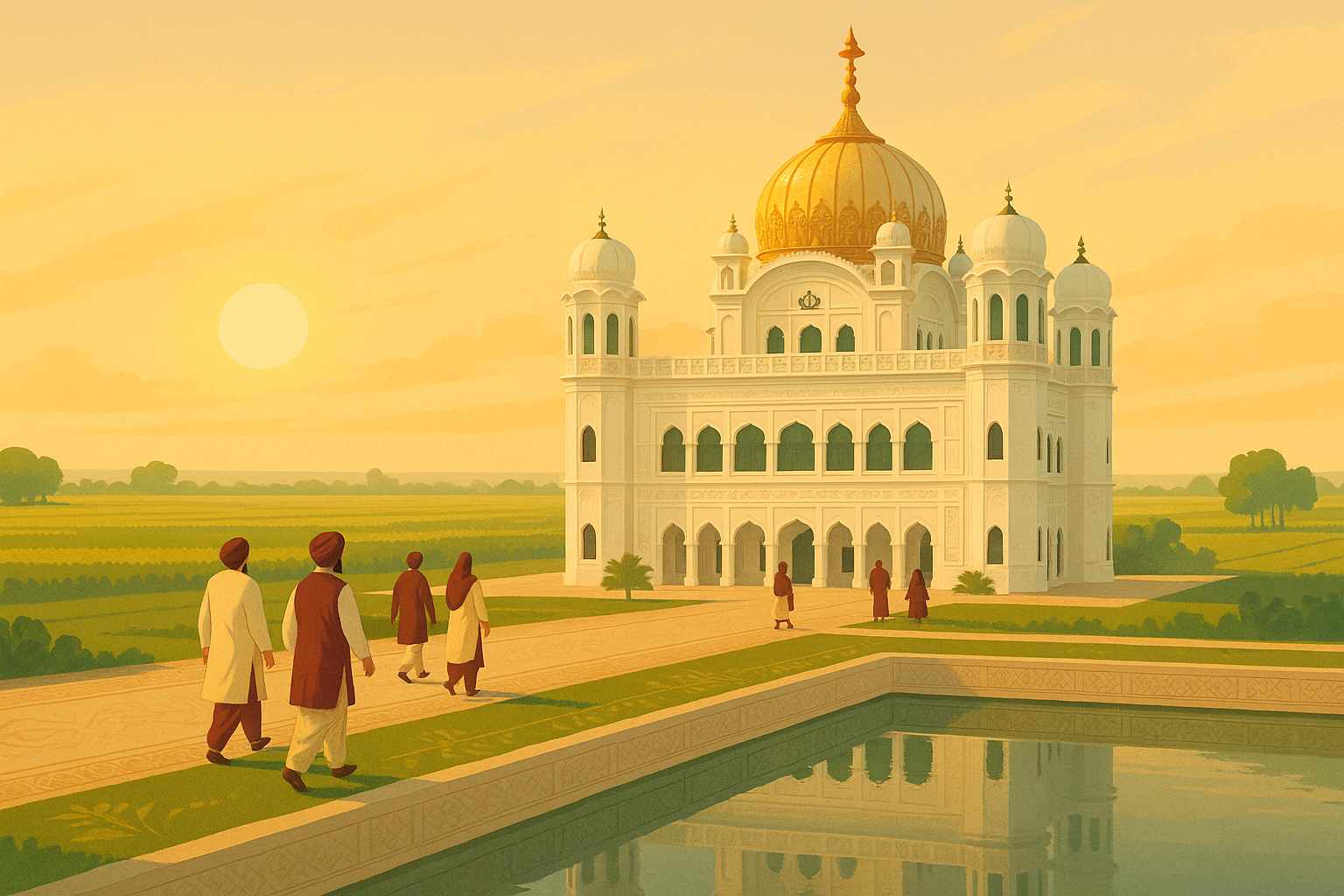
Gurdwara Darbar Sahib at Kartarpur in Pakistan marks the place where Guru Nanak, the founder of Sikh tradition, spent the final years of his life. The Kartarpur Corridor was created to let eligible pilgrims travel from Dera Baba Nanak in India to the gurdwara without a conventional visa, subject to official permission and border procedures.
Current corridor status: as checked on 3 November 2026, the Government of India’s official Kartarpur portal states that corridor services are “suspended till further directions” because of the prevailing security situation. Do not make travel bookings or rely on an old 2025 guide. Check the Ministry of Home Affairs portal for any later reopening notice.
Why Kartarpur Sahib is sacred
Kartarpur stands on the west bank of the Ravi in today’s Narowal district of Pakistan. The official Indian pilgrimage portal states that Guru Nanak spent the last 18 years of his life there. Sikh tradition remembers Kartarpur as a community shaped by devotion, honest work and sharing.
The place is associated with naam japna (remembrance of the divine), kirat karni (honest work) and vand chhakna (sharing with others). These familiar summaries help beginners, but the gurdwara should not be treated merely as a symbol or tourist monument. It is an active sacred place centred on Guru Granth Sahib, sangat and seva.
What the Kartarpur Corridor is
The corridor links the passenger terminal at Dera Baba Nanak in Gurdaspur district, Punjab, with Gurdwara Darbar Sahib across the international border. The Indian side includes a road and integrated passenger terminal leading to the border; the gurdwara is about 4.5 kilometres from the border according to the official portal.
India and Pakistan signed the corridor agreement on 24 October 2019, and the corridor opened in November 2019 around the 550th birth anniversary of Guru Nanak. The arrangement provided a dedicated route for Indian citizens and eligible Overseas Citizens of India, with travel normally completed on the same day.
“Visa-free” did not mean document-free or unrestricted entry into Pakistan. When operating, travel required advance registration, approval, an Electronic Travel Authorization and immigration, customs and security processing. Pilgrims were permitted to visit Kartarpur Sahib through the corridor, not use it as a general border crossing.
Current corridor status
The live Ministry of Home Affairs portal is the controlling source for applicants travelling from India. On 3 November 2026 it displays a suspension notice and says services remain suspended until further directions.
This status can change through a government decision. A blog cannot safely predict a reopening date, and a visible application form or old FAQ does not override the suspension banner. Verify all of the following on the official portal before planning:
- whether the corridor is operating on the intended date;
- who is currently eligible;
- how far in advance applications are accepted;
- which passport, OCI, photograph and authorization documents are required;
- fees or service charges, if any;
- baggage, currency, prohibited-item and health rules;
- reporting time, transport and same-day return requirements.
If corridor services resume
The following describes the established official process only as background. Requirements must be rechecked after any reopening.
Registration and approval
The Ministry of Home Affairs portal has been the official registration channel. It states that registration itself does not create a right to travel. Approved applicants receive or download an Electronic Travel Authorization (ETA) tied to the travel date.
Documents
Past official instructions required Indian pilgrims to hold a valid Indian passport. Eligible OCI cardholders needed their valid foreign passport and OCI card. Scanned photographs and document pages were required during the online application, and travellers had to carry their ETA and original documents.
Departure and return
Processing took place at the Passenger Terminal Building at Dera Baba Nanak. Pilgrims passed immigration, customs and security controls, travelled to the gurdwara and returned the same day. The ETA did not authorize travel elsewhere in Pakistan.
Baggage and prohibited items
The portal published weight limits and a negative list. These are operational rules and may change if services reopen. Never use a copied blog checklist as the final authority.
Kartarpur is not the Attari–Wagah route
The dedicated corridor begins at Dera Baba Nanak, not at the Attari–Wagah land crossing. Travel to Pakistan under a regular visa or an organised religious-shrine protocol is a separate process. An older article that tells corridor pilgrims to use Attari–Wagah mixes two different routes.
Likewise, viewing the gurdwara from the Indian side near Dera Baba Nanak is not the same as crossing through the corridor. When the corridor is suspended, local access to Dera Baba Nanak may continue, but border-area instructions must still be followed.
Respectful conduct at the gurdwara
- Cover your head and remove footwear in the designated area.
- Wash hands and follow local instructions before entering the prayer space.
- Dress modestly and keep phones quiet.
- Do not photograph Guru Granth Sahib, worshippers, security areas or ceremonies where photography is restricted.
- Sit respectfully in the congregation without treating seating arrangements as a spectacle.
- Accept langar respectfully, take only what you can eat and avoid waste.
- Offer seva only through appropriate channels and follow the guidance of sevadars.
- Avoid tobacco, alcohol and intoxicants, which are prohibited in gurdwara settings and on the official corridor premises.
People of different backgrounds may visit a gurdwara when permitted, but welcome does not remove the responsibility to observe its discipline.
Understanding langar and seva
Langar is the community kitchen and shared meal associated with Sikh practice. It expresses service, hospitality and eating together without social hierarchy. It is not simply free restaurant food.
Seva means selfless service and can include preparing or serving food, cleaning and other community tasks. Visitors should wait for direction rather than inventing a role or photographing volunteers without consent.
Planning without misinformation
- Use the exact official domain ending in
mha.gov.infor Indian corridor status and registration. - Do not pay an agent for a “guaranteed” ETA or special border access.
- Do not send passport scans to an unofficial social-media account.
- Check government advisories again shortly before departure, even after receiving approval.
- Keep refundable travel arrangements where possible because international-border operations can change quickly.
- Use current Punjab Police, district and terminal instructions for local access and crowd management.
Frequently asked questions
Is the Kartarpur Corridor open now?
As checked on 3 November 2026, the official Ministry of Home Affairs portal says services are suspended until further directions. Check the portal for a newer notice.
Is the corridor the same as a normal Pakistan visa?
No. It is a dedicated pilgrimage arrangement with registration, approval, ETA and border processing. When operating, it does not authorize general travel elsewhere in Pakistan.
Where does the corridor start in India?
At the Passenger Terminal Building near Dera Baba Nanak in Gurdaspur district, Punjab—not at Attari–Wagah.
Why is Kartarpur important to Sikhs?
Guru Nanak spent his final years there and established a community remembered through devotion, honest labor, sharing and service.
Can a travel agent guarantee permission?
No. Official registration and government approval control travel. Registration itself does not guarantee authorization.