
Jayapala Tree Identification-Botanical Name and Characteristics Revealed
In the heart of many Indian villages, there are whispers about certain plants. Some are revered for their healing touch, others are offered in daily puja, and a select few are spoken of with a mix of deep respect and caution. The Jayapala tree, or Jamalgota as many of us know it, belongs to this special category. It's not just another tree in the landscape; it's a powerful force of nature, a secret of Ayurveda that demands understanding and wisdom.
This remarkable tree is a living example of how our ancient traditions viewed nature – as a source of both immense healing and potent danger. To truly appreciate its place in our culture, we must look beyond the surface and understand its identity, its characteristics, and the wisdom our ancestors attached to it.
Unveiling the True Identity: The Botanical Name of Jayapala
Every plant in the vast library of Ayurveda has a formal name, a scientific identity that helps us understand its family and lineage. For the Jayapala tree, this name is Croton tiglium. It belongs to the Euphorbiaceae family, a large family of plants, many of which are known for their significant medicinal properties.
While botanists call it *Croton tiglium*, in our homes and local pharmacies, we know it by more familiar names like Jamalgota in Hindi or Purging Croton in English. This tree feels most at home in the warm, damp forests of India and Southeast Asia, thriving in places like Assam, Bengal, and across South India. Its scientific name is a key to unlocking a world of knowledge, but its common names are what connect it to our hearts and histories.
How to Recognise This Powerful Tree?
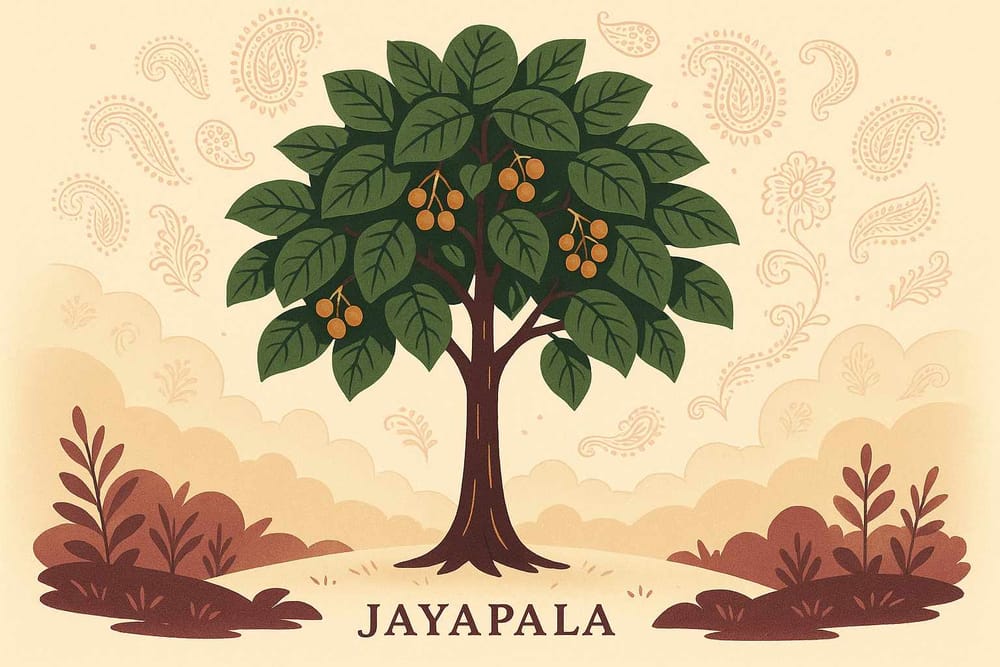
Identifying the Jayapala tree is like getting to know a person with a strong personality. You need to pay attention to the details. It's typically a small, evergreen tree, reaching a height of about 20 feet. Its appearance is quite distinct if you know what to look for.
- The Bark and Leaves: Imagine a tree with smooth, ash-coloured bark. Its leaves are a lovely yellowish-green, shaped like an oval with a pointed tip (ovate-lanceolate). They are thin and have serrated edges, giving them a delicate yet defined look.
- The Flowers and Fruits: The tree blossoms with small, humble, greenish-yellow flowers. From these flowers emerge its most potent part: the fruit. The fruit is a rounded capsule, yellowish when ripe, with three distinct ridges. Inside this capsule lie the powerful seeds.
- The Seeds of Power: The seeds are oval, brown, and have a hard shell. It is these seeds and the oil extracted from them that hold the famous (and infamous) properties of Jayapala. They have a bitter taste and are the primary reason this tree is so significant in traditional medicine.
A Double-Edged Sword: Jayapala in Ayurveda
In Ayurveda, Jayapala is not treated lightly. It is classified as an Upavisha, which means it's a sub-toxic substance. This classification itself is a testament to the deep wisdom of our ancestors. They understood that things with the power to harm could also have the power to heal, but only if handled with extreme care and knowledge.
The seeds are known for their incredibly strong purgative (laxative) properties. However, they are never used in their raw form. Ayurvedic practitioners insist on a process called shodhana (purification) to reduce the toxicity and make the seeds safe for medicinal use. This process is a crucial step that transforms a potential poison into a potent medicine.
After proper purification, Jayapala is used under expert guidance to treat severe constipation, certain skin diseases, and even wounds. But let this be a reminder: this is not a home remedy. The power of Jamalgota should only be wielded by a qualified Ayurvedic doctor. Understanding such powerful elements of our tradition requires deep knowledge, something we strive to share and make accessible at Bhaktilipi.in.
Learning More About the Jayapala Tree
As our curiosity about our roots deepens, many questions naturally arise. For instance, many people wonder, what exactly is the botanical name of the Jayapala tree? As we've learned, its scientific name is *Croton tiglium*, a name that opens the door to global botanical databases and research.
You might also ask, where is this tree commonly found? It grows wild in the tropical and subtropical hills and forests of India, Sri Lanka, and broader Southeast Asia. This native habitat is a key part of its identity.
A very practical question is, how do you identify the Jayapala tree? You can look for its signature smooth, greyish bark, its shiny green ovate leaves, and its distinct three-lobed fruit capsules. Its potent nature also gives its fruit a strong, medicinal scent that is hard to miss.
Given its powerful properties, a crucial concern is whether the Jayapala tree is toxic. The answer is a resounding yes. The seeds, in particular, are highly toxic and should never be consumed or handled without expert knowledge and the proper purification processes.
This leads to the question of what makes the Jayapala tree so unique. Its uniqueness lies in this very duality – its extreme toxicity on one hand, and its profound therapeutic value in Ayurveda on the other. It is a symbol of nature's power and the deep respect required to harness it.
Embracing Our Natural Heritage with Wisdom
The story of the Jayapala tree is a powerful lesson from our heritage. It teaches us that nature is full of wonders, some gentle and some fierce. Recognizing and understanding plants like *Croton tiglium* is not just about expanding our knowledge; it's about connecting with the wisdom of our ancestors who learned to live in harmony with these powerful natural elements.
By cherishing this knowledge, we honour our traditions and ensure that this wisdom is passed on with the same respect and caution it deserves. It reminds us to approach nature not just with curiosity, but with reverence.
Explore a World of Devotion with Bhaktilipi
If you are inspired by the deep wisdom embedded in our traditions, from the stories of our deities to the secrets of sacred plants, Bhaktilipi is your destination. We are dedicated to preserving and sharing this timeless knowledge in a way that resonates with today's world. Discover authentic devotional literature, understand complex rituals, and deepen your spiritual connection with us.
Stay connected to your roots. Subscribe to our YouTube channel for enlightening videos, and follow us on Facebook and Instagram for daily inspiration. Let Bhaktilipi be your companion on your spiritual journey!
A passionate group of people dedicated to preserving India's knowledge of Dharma, Karma, and Bhakti for ourselves and the world 🙏.