
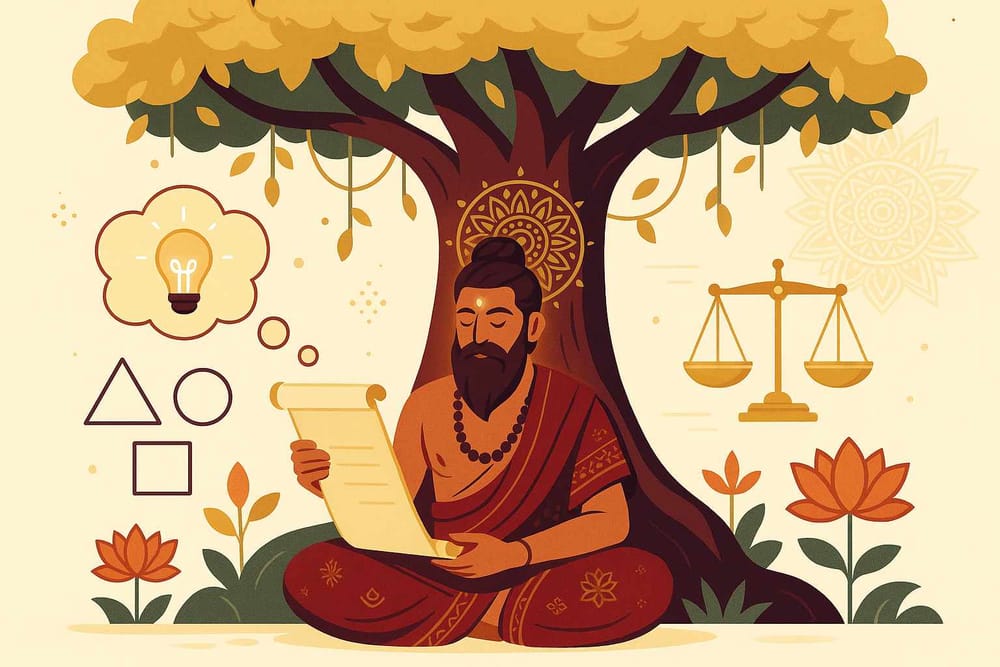
Hetvabhasa in Indian Logic: A 2025 Guide Explains Fallacies
Have you ever been in a family discussion, or maybe watching a heated debate on TV, and felt that something just wasn't right with one of the arguments? You couldn't quite put your finger on it, but the reasoning felt shaky, like a chair with one leg shorter than the others. It’s a common feeling. In our ancient Indian intellectual traditions, our sages and thinkers didn't just feel this; they systematically studied it. They gave it a name: Hetvabhasa.
This isn't some complex, dusty concept reserved for philosophers. It's a practical tool, a mental filter that our ancestors developed to separate truth from falsehood. It’s about learning to think with clarity, a skill more valuable today than ever before. So, let’s sit down together and understand this beautiful concept from our heritage.
What Exactly is This 'Hetvabhasa'?
Let's break down the word. 'Hetu' means 'reason' or 'cause', and 'abhasa' means 'fallacy', 'error', or 'mere appearance'. So, Hetvabhasa is simply a reason that *appears* to be a valid reason but is actually defective. It’s a pseudo-reason, a clever imposter in an argument that can lead us to the wrong conclusion.
This concept is a cornerstone of the Nyaya school of Indian philosophy, which is all about logic and reasoning. Understanding it is crucial because it helps us identify these flawed arguments, whether they come from others or even from our own minds. By spotting a faulty 'hetu', we can strengthen our own thinking and avoid being misled. The entire process of correct inference relies on having a valid reason (hetu) that is inseparably connected to the conclusion. This inseparable connection is a deep concept in itself, known as Vyapti in Indian logic.
The Five Common Traps of Faulty Logic
Our ancient texts, especially the Nyaya Sutras, beautifully classify Hetvabhasa into five main types. Think of these as five common thinking traps we can learn to avoid. Recognizing them can be quite empowering in our daily conversations!
- Savyabhichara (The Irregular or Wandering Reason)This happens when the reason given is not consistently or exclusively connected to the conclusion. It 'wanders' around. For example, if someone says, "He must be a wise man because he has a long beard." We know that while some wise men might have beards, not everyone with a beard is wise, and not all wise men have beards. The reason (long beard) is not a reliable indicator of the conclusion (being wise).
- Viruddha (The Contradictory Reason)This is a fascinating one. Here, the reason you provide actually proves the exact opposite of what you are trying to argue. Imagine someone saying, "We should increase the volume of the music to create a peaceful, quiet environment." The reason (increasing volume) directly contradicts the goal (a quiet environment). It’s a self-defeating argument.
- Asiddha (The Unproven or Assumed Reason)This fallacy occurs when the reason itself is not established or is just an unproven assumption. For instance, arguing that "The golden mountain is on fire because it is smoky." The very existence of a 'golden mountain' is an unproven assumption (Asiddha), so any reasoning based on it is bound to be flawed from the start. In modern times, it's like saying a new product works because of its 'magical ingredient' without any proof that the ingredient even exists or has any effect.
- Satpratipaksha (The Counter-balanced Reason)This happens in debates when you present a reason, and your opponent presents another reason that is equally strong and proves the opposite conclusion. This creates a stalemate, where both arguments cancel each other out, and no conclusion can be reached. It shows that the reasoning is not conclusive enough to stand on its own.
- Badhita (The Contradicted Reason)This fallacy occurs when your conclusion, derived through logic, is directly contradicted by a stronger source of knowledge, like direct perception (Pratyaksha). For example, if someone tries to logically prove to you that "Fire is cold," you can simply touch it (from a safe distance!) and feel the heat. Your direct experience is a stronger proof that immediately invalidates the logical argument.
Why This Ancient Wisdom Matters in Our Modern Lives
You might wonder if this is all just philosophy. But think about it – our daily lives are filled with arguments and information. From advertisements promising miracle results to news clips on social media and even simple discussions at home, we are constantly processing reasons and conclusions. Hetvabhasa is like a shield that protects our minds.
In the age of misinformation, being able to spot an 'Asiddha' (unproven reason) can save you from falling for scams. Understanding 'Viruddha' (contradictory reason) helps you see through political promises that don't add up. This isn't just about winning debates; it’s about making better decisions for yourself and your family. In the grand tradition of *Shastrartha* (scriptural debates), the goal was not to win, but to arrive at the truth. Hetvabhasa was the tool that cleared the path of intellectual clutter.
Your Path to Bhakti & Beyond Starts Here
Exploring deep concepts like Hetvabhasa is a journey into the heart of our culture's immense wisdom. At Bhaktilipi, we believe this knowledge should not be confined to ancient texts but should illuminate our modern lives. We are dedicated to bringing you timeless devotional literature, stories, and traditions in a way that feels personal and inspiring.
We simplify complex spiritual topics, empowering you with authentic knowledge to enrich your spiritual journey. If you seek clarity, inspiration, and a deeper connection to your roots, Bhaktilipi is your companion. To continue this journey with us, subscribe to our newsletter and follow our community on Facebook, Instagram, and YouTube.
Embracing Clarity in Our Thoughts and Words
Hetvabhasa is more than just a logical framework; it is a timeless guide for seeking truth with intellectual honesty. It teaches us to pause, question our assumptions, and demand clarity not just from others, but from ourselves. To avoid these fallacies, we must ensure our reasons are valid, relevant, and supported by genuine evidence.
By embracing these principles, we honor the legacy of rigorous reasoning that has been a hallmark of Indian intellectual tradition for centuries. We learn to build more meaningful dialogues, make more informed choices, and contribute to a world where truth and clarity are valued. Let this ancient wisdom be your tool for a more thoughtful and discerning life.
A passionate group of people dedicated to preserving India's knowledge of Dharma, Karma, and Bhakti for ourselves and the world 🙏.