
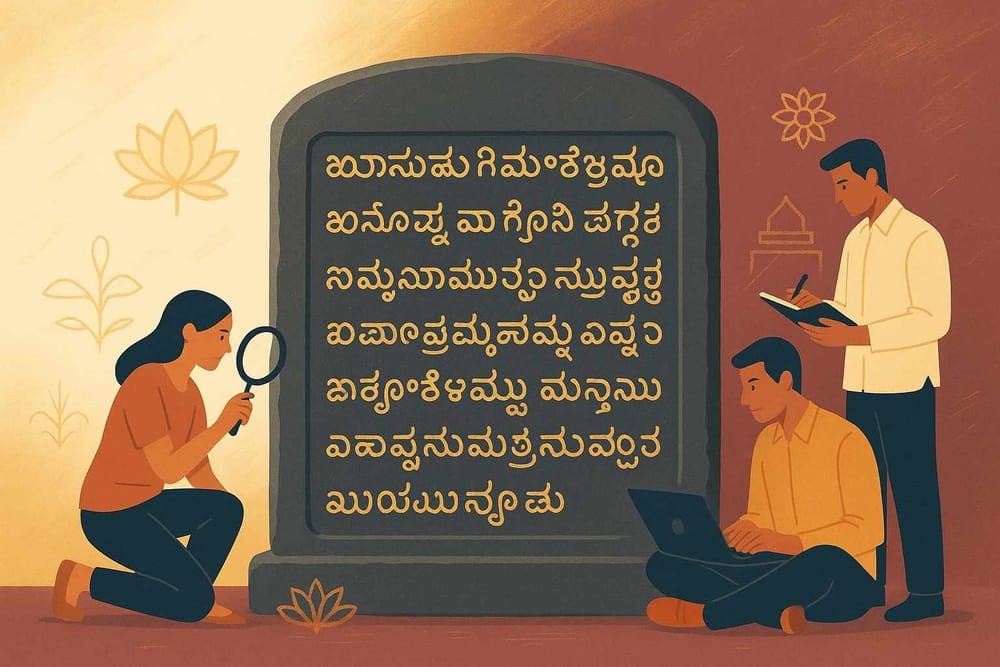
Halmidi Inscription Secrets Emerge: New Insights in 2025
Have you ever held a piece of history in your hands? Not just an old object, but something that whispers tales from a time long forgotten. In a quiet little village called Halmidi in Karnataka's Hassan district, a simple stone slab was found in 1936. This wasn't just any stone; it was the Halmidi Shasana, the very first love letter to the Kannada language, our oldest known inscription, dating all the way back to around 450 CE. It feels like finding the first words of our ancestors, carefully carved for us to read centuries later.
This single piece of sandstone is more than just an artifact; it’s a milestone. It’s the proof of our deep linguistic roots and a window into the life of our forefathers. As we move forward, especially with the renewed interest in our heritage, understanding the story of this stone becomes even more special. It connects us to who we were and who we are today.
A Glimpse into the World of the Kadambas
So, what story does this ancient stone tell us? It transports us back to the time of the Kadamba dynasty, the first rulers to establish a kingdom where Kannada was spoken and cherished. The inscription, etched in a script that is an early form of Kannada evolved from Brahmi, isn't a grand royal decree but something far more personal and powerful. It records a gift of land—two villages—to a brave warrior named Vija-Arasa for his heroism in battle. This tells us that Kannada was not just a language of the people but the language of administration and honor.
Imagine the scene: a kingdom thriving, where local culture and language were given the respect they deserved. The Halmidi inscription reveals a society that was well-organized, with systems for governance and a deep respect for those who protected the land. It’s a beautiful reflection of how royal traditions helped shape and preserve local culture, a practice that has continued through generations.
The Language of Our Soul: Why the Inscription Matters
For anyone who loves language, the Halmidi Shasana is a true treasure. It’s like looking at a family album and seeing the face of your great-great-grandparent for the first time. The script shows the beautiful, budding form of our modern Kannada, with influences from Sanskrit and Prakrit, painting a picture of a time when languages flowed into each other like rivers.
Here’s what makes it so important for us:
- The First Official Stamp: This inscription is the earliest proof we have of Kannada being used in an official capacity. It wasn’t just spoken in homes; it was written, recorded, and used to grant land and honor heroes, giving it a status of great importance.
- A Living History of Words: The text contains unique words and poetic structures that offer clues about ancient dialects. It shows that even 1,500 years ago, Kannada was a rich and expressive language, capable of not just administration but also art. It is a vital link that helps linguists trace the journey of our language through time.
This profound connection to our past is something we at Bhaktilipi hold very dear. Our mission is to safeguard such timeless stories and devotional literature for everyone to experience. If you wish to explore more about how we are keeping our spiritual heritage alive, you can find our collection of timeless works on our platform Bhaktilipi.in.
Bringing Our Heritage Closer to Home
While the original Halmidi inscription is safely preserved at the Government Museum in Bengaluru for all to see, a wonderful new chapter in its story is unfolding. To celebrate our state's history and pride, there's a beautiful initiative to install replicas of the Halmidi Shasana in all 31 district headquarters of Karnataka. This means the voice of our ancestors is no longer confined to a museum but is coming closer to us, into our own cities and towns.
This effort is a perfect example of how we can blend respect for the past with modern ways of sharing knowledge. It reminds us that our history is not meant to be locked away but celebrated and made a part of our daily lives. This act of preserving heritage ensures that the legacy of the Halmidi inscription inspires not just us, but our children and their children too.
A Legacy Etched in Stone, Carried in Our Hearts
The Halmidi inscription is more than just the oldest Kannada record; it's a symbol of our identity and a source of immense pride. It’s a powerful reminder that our roots run deep and our culture has a story that has been unfolding for millennia. Every time we speak, read, or write Kannada, we are continuing a legacy that was formally recorded on that humble stone slab so many centuries ago.
Let's take a moment to appreciate this gift from our past. Let's share its story and feel the connection to the countless generations that came before us. After all, our traditions and our language are the threads that weave us all together into one beautiful family.
If you feel the same connection to our rich heritage and wish to be a part of a community that celebrates it, we invite you to join us. You can stay updated with more such inspiring stories by following Bhaktilipi on social media.
A passionate group of people dedicated to preserving India's knowledge of Dharma, Karma, and Bhakti for ourselves and the world 🙏.