
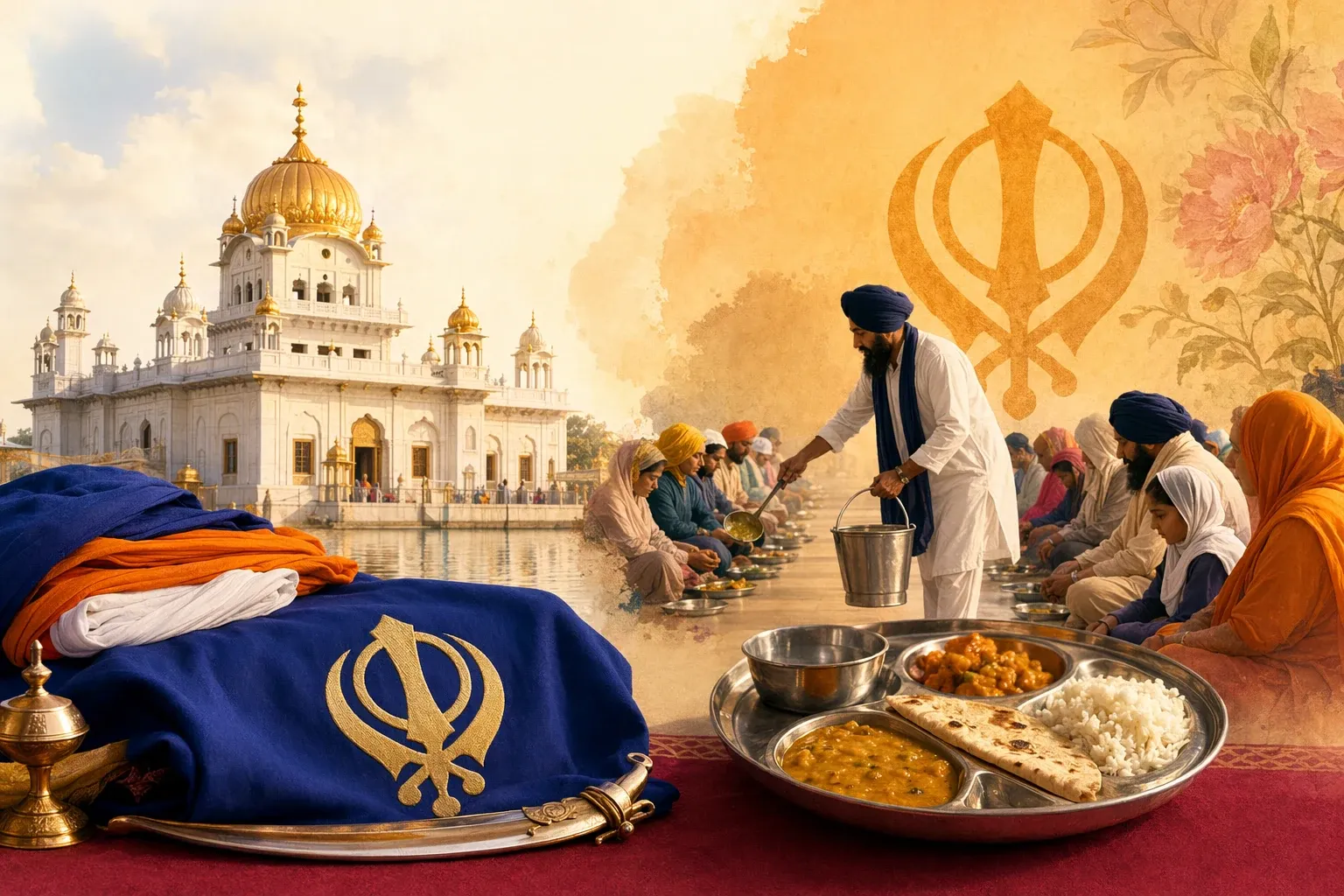
A gurdwara is the Sikh place of worship, and langar is the free community kitchen where people sit together and share food. Together, they show Sikh values in action: remembrance, equality, humility, and service.
For young readers, this is one of the easiest ways to understand Sikhism because the teaching becomes visible. People pray, listen, volunteer, cook, clean, serve, and eat together without asking who deserves dignity.
A gurdwara is the Sikh place of worship, and langar is the free community meal served there. Together, they show Sikh values in action. The gurdwara gathers people for prayer, kirtan, learning, and sangat. Langar turns equality into a lived experience by inviting people to sit and eat together.
Simple answer
The short meaning is this: A gurdwara is the Sikh place of worship, and langar is the free community meal served there. Together, they show Sikh values in action. The gurdwara gathers people for prayer, kirtan, learning, and sangat. Langar turns equality into a lived experience by inviting people to sit and eat together. For a student, this is the safest starting point because it avoids two common mistakes. One mistake is to reduce Sikhism to clothing or food habits. The other is to blur Sikhism into another tradition and ignore its own voice.
Sikhism is learned through sangat, scripture, music, service, memory, and disciplined living. That means the tradition is not only about private belief. It asks what kind of person we become in family life, public life, work, study, and moments of difficulty.
Tradition, interpretation, and historical context
In Sikh tradition, the Gurus are the guiding teachers, and Guru Granth Sahib is honoured as the eternal Guru. Teachings are received not as random inspirational lines, but through devotion, kirtan, reflection, and ethical living. This traditional layer deserves respect because it explains how Sikhs themselves understand the path.
Interpretation asks how the teaching shapes daily life. For example, one person may connect seva with volunteering at langar, another with helping neighbours, another with honest work and sharing earnings. The value remains rooted in Sikh teaching, but the application can appear in many ordinary situations.
Historical context asks how the tradition developed in Punjab, how the Gurus shaped community institutions, and how later Sikh identity responded to social and political pressures. This does not weaken faith. It simply helps readers avoid flat, one-line claims about a rich living tradition.
Key points to remember
- Sangat means the gathered community.
- Pangat means sitting in a line or shared row for the community meal.
- Visitors usually cover the head, remove shoes, and behave respectfully inside a gurdwara.
- Langar is usually vegetarian so that people from different backgrounds can eat together comfortably.
What a gurdwara is
Start with the plain idea before adding details. What a gurdwara is is important because it gives readers a handle on the topic without forcing them to memorise everything at once. A good beginner explanation should answer the basic question, then show why the answer matters in real life.
What happens inside
This section needs careful language. Sikh tradition has its own vocabulary and emotional world, so translations help but never carry the whole feeling. Words such as Guru, sangat, seva, Khalsa, Gurbani, and langar are best explained with examples instead of being reduced to dictionary meanings.
Langar meaning and why everyone sits together
One practical example is the gurdwara. It is not only a building. It is a place where scripture, music, community, food, and service come together. Even when this article is about a different Sikhism topic, the gurdwara helps beginners see how teaching becomes practice.
Basic visitor etiquette
Another useful example is langar. People from different backgrounds sit and eat together. That one act quietly teaches equality, humility, and service. It also shows why Sikh values should not be explained only as abstract beliefs; they are meant to be practiced.
Why this practice expresses Sikh values
For modern readers, this topic is still relevant because young people are asking identity questions: What do I believe? How should I treat others? How do I stay disciplined? What does community mean? Sikhism answers these questions with devotion joined to action.
Common mistakes to avoid
- Do not describe Sikh identity as a costume or a cultural decoration.
- Do not treat all Sikh families as if they follow every practice in exactly the same way.
- Do not blur Sikhism into another religion; shared history does not erase distinct identity.
- Do not quote scripture or tradition without context when the topic needs careful explanation.
Common questions
Where do Sikhs worship?
A gurdwara is the Sikh place of worship, and langar is the free community kitchen. Together they express prayer, equality, service, and welcome.
What is a gurdwara?
A gurdwara is the Sikh place of worship, and langar is the free community kitchen. Together they express prayer, equality, service, and welcome.
What is langar in Sikhism?
A gurdwara is the Sikh place of worship, and langar is the free community kitchen. Together they express prayer, equality, service, and welcome.
What happens in Sikh worship?
A gurdwara is the Sikh place of worship, and langar is the free community kitchen. Together they express prayer, equality, service, and welcome.
Why this matters today
For young readers, Sikhism offers more than facts for a school answer. It gives a model of devotion that should become courage, service, honest living, and respect for human dignity. Whether someone is Sikh or simply learning about Indian traditions, this is a valuable way to understand the subject.
The careful path is to learn with humility. Listen to Sikh voices, understand the role of Guru Granth Sahib, notice the importance of community, and avoid turning living faith into stereotypes. When we do that, the topic becomes clearer and more respectful at the same time.
Gurdwara and langar teach a simple but powerful lesson: spirituality becomes stronger when it feeds people, welcomes people, and reduces ego.