
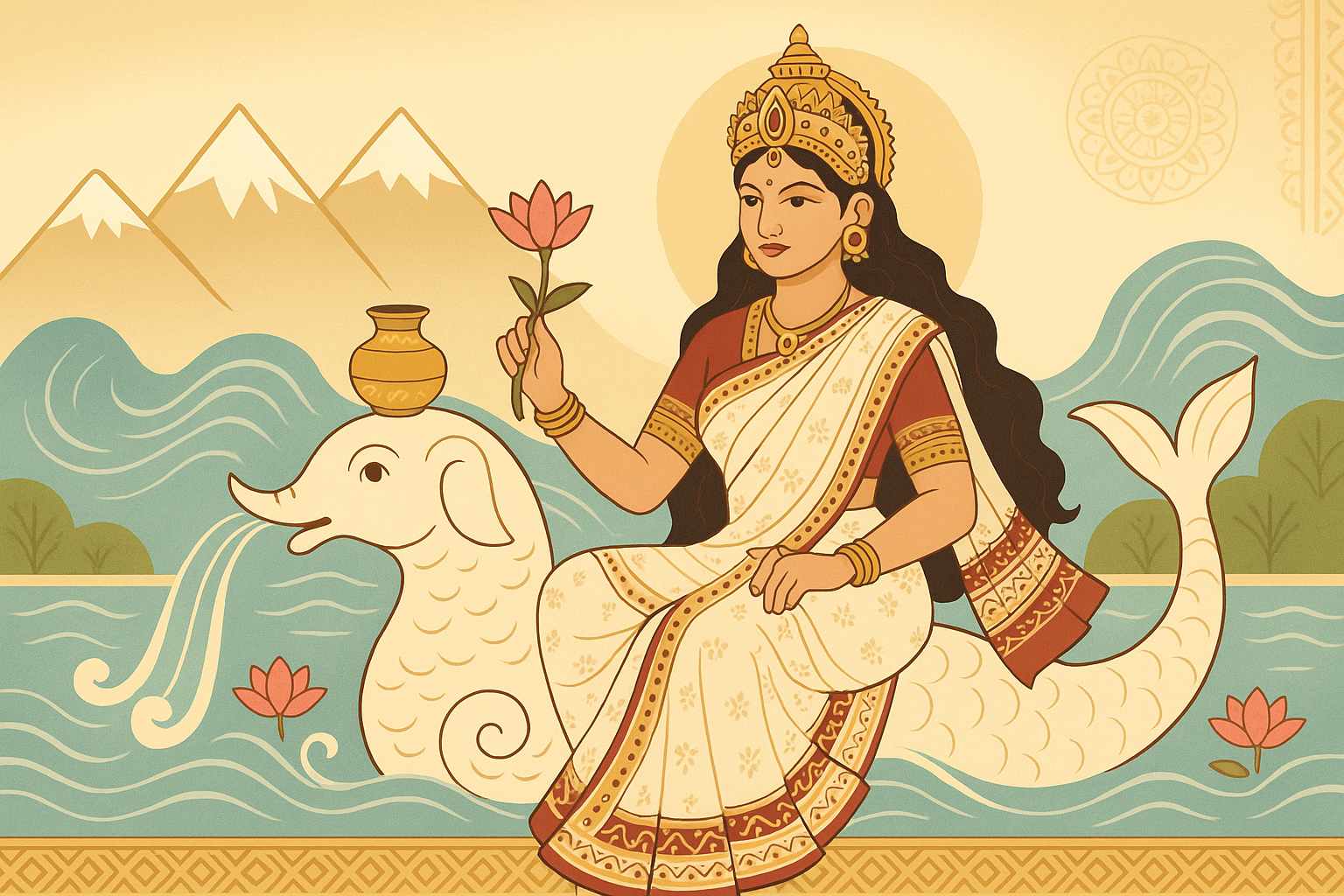
Ganga is both a major river system and a goddess in Hindu traditions. Devotees honour her as Ganga Ma or Mother Ganga, a source of sacred purification, life and liberation. Her stories connect King Bhagiratha's effort, Shiva's matted hair, the ancestors of Sagara and the river's journey through the human world.
Religious meaning, literary narrative, iconography, geography and environmental science are different kinds of knowledge. Sacred purity and measurable water quality answer different questions.
Who is Goddess Ganga?
Ganga personifies the sacred river known in English as the Ganges. In images she can appear as a crowned goddess, often associated with water and the makara, a composite aquatic creature. She may also appear as a small figure in Shiva's hair, recalling the story of her descent.
River goddesses have a long history in South Asian art. The Metropolitan Museum of Art describes rivers as some of the subcontinent's ancient personified deities and identifies the makara as Ganga's vehicle in later iconography.
The descent of Ganga
One of the best-known narratives begins with King Sagara's descendants, whose release requires Ganga to descend from the celestial realm. Bhagiratha performs prolonged austerities to bring her to earth. Because the force of the descent would be overwhelming, Shiva receives Ganga in his matted hair and releases her in a controlled flow.
The story explains the name Bhagirathi, celebrates determined effort and connects divine grace with responsibility. The expression “Bhagiratha effort” can signify an undertaking requiring extraordinary perseverance.
Versions differ among the Ramayana, Mahabharata and Puranic traditions. Details of Ganga's origin, the sequence of events and her divine relationships are not identical in every text. A careful guide identifies the tradition rather than inventing one universal version.
The descent of Ganga is a sacred narrative, not a geological description of the river's formation. Its religious truth and literary meaning should not be disguised as a scientific account.
Why Shiva holds Ganga in his hair
Shiva's role expresses both power and restraint: he can withstand the celestial torrent and make its life-giving arrival possible without destroying the earth. Images of Gangadhara, “bearer of Ganga,” show the goddess emerging from or resting in Shiva's locks.
The Metropolitan Museum's teaching material explains the small Ganga figure in Shiva's hair and the Himalayan symbolism of his crown. This is an iconographic reading of artworks, not evidence that a physical river was literally stored in human hair.
Bhagiratha, Jahnu and multiple names
The upper course is associated with the name Bhagirathi in geography and with Bhagiratha in sacred narrative. Another story says the sage Jahnu swallowed the rushing river and later released her, giving Ganga the epithet Jahnavi.
Names such as Ganga, Bhagirathi and Jahnavi can therefore carry geographic, poetic and theological meanings. They should not be treated as proof that every named channel or story is the same category of fact.
Ganga in the Mahabharata
In the Mahabharata, Ganga also appears as the mother of Bhishma. Her marriage to King Shantanu and the fate of the Vasus form a distinct epic narrative. This relationship should not be collapsed into the Bhagiratha descent story, even though both concern the same goddess.
Epic characters are part of the text's sacred and literary world. Claims about exact modern dates or archaeological proof require independent evidence.
Symbolism and iconography
- Flowing water: renewal, continuity and life.
- White clothing or luminous form: purity in devotional and artistic representation.
- Water vessel: abundance and sacred water.
- Makara: Ganga's aquatic vehicle in common iconography.
- Shiva's hair: the controlled descent of immense power.
- River at a temple doorway: purification and transition into sacred space, often paired with Yamuna in North Indian temple art.
Symbols vary by period, region and medium. A makara alone does not automatically identify every female figure as Ganga; inscription, context, attributes and comparison matter.
Worship and practice
Devotional practices include bathing, offering flowers or lamps, reciting prayers, carrying Ganga water and performing rites for ancestors. At Haridwar, Varanasi and other ghats, forms of Ganga aarti bring worshippers together through lamps, music and prayer.
Ganga Dussehra commemorates the descent of Ganga in many communities. Kartik observances, pilgrimage bathing and local festivals also vary. Dates follow religious calendars and should be checked for the relevant year and place.
Consent and safety matter at crowded ghats. Do not photograph mourners, cremations, private rites or identifiable worshippers without permission. Follow barriers, boat rules and local instructions.
Purification, liberation and ancestor rites
Within Hindu traditions, Ganga is associated with purification from sin and with auspicious passage after death. Families may immerse ashes or perform offerings for ancestors at the river. These practices express theology, grief, continuity and hope.
“Purifies” in this religious context does not mean that the water has been sterilised or made medically safe. Spiritual claims should not be converted into guarantees about infection, toxic exposure or disease treatment.
The physical river
The Ganga river system rises in the Himalayas and flows across northern India into Bangladesh, where distributaries contribute to the great delta before reaching the Bay of Bengal. Names and channels change along the system; the goddess's sacred presence is understood more broadly than one hydrological label.
The river supports cities, farming, ecosystems, transport, pilgrimage and livelihoods. It also faces sewage, industrial discharge, solid waste, altered flows and other pressures. Reverence does not remove the need for monitoring and pollution control.
Water quality and health
The Central Pollution Control Board measures parameters such as dissolved oxygen, biochemical oxygen demand and faecal coliform at multiple locations. Results vary by location and time; one passing measurement does not certify the entire river for every use.
Outdoor-bathing criteria are not drinking-water standards. Never assume untreated river water is safe to drink because it is sacred. People who are pregnant, very young, elderly or immunocompromised should be especially cautious. Avoid swallowing water, cover wounds, wash after exposure and follow current public-health guidance.
Do not use Ganga water instead of medical care. No river water is a proven cure for cancer, infection or chronic illness.
Environmentally responsible devotion
- Use designated offering points and retrieval systems where available.
- Avoid plastic bags, synthetic cloth, foam decorations, chemical colour and non-biodegradable packaging.
- Do not throw food, bottles, idols or cremation waste into the river outside lawful managed practices.
- Choose reusable lamps or managed community ceremonies when possible.
- Do not wash with detergents or release oils and chemicals at the bank.
- Support sanitation, sewage treatment and local clean-up without treating worshippers as spectacle.
Calling the river a goddess can deepen an ethic of care. Conservation is not opposed to devotion; protecting water, habitats and public health can be an expression of responsibility to Ganga.
Common questions
Is Ganga the daughter of Brahma or Vishnu?
Texts and regional traditions give different accounts of her celestial origin. State the source rather than forcing all versions into one family tree.
Why did Shiva catch Ganga?
In the descent narrative, her force would have overwhelmed the earth. Shiva receives the torrent in his hair and releases it safely.
Is Ganga the mother of Bhishma?
Yes, in the Mahabharata's narrative Ganga and Shantanu are Bhishma's parents.
Is Ganga water scientifically self-purifying?
The river has been studied scientifically, but slogans do not replace location-specific water-quality tests. Pollution and pathogens remain real risks.
Can sacred river water be drunk untreated?
No general safety guarantee is possible. Drinking standards differ from bathing standards, and untreated surface water may carry pathogens or contaminants.
Are Ganga and the Ganges different rivers?
They are names used for the same broad river, though the river system has named headstreams, channels and distributaries.
How to read Ganga traditions carefully
- Identify whether a statement comes from the Ramayana, Mahabharata, a Purana, art history, local practice or modern science.
- Allow multiple sacred versions without calling every detail historical fact.
- Use iconographic attributes and context to identify images.
- Separate spiritual purification from medical water safety.
- Check current festival, bathing and water-quality information locally.
- Treat conservation and respectful worship as compatible obligations.
Sources
- Metropolitan Museum of Art: The Descent of the Ganges
- Metropolitan Museum of Art: Shiva Gangadhara
- Metropolitan Museum of Art: river goddesses in Indian art
- Metropolitan Museum of Art: South and Southeast Asian art educator resource
- Central Pollution Control Board: Ganga water-quality monitoring
- Central Pollution Control Board: interstate Ganga water quality