
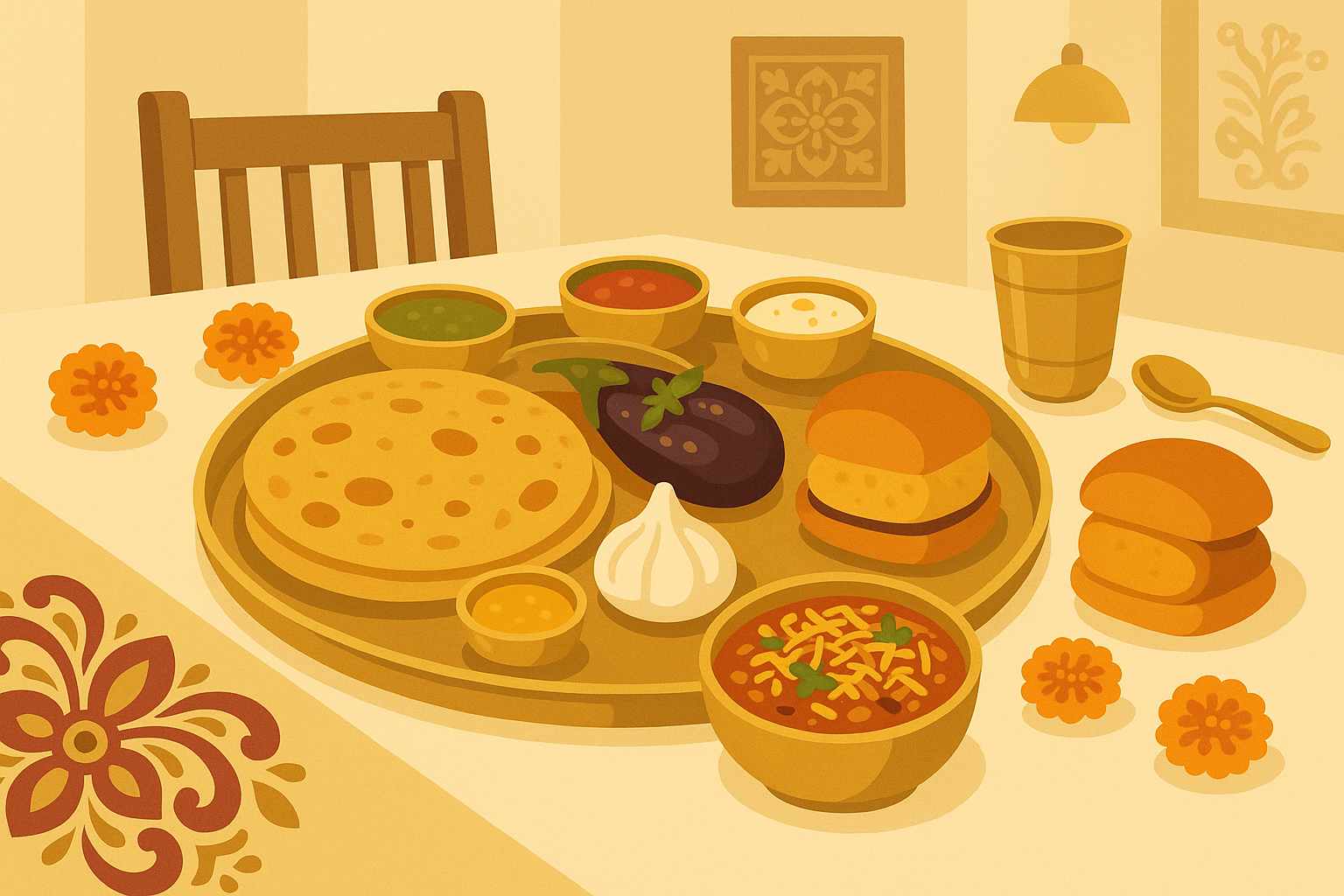
Maharashtrian food is not a single fixed menu. Maharashtra stretches from the Arabian Sea across the Western Ghats to the Deccan plateau and Vidarbha, and its kitchens reflect those landscapes. Coconut, rice, seafood and kokum are prominent along parts of the Konkan coast; inland meals often draw on millets, pulses, peanuts, sesame and seasonal vegetables; and regional spice blends give Malvani, Kolhapuri, Varhadi and Saoji cooking distinct identities.
This guide introduces those regional patterns and some widely recognised dishes. Recipes and names vary between communities and households, so the examples are a starting point rather than a claim that every Maharashtrian family eats in the same way.
Why Maharashtrian food varies by region
Geography helps explain the range. The Maharashtra Tourism Department describes coastal cooking as rich in seafood, coconut and kokum, while the plains support dishes based on jowar, bajra, vegetables, chutneys and pickles. Cities add another layer: Mumbai and Pune have influential street-food cultures, while Nagpur, Nashik, Kolhapur and other centres have their own local specialities.
Religion, caste, community, occupation, season and household custom also shape a meal. Maharashtra has substantial vegetarian traditions as well as fish, chicken and mutton preparations. It is therefore more accurate to speak of Maharashtrian cuisines in the plural.
Konkan and Malvan
The Konkan coast is closely associated with rice, coconut, kokum and seafood. Fish and prawn curries may combine coconut with souring ingredients, while solkadhi is commonly made with kokum and coconut milk. Availability and preparation differ along the coast and between Hindu, Muslim and Christian communities.
Malvani cuisine, centred in the southern Konkan, is known for a regional masala and for fish, shellfish and meat dishes. Coconut appears in several forms, but not every coastal dish is heavy or fiery. The official Maharashtra tourism overview distinguishes Malvani cooking while placing it within the broader coastal food landscape.
Kolhapur and western Maharashtra
Kolhapuri cooking is famous for robust spice blends. Tambda rassa is a red meat gravy, while pandhra rassa is a pale, milder accompaniment traditionally associated with meat meals. Bhakri is a common partner. Maharashtra Tourism’s Kolhapur guide treats these dishes as part of the district’s living culinary identity, not merely restaurant labels.
Western Maharashtra also has many everyday vegetarian foods: pithla or zunka with bhakri, bharli vangi, usal, amti and seasonal vegetable preparations. Jowar and bajra breads remain important, especially outside the largest cities.
Vidarbha: Varhadi and Saoji traditions
Vidarbha has several culinary traditions rather than one uniform style. Varhadi cooking is often described as assertively spiced and uses ingredients such as sesame, mustard, black pepper and gram flour. Saoji cuisine, strongly associated with Nagpur and the Saoji community, is known for dark, aromatic masalas and meat gravies.
Popular summaries sometimes reduce both traditions to a contest about heat. Spice intensity varies by cook, and their identity also lies in roasting, grinding, ingredient balance and inherited technique.
Mumbai, Pune and Nashik street foods
Vada pav—a potato fritter in a bread roll with chutneys—is closely associated with Mumbai and is now found across the state. Pav bhaji, bhel, sev puri and other foods also reflect the city’s history of migration, work and inexpensive public eating.
Misal combines a sprouted-pulse preparation with a spicy gravy and toppings such as farsan, onion, coriander and lemon, usually served with pav. Pune, Kolhapur and Nashik have recognisable variations; no single version represents the whole state. The Government of India’s Incredible India guide identifies misal pav, vada pav and sabudana vada among Nashik’s familiar foods.
Everyday staples worth knowing
- Bhakri: an unleavened flatbread commonly made from jowar, bajra or rice flour, depending on place and meal.
- Pithla and zunka: gram-flour preparations served with bhakri; texture and seasoning distinguish household versions.
- Usal: a preparation of beans or sprouted pulses. Misal builds on an usal or pulse base with gravy and toppings.
- Amti: a family of dal preparations that may balance sour, sweet and spicy notes.
- Bharli vangi: small brinjals filled with a spiced mixture that can include coconut, peanut, sesame or onion.
- Thalipeeth: a savoury multigrain flatbread, often made with a roasted flour mixture called bhajani.
- Poha: flattened rice cooked in many regional forms and widely eaten as breakfast or a snack.
Sweets, fasting foods and festivals
Puran poli is a sweet flatbread filled with cooked chana dal and jaggery, often flavoured with cardamom or nutmeg. It appears at festivals and family occasions, though accompaniments differ. Maharashtra Tourism also documents it alongside bhakri and sheera in festival food traditions.
Modak is especially associated with Ganesh Chaturthi. The steamed form, ukadiche modak, uses a rice-flour covering and a coconut-jaggery filling; fried and contemporary versions also exist.
Sabudana khichdi and sabudana vada are widely linked with Hindu fasting days, but fasting rules differ among families. Shrikhand, basundi and regional laddus add further variety to festive and celebratory meals.
Ingredients that recur without defining every dish
Peanuts, sesame, coconut, dried coconut, jaggery, tamarind, kokum, garlic and regional masalas recur across many recipes. Goda masala is used in some households for aromatic warmth; kala masala and other blends have their own regional and family formulations. A named masala is not a standardized formula, and commercial packets may differ sharply from home blends.
Maharashtrian food is often described as uniformly very spicy. Some preparations are hot, but others are mild, sweet-sour or delicately seasoned. Coastal, urban, festive, fasting and everyday foods each complicate the stereotype.
A beginner’s tasting route
- Begin with an everyday combination such as pithla-bhakri, usal or amti-rice.
- Compare two regional forms of one dish, such as Nashik and Kolhapuri misal.
- Try a coastal meal built around rice, fish or vegetables, coconut and kokum.
- Explore a Vidarbha or Kolhapur speciality with guidance about spice level.
- Add one festive sweet, such as puran poli or ukadiche modak.
This approach shows how staples, geography and occasion interact more clearly than a checklist of “top foods.” Vegetarian diners should ask about stock, shared cooking surfaces and accompaniments; people with peanut, sesame, coconut or gluten allergies should check ingredients directly.
How to explore Maharashtrian food respectfully
- Use regional names carefully and accept that spellings and recipes vary.
- Avoid treating one restaurant version as the only “authentic” form.
- Ask before photographing cooks, vendors or private religious meals.
- Credit the community or region connected with a dish when that history is known.
- Do not repeat unsupported health or medicinal claims about ingredients.
- For current restaurant hygiene, prices and opening hours, verify locally.
Frequently asked questions
Is all Maharashtrian food spicy?
No. Kolhapuri, Varhadi and Saoji dishes can be hot, but the state also has mild dals, rice dishes, breads, vegetable preparations, sweets and coconut-based foods.
What is a good vegetarian introduction?
Pithla-bhakri, bharli vangi, thalipeeth, usal, poha and a regional vegetarian thali show more range than relying only on snacks.
What should a seafood eater try?
A Konkan or Malvani meal may include a locally available fish curry, rice, a dry fish preparation and solkadhi. Ask what is seasonal and how the masala is prepared.
Are misal pav and vada pav traditional household meals?
They are important popular foods, especially in urban and public eating, but they do not represent the full range of household cooking across Maharashtra.