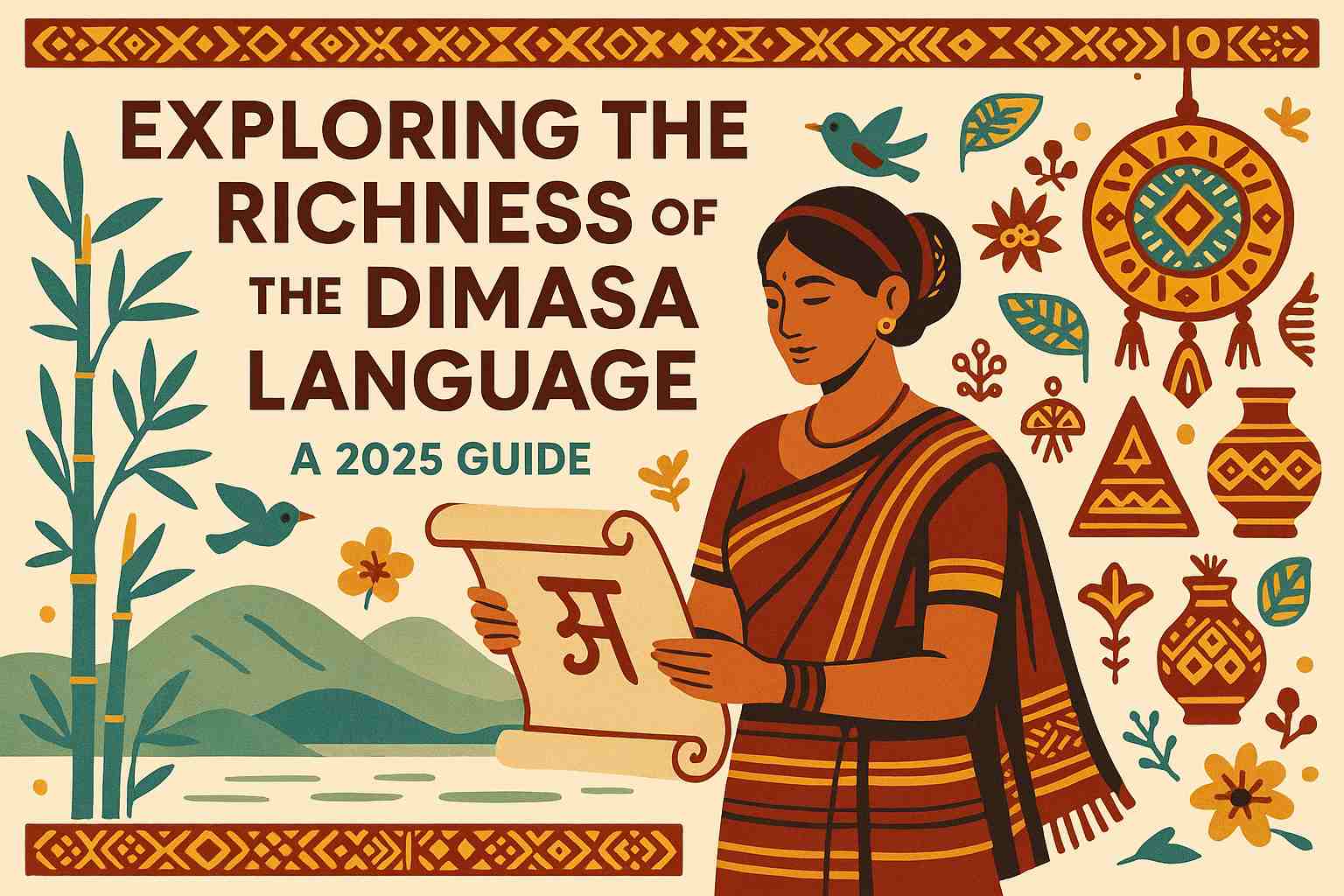
Exploring the Richness of the Dimasa Language: A 2025 Guide
Imagine standing in the lush, green hills of Assam, where the air is thick with the scent of rain-soaked earth. Now, imagine hearing a language that has echoed through these very valleys for centuries. A language that carries the stories of kings, the wisdom of elders, and the rhythm of nature itself. This is the sound of Dimasa, the ancestral voice of the Dimasa people.
It's more than just a way to speak; it's a living piece of our shared Indian heritage. As someone deeply connected to the diverse traditions of our land, I feel a pull towards these ancient tongues. They are the threads that weave the rich fabric of our culture. Let's take a journey together to understand the heart of this beautiful language.
Whispers from the Kachari Kingdom: The Ancient Roots of Dimasa
Every language has a story, and Dimasa's begins in the powerful Kachari Kingdom, one of the oldest in Northeast India. The Dimasa language doesn't just come from anywhere; its origins are deeply rooted in the Tibeto-Burman family of languages. It is spoken by the Dimasa people, who are among the earliest inhabitants of this region, particularly in Assam and Nagaland. Think of it as a cousin to other regional languages like Bodo and Kokborok, sharing a common ancestry.
For countless generations, Dimasa was a language of the heart and home, passed down not through books but through lullabies, folktales, and festival songs. This strong oral tradition was the vessel that carried the community's history, beliefs, and cultural identity safely through time. During colonial times, other languages were given more importance, but the Dimasa spirit ensured their mother tongue thrived within their communities, a true testament to their resilience.
The Melody and Structure: What Makes Dimasa Unique?
The beauty of Dimasa lies in its unique structure, which feels almost musical. Unlike English, it follows a Subject-Object-Verb (SOV) sentence pattern. So, a simple thought like "He is drinking water" would be structured differently, placing the action at the end. This gives the language a distinct rhythm and flow.
What truly makes it fascinating is that it's a tonal language. This means the pitch or tone you use to say a word can completely change its meaning. It’s a language where the melody is just as important as the words themselves!
While historically an oral language, today the Bengali-Assamese and Latin scripts are used for writing. This adaptation allows the ancient voice of Dimasa to be documented and taught to new generations. You can feel the community's close bond with nature in its vocabulary, which is rich with words related to farming, rivers, and the forest—the very elements that have sustained them for centuries. This connection to the land is a beautiful aspect of many indigenous cultures across Northeast India, including the vibrant Assamese and Meitei cultures.
More Than Words: Dimasa as a Carrier of Culture
Why is it so important to talk about a language spoken by around 110,000 people? Because the Dimasa language is the very soul of the tribe's culture. It is the language of their rituals, the verses of their traditional songs, and the narrative of their folklore. To lose the language would be to lose a library of unwritten knowledge and tradition.
It acts as a powerful symbol of identity, connecting the Dimasa people to their ancestors and their land in Dima Hasao, Cachar, and parts of Nagaland. In every greeting and every story told in Dimasa, there is a deep sense of belonging and shared history. This is what makes every regional language in India not just a tool for communication, but a precious cultural jewel.
Keeping the Flame Alive: The Future of the Dimasa Tongue
There is a concern that the Dimasa language is vulnerable, as younger generations often adopt more widely spoken languages. However, the story doesn't end there. There is a growing movement, a beautiful effort from within the community and by scholars, to ensure this flame never dies out.
Initiatives are underway to preserve and promote this beautiful language. Some schools in the Dima Hasao district have started teaching in Dimasa, a crucial step to keep the language alive in the hearts of children. Furthermore, dedicated researchers and digital archives, like the UNT Digital Library and the Muku and Boro Deasa archive, are working tirelessly to document oral stories and linguistic structures. These efforts are a beacon of hope, ensuring that the wisdom of the Dimasa people is preserved for the world to see.
For those of us curious to learn, you might wonder if it's possible to learn Dimasa online. While dedicated apps are still rare, resources are slowly emerging. Community-driven websites, academic papers like "Dimasa Language: Structure and Texts," and social media groups are becoming valuable spaces for learners to connect and discover the basics of this heritage language.
At Bhaktilipi, We Cherish Every Voice
Just as these communities are fighting to preserve their mother tongue, we at Bhaktilipi are on a similar mission. Our heart lies in preserving the devotional literature and spiritual wisdom from every corner of India. We believe that every chant, every story, and every hymn, whether from a well-known text or a rare regional manuscript, is a sacred treasure that deserves to be shared and cherished.
We work to bring these timeless spiritual gems to you in a way that feels personal and inspiring for today's world. By digitizing and reimagining these works, we hope to build a bridge between our ancient traditions and our modern lives, ensuring this spiritual wealth is accessible to everyone.
You can explore the richness of India's diverse spiritual heritage, including stories and traditions from regions like Assam, on Bhaktilipi.in. Stay connected with our journey and receive your dose of devotional inspiration by following us on Facebook, Instagram, and YouTube. Let's walk this path of discovery together.
A passionate group of people dedicated to preserving India's knowledge of Dharma, Karma, and Bhakti for ourselves and the world 🙏.