
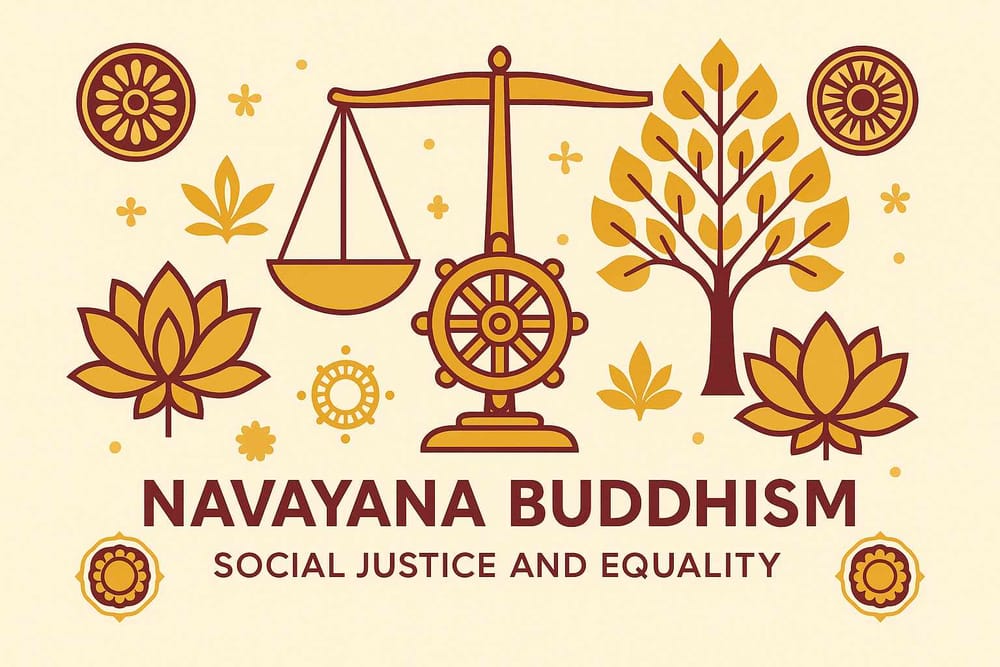
Exploring the New Path-Navayana Buddhism Explained
In the vast spiritual landscape of India, we often search for a path that speaks not just to our souls, but also to our everyday reality. We look for a belief system that feels just, fair, and relevant to the world we live in. Imagine a spiritual journey that began not in a quiet monastery, but in the heart of a struggle for human dignity. This is the story of Navayana Buddhism, a powerful and modern path forged by the great Dr. B.R. Ambedkar.
Navayana, which beautifully translates to the "New Vehicle" or "New Path," isn't just another branch of Buddhism. It is a reawakening, a revolution of thought that places social equality and justice at its very core. It's a path for those who believe that spirituality should empower us to create a better, more compassionate world for everyone.
The Dawn of a New Era: The Story Behind Navayana
To truly understand Navayana, we must go back to a pivotal moment in Indian history. The mid-20th century was a time of great change, but for millions, the crushing weight of the caste system was a reality they lived with every single day. Dr. B.R. Ambedkar, a brilliant jurist, a social reformer, and the architect of our Constitution, saw this injustice and knew that political freedom alone was not enough. He believed that true liberation had to be spiritual as well.
He searched deeply through various religions, seeking a framework that promised equality not just in theory, but in practice. He found his answer in the timeless teachings of the Buddha. On October 14, 1956, in Nagpur, a historic event unfolded. Dr. Ambedkar, along with nearly 380,000 of his followers, embraced Buddhism. This day, now celebrated as Dhammachakra Pravartan Day, wasn't just a conversion; it marked the birth of Navayana Buddhism, a movement that intertwined spirituality with social activism.
What Makes the 'New Path' Different?
You might wonder, how is Navayana Buddhism different from the traditional forms we know? The distinction is profound and rooted in its purpose. While all Buddhist paths seek an end to suffering, Navayana focuses on the suffering caused by man-made systems like caste discrimination.
- Focus on Social Justice, Not Rituals: Navayana shifts the focus from metaphysical concepts like rebirth, karma, and complex meditative states. Instead, it emphasizes a rational, ethical, and practical application of the Buddha's teachings to solve real-world problems. It’s about creating a just society here and now, rather than focusing solely on the cycle of samsara.
- Equality as the Ultimate Dharma: At the heart of Navayana is the unwavering principle of equality. It rejects the caste hierarchy completely and champions the dignity of every individual. For Dr. Ambedkar, the Buddha's message was a direct challenge to inequality, and he made this the central pillar of his new path in Buddhism.
- Dr. Ambedkar as a Guiding Light: In this tradition, Dr. Ambedkar is revered not just as a leader but as a Bodhisattva—an enlightened being who chose to guide others toward liberation. His life and his interpretation of the Buddha's teachings, especially his book "The Buddha and His Dhamma," are central texts for followers.
Exploring such profound spiritual journeys helps us understand the diverse ways people connect with the divine and with each other. At Bhaktilipi, we are dedicated to sharing these timeless stories of faith and transformation. To discover more about India's rich spiritual heritage, you can explore our collection of devotional literature on Bhaktilipi.in.
The Core Beliefs of an Ambedkarite Buddhist
So, what does it mean to walk this path? Practicing Navayana Buddhism is about living a life guided by principles that can change society from the ground up. It’s a path for everyone, not just one community, who believes in its message of universal justice.
A Rational and Ethical Way of Life
Navayana encourages a scientific and rational outlook, moving away from superstitions. The core practice involves embodying the principles of Prajna (wisdom), Karuna (compassion), and Samata (equality) in one's daily actions. It's about treating every person with respect, fighting for the rights of the oppressed, and using education as a tool for empowerment.
Is Navayana Buddhism only for certain communities?
Absolutely not. While it was born out of the Dalit community's struggle for liberation, its message is universal. Navayana Buddhism is for anyone who seeks a spiritual path grounded in reason, equality, and social responsibility. It welcomes all who believe that creating a just and fair world is a spiritual duty.
A Path of Hope for Modern India
In today's world, where we still grapple with issues of inequality and injustice, Navayana Buddhism stands as a powerful beacon of hope. It reminds us that spirituality is not about escaping the world, but about engaging with it and transforming it for the better.
It teaches us that true spiritual growth happens when we work to uplift others, challenge injustice, and build a society where every single person can live a life of dignity and freedom. This new vehicle, started by Dr. Ambedkar, continues to carry millions toward a brighter, more equal future.
If these stories of faith, reform, and spiritual awakening inspire you, consider subscribing to our newsletter or following us on social media. Join the Bhaktilipi family on Facebook, Instagram, and YouTube for regular updates and a deeper connection to your spiritual journey.
A passionate group of people dedicated to preserving India's knowledge of Dharma, Karma, and Bhakti for ourselves and the world 🙏.
Comments
Related in
Exploring the Navayana - Buddhism's Modern Path
In our hearts, many of us carry a quiet longing—a desire for a spiritual path that doesn’t ask us to leave our minds at the door. We seek a faith that speaks not only of inner peace but also of justice and dignity in the world around us.
Navayana Buddhism- Explores a New Perspective
In the vast tapestry of Indian spirituality, faith is often a legacy we inherit, a path our ancestors walked. But sometimes, faith becomes a choice—a powerful, conscious decision to forge a new path. It becomes a statement, a revolution. This is the story of Navayana Buddhism, the "New
Exploring Spiritual Heritage-Navayana and Iconic Temples in Faridabad
Sometimes, we think we know a city. We see the tall buildings, the busy roads, the rush of daily life, and we assume that’s the whole story. I used to think of Faridabad that way – a bustling industrial hub, a close cousin to Delhi. But beneath this modern surface,