
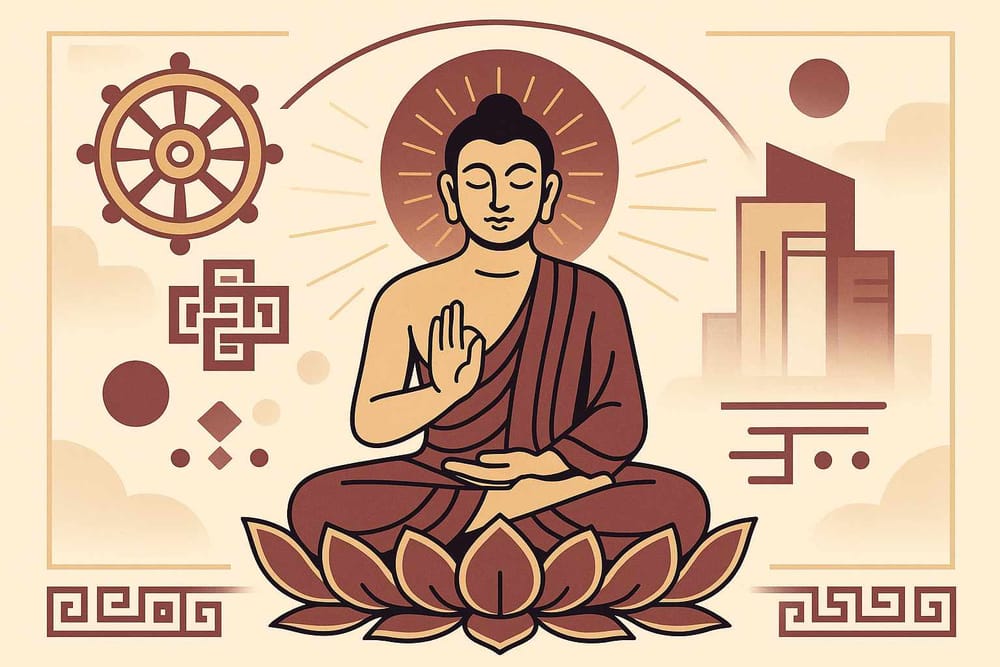
Exploring the Navayana - Buddhism's Modern Path
In our hearts, many of us carry a quiet longing—a desire for a spiritual path that doesn’t ask us to leave our minds at the door. We seek a faith that speaks not only of inner peace but also of justice and dignity in the world around us. What if such a path already exists, born right here on Indian soil from one of its greatest minds? This is the story of Navayana Buddhism, the "New Vehicle" envisioned by the great Dr. B.R. Ambedkar. It’s not just a religion; it's a powerful answer to the call for a spiritual life rooted in compassion, equality, and modern reason.
The Birth of a New Path: Why Dr. Ambedkar Chose Buddhism
To truly understand Navayana, we must journey back to a pivotal moment in Indian history. Dr. B.R. Ambedkar, the chief architect of our Constitution, spent his life fighting the deep-seated wounds of the caste system. He believed that true freedom couldn't be achieved through political means alone; it required a spiritual and psychological revolution. After studying the world's religions, he found his answer in the timeless teachings of the Buddha.
However, he wasn't interested in simply adopting an ancient tradition as it was. He saw the need for a fresh interpretation, one that addressed the specific social evils he fought against. On October 14, 1956, in a historic ceremony in Nagpur, Dr. Ambedkar, along with hundreds of thousands of his followers, embraced Buddhism. This wasn't just a conversion; it was the birth of Navayana. It symbolized a powerful departure from a system that sanctioned inequality and a journey towards a new spiritual home built on the pillars of Liberty, Equality, and Fraternity.
The Heart of Navayana: Core Beliefs That Set It Apart
Navayana stands distinct from other schools like Theravāda or Mahāyāna because it re-frames the Buddha's teachings to address real-world problems. Dr. Ambedkar saw Buddhism as a rational and scientific guide for human conduct, not a system of rituals or metaphysical speculation. Here are some of the core ideas that make Navayana so unique:
- Suffering (Dukkha) as a Social Problem: While traditional Buddhism often focuses on individual suffering caused by desire and attachment, Navayana expands this concept. It teaches that societal structures like casteism, poverty, and discrimination are immense sources of *dukkha*. The path to ending this suffering isn't just meditation but active social reform and the fight for justice.
- Rejection of Karma and Rebirth as Justifications for Inequality: Dr. Ambedkar argued that the concepts of karma and rebirth were often misinterpreted to justify the caste hierarchy—the idea that one's birth is a result of past actions. Navayana sets aside these ideas, empowering individuals to understand that their circumstances are a result of social and economic systems, which can and must be changed in this lifetime.
- Focus on Action, Not Worship: Navayana prioritizes moral action and ethical living over ritualistic practices. Instead of elaborate ceremonies, the focus is on education, critical thinking, and community empowerment. The goal of a Navayana Buddhist is to actively work towards creating a just and compassionate society, reflecting the Buddha's core message of kindness and equality.
- The Sangha as a Community of Changemakers: The *Sangha* (community) in Navayana is not limited to monks and nuns. It is a collective of all followers working together for social upliftment. This community is the engine of change, running educational initiatives, advocating for human rights, and building a network of support for the oppressed.
Navayana Today: A Living Legacy of Empowerment
Since its inception, Navayana has been more than just a spiritual identity; it has been a powerful movement for social and political empowerment, especially for the Dalit community in India. It has given millions a sense of dignity and a framework to challenge centuries of discrimination. This modern perspective on Buddhism is not just theoretical; its impact is visible on the ground.
We see its influence in the thousands of educational institutions established by its followers, who believe, as Dr. Ambedkar did, that education is the most powerful tool for liberation. It has inspired art, literature, and political movements that continue to advocate for human rights and social equality. While some purists may question its departure from traditional doctrines, for its followers, Navayana is the most authentic expression of the Buddha's teachings on compassion and the removal of suffering in today's world.
Explore Our World of Devotion
At Bhaktilipi, we believe that spirituality is a personal journey, and every path holds its own wisdom. We bring timeless devotional literature and sacred stories to modern readers, making them accessible while preserving their sacred essence. Our goal is to connect India's rich traditions with the questions and needs of today’s world.
If you are inspired by paths that blend deep thought with heartfelt devotion, we invite you to explore our collections. Stay connected with us for new posts, features, and reflections by following us on Facebook, Instagram, and YouTube.
Embracing the New Vehicle: A Path for Our Times
Navayana Buddhism offers a powerful and refreshing spiritual framework. It reminds us that faith can be a force for positive change in the world, not just a retreat from it. Dr. Ambedkar's vision was to create a society free from oppression, and he offered Buddhism as the vehicle for this incredible journey.
For anyone seeking meaning beyond dogma, for those who believe spirituality must walk hand-in-hand with social responsibility, Navayana offers a path. It is a movement of dignity, a philosophy of reason, and a testament to the idea that true enlightenment lies in the service of humanity. By embracing its principles, we don’t just follow a religion; we participate in building a more equal and compassionate world for all.
Frequently Asked Questions on Navayana Buddhism
As we explore this unique path, some questions naturally arise. Let's clear up some common curiosities about the "New Vehicle."
Many ask what truly defines Navayana Buddhism. At its core, it is a modern interpretation of Buddhist teachings founded by Dr. B.R. Ambedkar. Its primary focus is on achieving social equality and justice, particularly dismantling the caste system, rather than on metaphysical concepts.
So, how does it differ from traditional schools like Theravada or Mahayana? The main difference lies in its practical and social application. Navayana sets aside ideas like karma and rebirth, which it views as potential tools of oppression, and instead emphasizes direct action, education, and human rights as the way to end suffering.
Why is it often called a "modern" path? It’s considered modern because it directly applies the Buddha's principles to contemporary social and political problems. It’s a spiritual path designed for the challenges of our time, championing reason and rejecting superstition. For a deeper dive, you can explore this modern perspective on Buddhism explained further on our blog.
Who are its followers today? While it was initiated for and is primarily practiced by the Dalit community in India, its message of social justice and rational spirituality is gaining appreciation globally. Anyone who believes in a faith that actively works to create a better, more equal world can find value in its teachings.
Is Navayana recognized as a form of Buddhism worldwide? Yes, it is widely recognized as a distinct and significant school of Buddhist thought. Its emphasis on "engaged Buddhism"—where spiritual practice is integrated with social action—resonates with many modern Buddhist movements across the globe.
A passionate group of people dedicated to preserving India's knowledge of Dharma, Karma, and Bhakti for ourselves and the world 🙏.
Comments
Related in
Navayana Buddhism- Explores a New Perspective
In the vast tapestry of Indian spirituality, faith is often a legacy we inherit, a path our ancestors walked. But sometimes, faith becomes a choice—a powerful, conscious decision to forge a new path. It becomes a statement, a revolution. This is the story of Navayana Buddhism, the "New
Exploring Spiritual Heritage-Navayana and Iconic Temples in Faridabad
Sometimes, we think we know a city. We see the tall buildings, the busy roads, the rush of daily life, and we assume that’s the whole story. I used to think of Faridabad that way – a bustling industrial hub, a close cousin to Delhi. But beneath this modern surface,
Exploring the New Path-Navayana Buddhism Explained
In the vast spiritual landscape of India, we often search for a path that speaks not just to our souls, but also to our everyday reality. We look for a belief system that feels just, fair, and relevant to the world we live in. Imagine a spiritual journey that began