
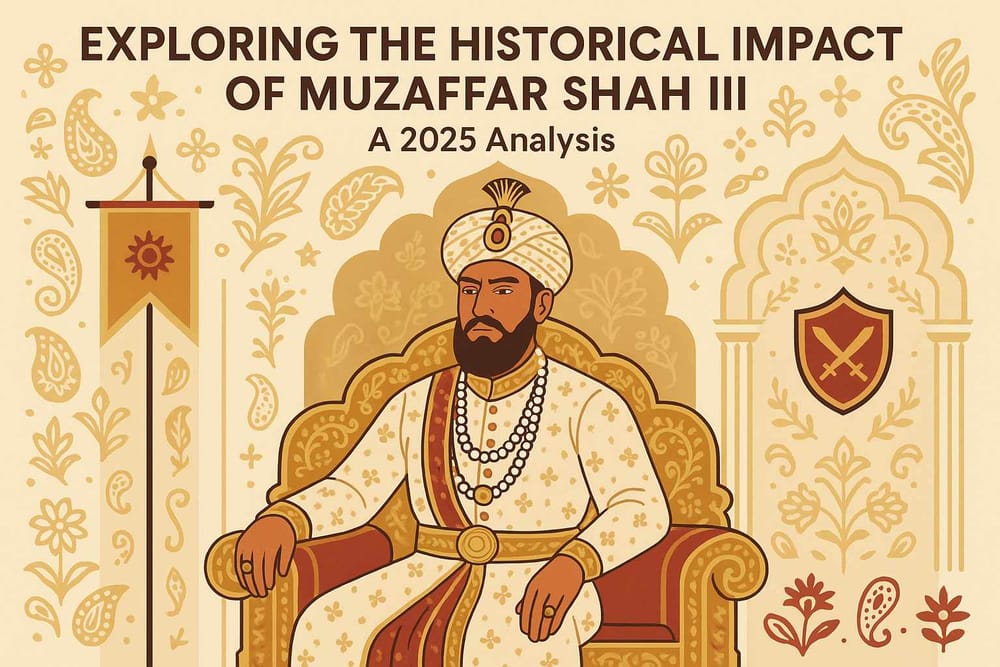
Exploring the Historical Impact of Muzaffar Shah III - A 2025 Analysis
Every kingdom has its final sunset, and for the once-glorious Gujarat Sultanate, that long twilight was embodied by its last ruler, Muzaffar Shah III. His life wasn't just the story of a king; it was a heart-wrenching saga of a collapsing era, a desperate struggle against the inevitable tides of history that were reshaping India forever. His name might not be as famous as the grand Mughals who succeeded him, but his story is a powerful reminder of the human cost of change and the end of an age.
A Kingdom on Shaky Ground: The World Muzaffar Shah III Inherited
To understand Muzaffar Shah III's challenges, we must first picture the Gujarat he was born into. The Sultanate, founded by the visionary Zafar Khan Muzaffar, had once been a jewel of India, its ports bustling with trade and its coffers overflowing. But by the time Muzaffar Shah III came to the throne, the golden age was a fading memory. The kingdom was like a grand old haveli, beautiful on the outside but crumbling within.
- Internal Cracks and Whispers of Betrayal: The court was no longer a united force. It was a hotbed of factionalism, with powerful nobles constantly vying for control. This internal discord weakened the Sultanate from its very core, making it vulnerable and unable to stand strong against outside threats. It was a house divided against itself, and its foundations were beginning to shake violently.
- The Mughal Shadow Looms Large: On the horizon, a formidable new power was rising. The Mughal Empire, under the brilliant and ambitious Emperor Akbar, was expanding its reach across the subcontinent. For regional kingdoms like Gujarat, this wasn't just a political shift; it was an existential threat, a storm cloud gathering that promised to change everything.
A Valiant but Tragic Struggle: The Clash with the Mughals
The reign of Muzaffar Shah III is forever defined by his heroic but ultimately doomed resistance against the Mughal juggernaut. It was a classic tale of a regional power trying to hold its own against a mighty empire.
- The Final Stand at Ahmedabad: The Siege of Ahmedabad in 1573 was the turning point. It was here that Muzaffar Shah III made his stand to defend his homeland. While he fought with courage, the battle exposed the painful reality of his limited resources against the might of Akbar’s organised army. It was a fight against destiny itself.
- A King's Resilience: Even after his defeat and imprisonment in Agra, his spirit was not entirely broken. In a remarkable display of resilience, he escaped in 1583 and, with the support of loyal nobles, briefly managed to reclaim his throne. This short-lived victory speaks volumes about his determination, even when all hope seemed lost. It was a final, defiant flicker of the Sultanate's flame before it was extinguished for good.
A Legacy Carved in Stone, Not Just in War
It's easy to remember a ruler only by their battles, but that would be an incomplete picture of Muzaffar Shah III. Even as his kingdom faced political turmoil, the cultural heartbeat of Gujarat continued to thrive. The era saw a beautiful continuation of the region's artistic traditions.
The architecture of the time, from mosques to public buildings, reflects a stunning fusion of Persian and local Gujarati styles. It’s a testament to the Sultanate's long-standing patronage of the arts. Imagine, while swords clashed on the battlefields, the artisans' chisels were still peacefully at work, carving a legacy in stone that would outlast the empire itself. This cultural contribution is a gentle reminder that beauty can flourish even in the most turbulent of times.
Reflecting on the Legacy: A 2025 Perspective
Today, as we look back with a fresh perspective, Muzaffar Shah III is seen not as a failure, but as a tragic and complex figure. He is a symbol of a monumental transition in Indian history—the shift from powerful regional sultanates to a consolidated Mughal empire. His story is a deeply human one, filled with struggle, resilience, and the sorrow of seeing a legacy crumble. To learn more about this, you can explore Muzaffar Shah III's detailed legacy.
Understanding these historical shifts helps us appreciate the rich, layered fabric of our own identity. It's in these stories of the past that we find lessons for our future. A deeper dive into the legacy of Muzaffar Shah III can offer us profound insights into the cycles of power and destiny.
Connect with Your Roots Through Bhaktilipi
Stories like that of Muzaffar Shah III are more than just history; they are a part of our collective soul. They teach us about resilience, culture, and the passage of time. At Bhaktilipi, we are dedicated to preserving and sharing these timeless narratives and devotional traditions that form the bedrock of our culture.
If the story of this last Sultan has moved you, we invite you to explore the vast ocean of wisdom and history with us. We reimagine these sacred texts and stories for today’s world, making them accessible and inspiring. Let's explore the path of bhakti and history together. Connect with our community on YouTube, Facebook, and Instagram.
Frequently Asked Questions about Muzaffar Shah III
Many wonder what makes Muzaffar Shah III so important in Indian history. His significance lies not in grand victories, but in his position as the final ruler of an independent Gujarat Sultanate. His reign is a crucial case study of the political dynamics of 16th-century India, marking the end of a powerful regional dynasty and its absorption into the Mughal Empire.
Why is he remembered as such a poignant figure? Muzaffar Shah III is remembered for his persistent, though unsuccessful, struggle to maintain his kingdom's sovereignty against the overwhelming power of Akbar. His story is a humanizing look at the challenges faced by regional rulers during a period of imperial consolidation, making him a symbol of resistance in the face of insurmountable odds.
What was the lasting impact of his rule on Gujarat's culture? Despite the political chaos, his era continued the rich tradition of Indo-Islamic architecture. This cultural continuity shows that even during times of great upheaval, the artistic spirit of a region can endure and leave behind a legacy of beauty and fusion.
Is there a lesson in his story for us today? Absolutely. The story of Muzaffar Shah III offers profound insights into the nature of power, the importance of internal unity, and the inevitability of change. It reminds us that history is shaped by both grand empires and the personal struggles of individuals caught in its currents.
How do modern historians view his legacy? Contemporary analysis, especially with a 2025 perspective, sees him as a symbol of transition. His reign is less about personal failure and more about the larger historical forces at play. Historians appreciate his story for what it teaches us about the complex shift from a collection of regional powers to a centralized empire in India.
A passionate group of people dedicated to preserving India's knowledge of Dharma, Karma, and Bhakti for ourselves and the world 🙏.
Comments
Related in
The Legacy of Muzaffar Shah III - A 2025 Historical Analysis
Every corner of our incredible India whispers stories of glory, struggle, and time itself. The soil of Gujarat, especially, holds the memory of a magnificent era – the time of the Gujarat Sultanate. But every story has a final chapter. Today, let’s travel back to the 16th century and walk