
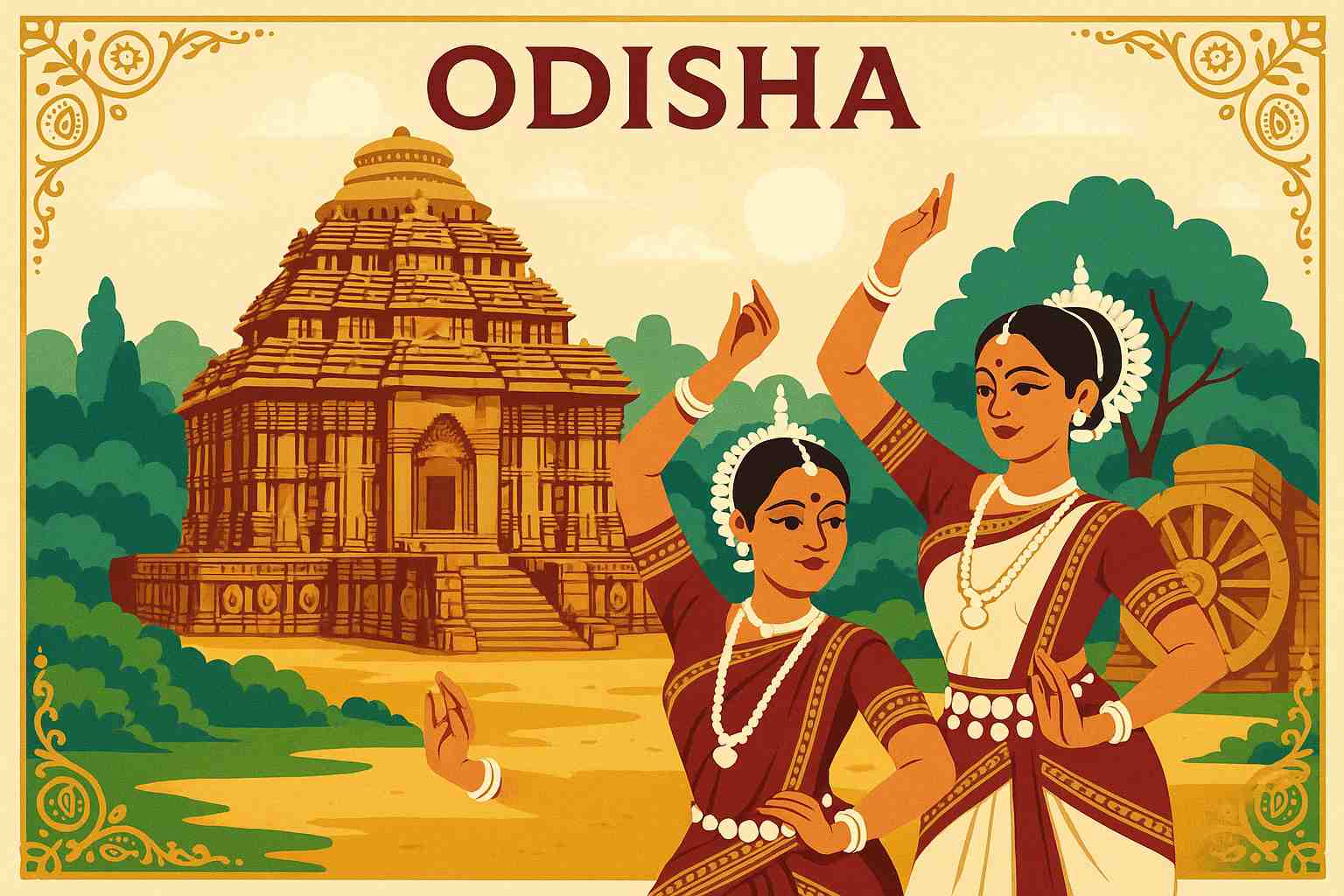
Odisha’s historic sites include living temples, monumental ruins, rock-cut Jain shelters, Buddhist monasteries, fort remains and landscapes shaped by pilgrimage. Calling all of them “ancient ruins” is misleading: Puri and Bhubaneswar remain active religious centres, while Konark and the Buddhist complexes are protected archaeological places.
This guide introduces the principal heritage circuits and explains what makes them different. Dates, access, photography, worship and conservation rules can change, so check the responsible authority before travelling.
Odisha’s heritage is more than temple ruins
Odisha preserves evidence of Hindu, Buddhist and Jain traditions over more than two millennia. Its best-known monuments belong to the Kalinga architectural tradition, but the state’s historical record also includes Ashokan inscriptions, monastic learning centres, caves made for ascetics, forts and living ritual landscapes.
A useful itinerary treats each place according to its present character. A functioning temple calls for religious etiquette; an excavated monastery needs archaeological care; a World Heritage property has formal conservation boundaries; and a cave complex requires attention to fragile carvings and inscriptions.
Konark Sun Temple
The 13th-century Sun Temple at Konark represents Surya’s celestial chariot through its monumental design. UNESCO describes twelve pairs of carved wheels and seven horses, with sculpture depicting religious, courtly, musical and everyday subjects. The complex was inscribed on the World Heritage List in 1984.
The main sanctuary tower no longer stands, while the great audience hall dominates the surviving complex. This distinction matters: photographs of the current monument do not show the temple exactly as it appeared when complete.
Konark is protected and managed through national conservation law and the Archaeological Survey of India. Do not climb on sculpture, cross barriers or touch carved surfaces. The wheels are not simply decorative “sundials”; interpretations of their symbolism and time-reading should be presented with care rather than as a single proven function.
Puri and the Shree Jagannath Temple
The Shree Jagannath Temple at Puri is a living centre of worship associated with Jagannath, Balabhadra and Subhadra. Puri district’s official account connects the present monumental temple with the Eastern Ganga ruler Anantavarman Chodaganga and the 12th century.
Its significance cannot be reduced to architecture. Daily ritual, Mahaprasad, hereditary services and the annual Ratha Yatra are part of a living institution. Temple entry rules are separate from access to Puri as a city and from the public chariot festival; visitors should consult current official guidance rather than assume that every area is open to everyone.
Respect worship, dress requirements and photography restrictions. Do not use an unofficial intermediary’s promise of special access as a substitute for temple information.
Bhubaneswar’s temple landscape
Bhubaneswar’s historic core, often called Ekamra Kshetra, contains temples from different periods and scales. Lingaraj is a major living temple complex; Mukteshwar is celebrated for its carved gateway and refined ornament; Rajarani is known for its sculptural programme; and Parasurameswar represents an earlier phase of the regional temple tradition.
These monuments should not be described as interchangeable examples of one style. Their ground plans, towers, halls, sculptural themes, ritual status and dates differ. A guided heritage walk can make those distinctions clearer than a rushed checklist.
Some temples remain active sacred spaces and may restrict entry or photography. View exterior architecture from permitted areas and follow local instructions without treating worshippers as part of a tourist display.
Udayagiri and Khandagiri: Jain rock-cut heritage
The twin hills of Udayagiri and Khandagiri near Bhubaneswar contain rock-cut shelters associated with Jain ascetics and the era of King Kharavela. Odisha Tourism dates major development to around the second century BCE. The Hathigumpha inscription is especially important for understanding Kharavela’s reign, though its damaged text and readings require scholarly caution.
The caves include carved façades, cells, reliefs and inscriptions. They were not palaces in the ordinary residential sense, even when modern names such as “Queen’s Cave” encourage that impression. Their ascetic and patronage context should remain central.
Do not confuse these caves with Udayagiri Buddhist Monastery in Jajpur district. They share a name but belong to different places and religious histories.
The Buddhist Diamond Triangle
Ratnagiri, Udayagiri and Lalitgiri form Odisha’s Buddhist Diamond Triangle. Excavations have revealed monasteries, stupas, shrines, sculptures, seals and inscriptions that show the region’s importance to Buddhist learning and practice.
- Ratnagiri contains major monastic remains, a large stupa, richly carved doorways, votive stupas and sculpture associated with Mahayana and Vajrayana traditions.
- Udayagiri in Jajpur includes the Madhavapura and Simhaprastha monastic complexes, with brick monasteries, stupas, prayer spaces, sculpture and a stepped well.
- Lalitgiri preserves evidence from an especially long period, including monastic remains, a chaitya structure, stupas and relic deposits recovered through excavation.
“Diamond Triangle” is a modern circuit name linked with the area’s Vajrayana heritage; it does not mean the three sites form a geometrically exact triangle or belong to one construction phase.
Dhauli and the memory of Kalinga
Dhauli, near Bhubaneswar, is associated with the Kalinga War and carries Major Rock Edicts of Ashoka, including separate edicts addressed to administrators. The inscriptions are primary historical evidence; later stories about the battlefield and Ashoka’s transformation should be distinguished from what the texts themselves say.
The modern Shanti Stupa adds a later layer of Buddhist commemoration to the landscape. Visitors therefore encounter ancient inscription, historical memory and modern monument together.
Other places that broaden the itinerary
- Barabati Fort, Cuttack: surviving gateways, earthworks and archaeological remains mark a strategic historic centre rather than a complete standing palace.
- Chausathi Yogini, Hirapur: a small circular temple associated with yogini worship; current ritual and visitor rules deserve respect.
- Khiching: known for the Kichakeswari temple and sculptural heritage in northern Odisha.
- Ratnagiri district and western Odisha sites: regional forts, temples and museums show that Odisha’s heritage is not confined to the Bhubaneswar–Puri–Konark corridor.
Before adding a remote monument to an itinerary, verify road conditions, opening hours and whether local permission or a guide is appropriate.
Planning a responsible heritage route
A short first visit
A common three-part introduction combines Bhubaneswar’s temples and Udayagiri–Khandagiri, Puri’s living Jagannath tradition, and Konark’s protected monument. Travel time, heat, worship schedules and conservation hours make it better to allow more than one day.
A Buddhist extension
The Diamond Triangle deserves a dedicated day or overnight plan rather than a hurried detour. Distances between Ratnagiri, Udayagiri and Lalitgiri, museum hours and seasonal weather should be checked locally.
Best season and conditions
Official tourism guidance often recommends the cooler months, roughly October to March, for outdoor heritage travel. Monsoon rain and summer heat can affect paths and comfort. This is general planning advice, not a guarantee of weather.
Heritage etiquette and conservation
- Follow ASI, temple, museum and district-administration rules at each site.
- Do not touch sculpture, enter closed cells, climb structures or make rubbings of inscriptions.
- Ask before photographing worship, monks, priests, workers or local residents.
- Dress and behave appropriately at living sacred sites.
- Use licensed guides where available and ask them to separate inscription, archaeology, tradition and legend.
- Carry waste out and avoid food, smoke or flame near protected remains.
- Never buy an object represented as an excavated antiquity.
Frequently asked questions
What is Odisha’s only UNESCO World Heritage Site in this group?
The Sun Temple at Konark is the UNESCO World Heritage property discussed here. Other sites may have national, state, archaeological or religious protection without being UNESCO-listed.
Are Udayagiri caves and Udayagiri monastery the same?
No. Udayagiri–Khandagiri near Bhubaneswar is primarily associated with Jain rock-cut heritage. Udayagiri in Jajpur is a Buddhist monastic archaeological complex within the Diamond Triangle.
Can everyone enter Jagannath Temple?
The temple maintains entry rules that differ from access to the public city and Ratha Yatra route. Check current official guidance and respect restrictions.
How should visitors verify historical claims?
Start with inscriptions, excavation reports, ASI material, UNESCO documentation and official museum or tourism interpretation. Treat dramatic legends as traditions unless supported by historical evidence.