
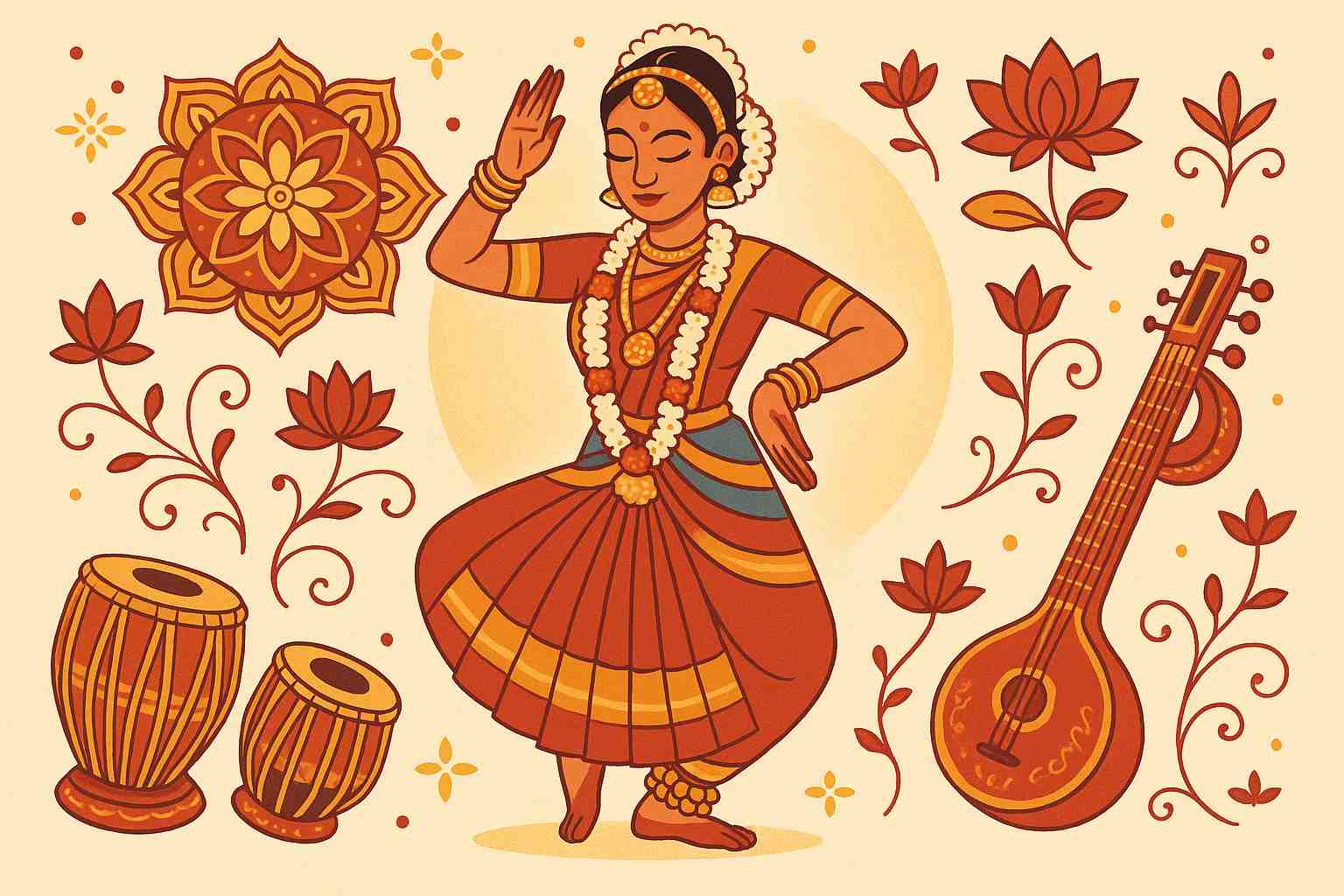
Exploring the Depths of Bharata's Natya Shastra-Ancient Indian Performing Arts Defined
Have you ever watched a classical dance performance and felt a wave of emotion wash over you—joy, sorrow, or wonder—without a single word being spoken? Have you ever been so captivated by a drama that the stage disappears, and you are living the story? This magical connection, this very soul of Indian performance, flows from a single, ancient source: the Natya Shastra.
This isn't just a book; it's a universe in itself. Authored by the great sage Bharata Muni, this monumental treatise is the foundational pillar of all ancient Indian performing arts. It’s the original guide that taught us how to tell stories, express feelings, and connect with the divine through dance, music, and drama. For centuries, it has been the silent guru for every artist who has graced the Indian stage.
A Gift from the Gods: The Sacred Origins of Natya
The story of the Natya Shastra begins not in a scholar's study, but in the heavens. Legend says that Lord Brahma himself created 'Natya' as a fifth Veda—the 'Natya Veda'. Why? Because in a world of turmoil, he wanted to create an art form that was accessible to everyone, regardless of caste or creed, to teach, to inspire, and to uplift the human spirit.
This divine knowledge was then passed down to the sage Bharata, who meticulously compiled it into the 36 chapters and over 6,000 poetic verses we know today. Compiled over a vast period, estimated between 200 BCE and 200 CE, its wisdom was first passed down through oral traditions, from guru to shishya, ensuring its flame was never extinguished. It’s a beautiful reminder of how deeply our Indian culture is rooted in spiritual wisdom.
Inside the Treasure Trove: What Does the Natya Shastra Contain?
Opening the Natya Shastra is like discovering a blueprint for creating art that touches the soul. It is incredibly detailed, covering everything an artist could possibly need to know. It’s a holistic guide that addresses not just the performance, but the entire ecosystem around it.
- The Theory of Rasa: The Heartbeat of Emotion
This is perhaps the most profound contribution of the Natya Shastra. Bharata explains that the ultimate goal of any performance is to evoke a specific emotional state in the audience, known as 'Rasa'. He identified eight primary Rasas: Shringara (Love), Hasya (Laughter), Karuna (Sorrow), Raudra (Anger), Veera (Heroism), Bhayanaka (Fear), Bibhatsa (Disgust), and Adbhuta (Wonder). Every movement, expression, and note is designed to create this aesthetic bliss. - The Language of Abhinaya: Expression Beyond Words
The text masterfully breaks down the art of acting (Abhinaya) into four types: Angika (body movements and gestures or mudras), Vachika (voice and speech), Aharya (costume and makeup), and Sattvika (the authentic expression of emotion). It's a complete system for an actor to become the character, inside and out. - The Stage and the Sound: A Complete Experience
Bharata didn't just focus on the actors. He provided detailed instructions on stage design, acoustics, musical instruments, rhythmic cycles (Tala), and musical scales. He understood that a performance is a symphony where every element must work in perfect harmony to transport the audience to another world.
More Than an Art Form: A Philosophy for Life
The Natya Shastra teaches us that art is not mere entertainment; it's a spiritual journey. It beautifully integrates the four goals of human life—Dharma (righteousness), Artha (prosperity), Kama (pleasure), and Moksha (liberation)—into its narrative structures.
Through the stories and emotions portrayed on stage, the audience experiences a kind of emotional cleansing or catharsis. The Rasa theory is not just about feeling; it's about transcending our personal emotions to connect with a universal experience. This makes art a form of meditation, a path to self-awareness and a deeper understanding of the human condition.
A Living Legacy: The Echoes of Natya Shastra Today
Look closely at any classical Indian dance form today—be it the grace of Bharatanatyam, the storytelling of Kathakali, the fluidity of Odissi, or the vibrancy of Kuchipudi—and you will see the principles of the Natya Shastra breathing and alive. The hand gestures (mudras), the facial expressions (bhavas), and the character archetypes are all drawn from this ancient wellspring of knowledge.
Its influence doesn't stop there. The rich rhythm and heritage of Indian folk traditions and even the narrative techniques used in modern Indian cinema owe a debt to the dramatic principles laid out by Bharata thousands of years ago. In April 2025, this incredible text was added to UNESCO's Memory of the World Register, a global recognition of its timeless value to humanity.
In our fast-paced digital world, connecting with such profound texts can feel challenging. But it is this very wisdom that can ground us and bring a sense of meaning back into our lives. At Bhaktilipi, we are deeply passionate about preserving these timeless devotional and cultural texts. We strive to share these stories and philosophies in a way that inspires and connects with you today.
Curiosities Unravelled: Your Questions on the Natya Shastra
Many of us have questions about this foundational text, so let's explore some of them. People often wonder, what exactly is Bharata's Natya Shastra? Think of it as the ultimate encyclopedia for Indian performing arts, a divine guide that explains not just the 'how' but also the 'why' behind dance, drama, and music.
Another common query is about its age. While pinning down a single date is difficult, scholars believe it was compiled over centuries, roughly between 200 BCE and 200 CE, making its wisdom over two thousand years old. This leads to the question of its significance. The Natya Shastra is vital because it codified and preserved the artistic traditions of ancient India, creating a unified framework that has allowed our arts to flourish with authenticity for millennia.
Many are curious about its contents. Does it only focus on dance and drama? Not at all. It is a comprehensive text that delves deep into vocal and instrumental music, stagecraft, costumes, and even the ideal audience, making it a complete guide. Its most famous concept is Rasa, which it defines as the aesthetic flavour or emotional essence that an audience should experience. It is the very soul of the performance.
Finally, is it still relevant? Absolutely. Its principles are the bedrock of classical Indian arts and continue to inspire artists in contemporary theatre and cinema. The Natya Shastra is a living tradition, a testament to how it has preserved the soul of ancient Indian arts by connecting modern artists to their deep cultural roots.
Conclusion: Honouring an Eternal Legacy
The Natya Shastra is more than just a historical artifact; it is a river of wisdom that continues to nourish the cultural landscape of India. It reminds us that art is a sacred bridge between the human and the divine, a language that speaks directly to the heart.
By exploring its teachings, we don't just learn about performance; we learn about ourselves. As we continue to celebrate and practice these art forms, we honour the timeless genius of Bharata Muni and keep this incredible legacy alive for generations to come. To stay connected with the heart of India's devotional and cultural heritage, we invite you to follow Bhaktilipi on Facebook, Instagram, and YouTube. Join our community as we explore these traditions together.
A passionate group of people dedicated to preserving India's knowledge of Dharma, Karma, and Bhakti for ourselves and the world 🙏.