
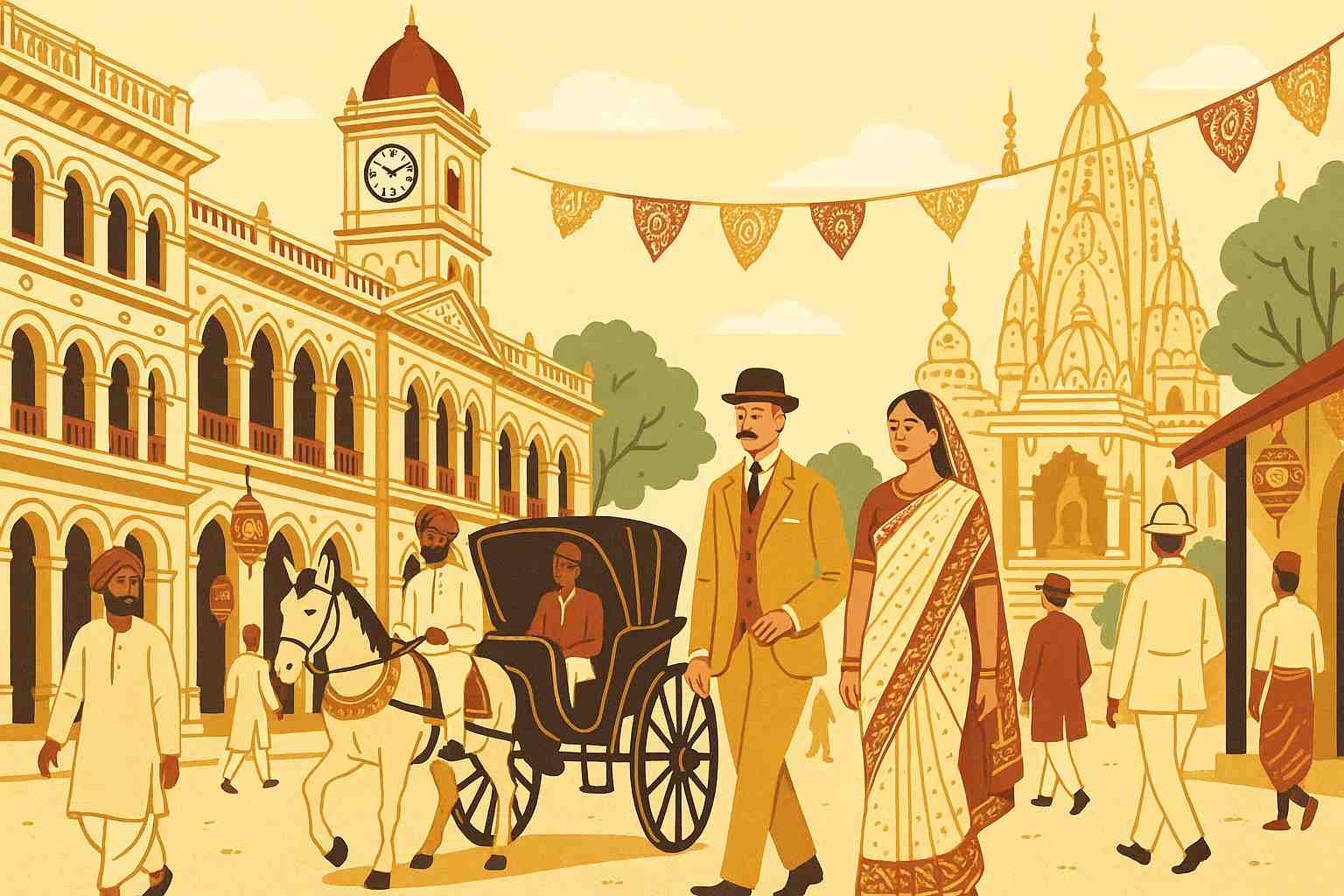
Exploring the British Era in India: 1803-1947- A Detailed Overview
Walk through any of our older cities, and you'll see it. A Victorian-era building standing next to a Mughal archway, the familiar rumble of a train on tracks laid over a century ago, or even the English words that have seamlessly woven themselves into our daily conversations. These are not just relics of the past; they are the living, breathing echoes of the British era in India, a period from 1803 to 1947 that fundamentally reshaped our land, our society, and our destiny.
This wasn't just a change of rulers. It was a time of immense churning that touched every aspect of Indian life. To understand who we are today, we must look back at this complex chapter of our history, a story of both profound loss and incredible resilience.
The Tightening Grip: How British Power Was Consolidated (1803-1857)
The story begins not with the British Crown, but with a trading company – the East India Company. By the early 1800s, this company had become a formidable political power. The victory in the Second Anglo-Maratha War (1803-1805) was a turning point, firmly establishing British dominance over North India.
From there, their influence spread through a mix of clever politics and military might. Policies like the ‘Doctrine of Lapse’, introduced by Lord Dalhousie, were particularly controversial. It allowed the British to annex any princely state if the ruler died without a male heir. This single policy changed the map of India, angering many Indian rulers and sowing the seeds of deep mistrust. To manage these vast new territories, administrative hubs or ‘Presidencies’ were set up in Bengal, Madras, and Bombay, forever changing the character of these cities.
This expansion of power wasn't just limited to the major centres. The British influence seeped into the smaller towns and princely states as well, creating a complex web of control. This can be seen in how the administrative and cultural landscape was altered in regional centres across the country, much like the historical perspective on Sikar during the British era shows.
An Economy Remade: The Financial Impact of British Rule
The economic policies of the British were designed with one primary goal: to benefit Britain. This led to a massive and systematic overhaul of India's economy, often with devastating consequences for our people.
- From Self-Sufficiency to Dependence: Land revenue systems like the Permanent Settlement gave immense power to zamindars (landlords) while burdening the peasants with crippling taxes. Our farmers were pushed to grow cash crops like indigo and cotton for factories in Britain, often at the expense of food crops, which contributed to terrible famines.
- The Weaver's Tale: For centuries, India was world-renowned for its exquisite textiles. The Industrial Revolution in Britain, however, flooded our markets with cheap, machine-made cloth. This systematically dismantled our thriving handloom industry, leaving millions of skilled artisans without a livelihood. Dadabhai Naoroji famously called this the ‘Drain of Wealth’, a theory that explained how India's resources were being funnelled to Britain.
- Infrastructure with an Agenda: Yes, the British built railways, telegraph lines, and canals. But these were not primarily for the welfare of Indians. They were strategic tools built to transport raw materials out of the country quickly and move troops efficiently to quell any dissent.
A Society in Flux: Cultural Shifts and the Rise of a New Identity
The British presence brought about deep and lasting changes in the very fabric of our society. It was a time of conflict, confusion, and also, unexpectedly, of new awakenings.
Western education, introduced through new schools and universities, was a double-edged sword. It aimed to create a class of Indians who would help run the colonial administration, but it also exposed us to ideas of liberty, equality, and democracy. This new English-educated middle class would eventually produce the very leaders who championed India’s freedom struggle.
Social reforms were also a significant part of this era. The abolition of practices like Sati in 1829 and the passing of the Widow Remarriage Act in 1856 were progressive steps. However, these changes were often imposed from an outsider's perspective, creating a complex cultural dialogue. Alongside these reforms, missionary activities spread, leading to religious conversions and often creating friction with our deep-rooted traditional beliefs.
Through all this upheaval, our cultural and spiritual traditions endured. It was during this period of foreign rule that a powerful sense of a unified Indian identity began to take shape. People started looking inwards, seeking strength in our shared heritage and timeless stories of faith.
Preserving this very heritage is at the heart of what we do at Bhaktilipi. We believe that by understanding our past and cherishing our devotional literature, we can build a stronger connection to our roots. Bhaktilipi is a digital space dedicated to bringing these timeless stories and scriptures to you in a way that inspires and resonates today. Explore our collection of devotional treasures and rediscover the wisdom that has guided our land for centuries.
Stay connected with our mission by subscribing to our newsletter or following our journey on social media:
Frequently Asked Questions about the British Era
Many people wonder how British rule really changed our society on a daily basis.
The British introduced significant changes that affected everyday life. Western education created new opportunities but also devalued traditional knowledge systems. New laws and a centralized legal system, like the Indian Penal Code of 1860, brought uniformity but often clashed with local customs. The very structure of our towns and cities began to change, reflecting colonial priorities.
Was the Indian economy completely ruined by the British?
While "ruined" is a strong word, the Indian economy was fundamentally restructured to serve British interests. Our self-sufficient village economies were disrupted, our world-class artisan industries were decimated, and our agricultural sector was exploited for raw materials. This created a legacy of economic dependency that India had to overcome after independence.
What were some of the key moments that defined the struggle against the British?
The journey to freedom was long and marked by many pivotal events. The Revolt of 1857 was a major turning point, leading to the end of Company rule and the beginning of direct rule by the British Crown. Later, the formation of the Indian National Congress, the Swadeshi movement after the Partition of Bengal, and Mahatma Gandhi's mass movements like the Quit India Movement in 1942 galvanised the entire nation towards the goal of independence.
How did India's diverse leaders contribute to the freedom movement?
Our freedom struggle was blessed with leaders of incredible vision and courage. While Mahatma Gandhi led with his philosophy of non-violence, leaders like Jawaharlal Nehru, Sardar Patel, and Subhas Chandra Bose played equally crucial roles. They mobilized people from every corner of the country, uniting them under the common cause of a free India and laying the groundwork for the nation we live in today.
A passionate group of people dedicated to preserving India's knowledge of Dharma, Karma, and Bhakti for ourselves and the world 🙏.
Comments
Related in

British Era in India: A 1803-1947 Exploration
Have you ever sat on a train, watching the countryside zip by, and wondered about the hands that first laid those tracks? Or perhaps, while dealing with official paperwork, you've marvelled at the sheer complexity of our administrative system? These everyday experiences are living remnants, echoes of a