
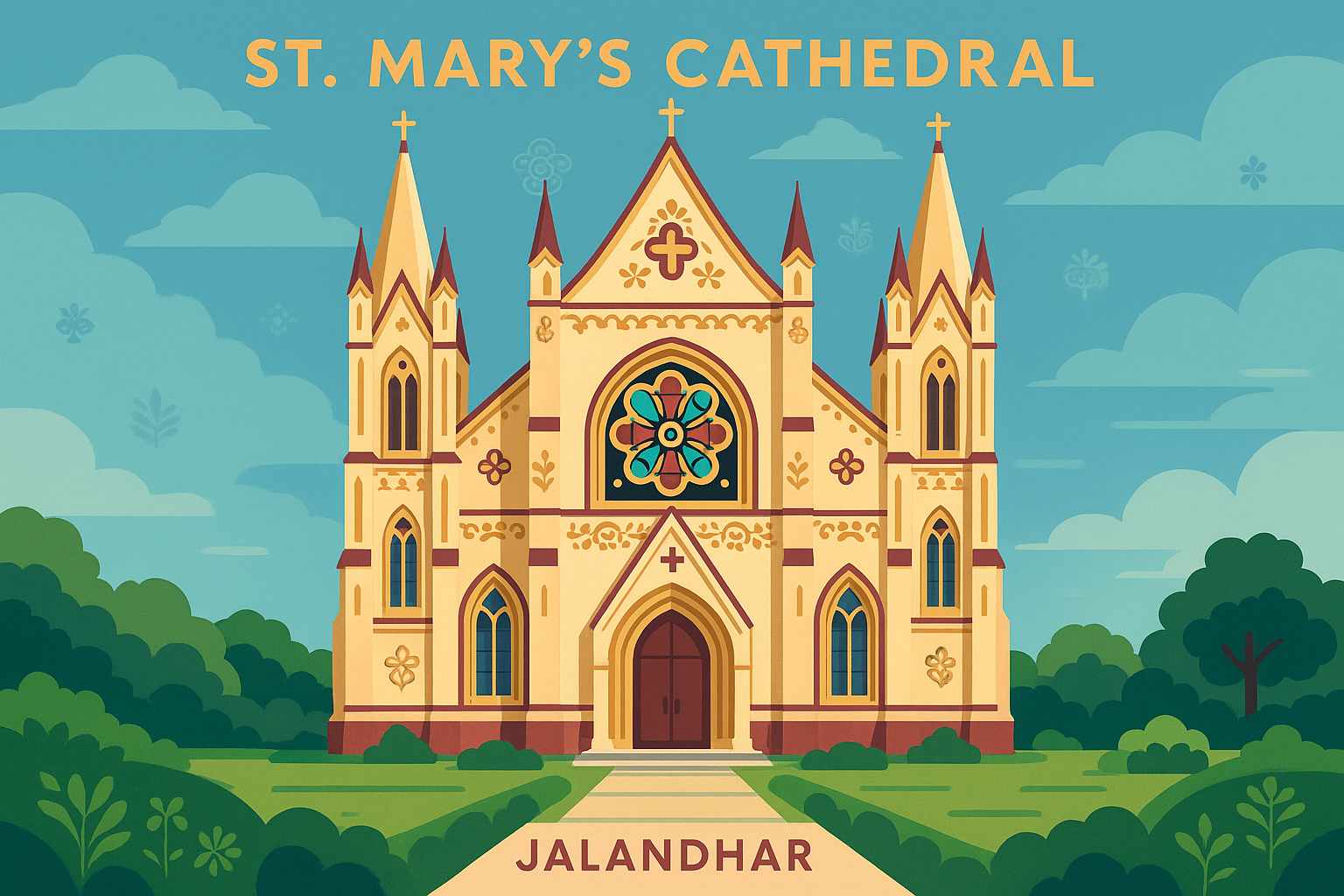
St. Mary’s Cathedral in Jalandhar Cantonment is the principal church of the Roman Catholic Diocese of Jalandhar. The present building opened in 1989, but the site’s Catholic history reaches back to a St. Patrick’s church established in 1847.
The cathedral is an active place of worship, not only a heritage attraction. Its history connects the former Diocese of Lahore, the post-Partition Catholic mission in Indian Punjab, the creation of the Jalandhar diocese and the building of a new cathedral in the 1980s.
Where is St. Mary’s Cathedral?
The cathedral stands on Mall Road in the Jalandhar Cantonment area of Punjab. It is also described as the Cathedral of St. Mary the Immaculate Conception. As the bishop’s church, it serves a diocesan role beyond that of an ordinary parish.
The Catholic Bishops’ Conference of India identifies Jalandhar as a Latin Catholic diocese in the ecclesiastical province of Delhi. Its territory extends across parts of Punjab and Himachal Pradesh.
From St. Patrick’s church to cathedral
The earlier church on the site was dedicated to St. Patrick. Official tourism material dates its opening to 1847 and associates it with Rev. Fr. John McDonnell, a Capuchin priest of the Vicariate Apostolic of Agra.
This date is sometimes misprinted as 1947 in later summaries. The longer institutional chronology and Government of India tourism page support 1847. A careful account should flag the typo rather than repeat both dates as if they were competing traditions.
Before Partition, the region was served within the Diocese of Lahore. In 1952, an Apostolic Prefecture of Jalandhar was created for the Catholic mission in Indian Punjab, with Msgr. Alban Swarbrick as prefect. The church in Jalandhar Cantonment became an important mother church for this reorganised mission.
The Diocese of Jalandhar
The Holy See elevated Jalandhar to a diocese in 1971. Bishop Symphorian Keeprath was consecrated and installed in 1972, according to the diocese’s own historical account. St. Mary’s then served as the cathedral—the church containing the bishop’s cathedra, or official seat.
“Cathedral” therefore describes an ecclesiastical function, not simply a large or ornate building. A modest church can be a cathedral if it is the bishop’s seat, while a much larger church may not be one.
Why the old building was replaced
By the 1980s the diocese planned a new structure on the historic site. Demolition of the old church began in February 1987. This was a planned rebuilding project, not the post-Partition riot destruction sometimes asserted in travel summaries.
Pope John Paul II blessed the foundation stone during his 1986 visit to India. Bishop Symphorian Keeprath laid it at Jalandhar on 19 April 1987.
Building the present cathedral
Construction progressed through 1987 and the following years. The present cathedral was blessed and inaugurated on 29 October 1989, which coincided with Diwali that year.
Historical accounts associate the blessing with Archbishop José Sánchez, a papal representative, and the inauguration with Archbishop Agostino Cacciavillan, then Apostolic Pro-Nuncio to India. The event brought church leaders from different parts of India to Jalandhar.
The Diwali date is often interpreted as a gesture toward India’s plural religious setting. It should not be embellished into an unsupported story about a joint religious rite; the documented point is the deliberate inauguration date and the cathedral’s stated attention to Indian context.
What to notice in the architecture
The building combines the spatial requirements of Catholic worship with modern design and visual references intended for its Indian setting. Its white exterior, strong vertical lines, entrance composition and landscaped grounds distinguish it from the small 19th-century predecessor.
Inside, the principal focus is the sanctuary and altar. Stained or coloured glass modifies daylight and introduces biblical and devotional imagery. Visitors may also notice Marian images, the Stations of the Cross and other objects used in Catholic prayer.
Architecture descriptions online often attach labels such as Gothic, Romanesque, Indo-Saracenic or “East-West fusion” without identifying specific features or an architect’s statement. It is safer to describe visible form and documented design intention than to force the building into a historical style category.
Mary and the Immaculate Conception
The cathedral’s dedication refers to Mary under the title of the Immaculate Conception. In Catholic teaching, this means Mary was preserved from original sin from the beginning of her life. It does not refer to the virginal conception of Jesus, which is a different doctrine.
Marian images and prayer spaces should be understood within this living religious context rather than treated only as decorative art.
A place of worship and diocesan life
The cathedral hosts liturgies, diocesan ceremonies and major celebrations. Christmas and Easter can draw larger congregations, while ordinations, installations, memorials and other events reflect its role as the bishop’s church.
The diocese also carries out education, pastoral care and social-service work across its territory. The cathedral is a visible centre, but it should not be used to imply that all Catholic life in Punjab occurs in one building.
Visiting respectfully
Government tourism pages may publish general opening hours, but services, maintenance, security and special events can change access. Check current information with the cathedral or Diocese of Jalandhar before making a special journey.
- Enter quietly and avoid interrupting Mass, confession or private prayer.
- Dress appropriately for an active religious site.
- Ask before photographing people, clergy, services or restricted areas.
- Keep phones silent and do not use flash where prohibited.
- Do not pose on the altar platform or handle devotional objects.
- Follow staff instructions during festivals and crowded services.
Non-Catholic visitors are generally welcome to observe respectfully. Participation in Communion follows Catholic discipline; visitors who are uncertain can remain seated or ask a priest or usher.
Planning a heritage visit
Allow time to view the exterior and grounds without rushing through an ongoing service. The cantonment location may have traffic or access controls. Confirm transport, photography and opening conditions locally rather than relying on a dated “2025 guide.”
A useful visit focuses on three layers: the 1847 church history, the post-Partition and diocesan institutional history, and the architecture and worship of the 1989 building.
Common errors to avoid
- The first church was built in 1947: official tourism and diocesan chronologies support 1847; 1947 is a recurring typo.
- The old church was destroyed in riots in 1857: reliable institutional accounts describe planned demolition beginning in 1987 for rebuilding.
- The present cathedral is the 1847 building: it occupies the historic site but opened in 1989.
- It became a cathedral only because it was rebuilt: cathedral status follows the diocesan seat; the Diocese of Jalandhar was created in 1971.
- Diwali inauguration makes it a multi-faith temple: it remains a Roman Catholic cathedral; the date can signify civic and cultural openness without changing its religious identity.
- Published opening hours are permanent: active churches change access for services and events.
Frequently asked questions
When was St. Mary’s Cathedral built?
The first church on the site dates to 1847. The present cathedral was constructed after rebuilding began in 1987 and opened on 29 October 1989.
Who founded the original church?
Historical accounts associate the St. Patrick’s church with Rev. Fr. John McDonnell, a Capuchin priest serving under the Vicariate Apostolic of Agra.
Why is it called a cathedral?
It is the bishop’s principal church and seat of the Roman Catholic Diocese of Jalandhar.
Was the foundation stone connected with Pope John Paul II?
Yes. The Pope blessed the stone during his 1986 India visit; Bishop Symphorian Keeprath laid it at the site on 19 April 1987.
Can people of other faiths visit?
Visitors are generally welcomed when the church is open, provided they respect worship, local instructions and restrictions on photography or access.